


Basilio Sánchez, the physician-poet who has filled the Costa del Sol University Hospital in Marbella with verses
The recently retired healthcare worker participated alongside the poet Agustín Pérez Leal in a recital for patients and staff.

Basilio Sánchez was born in Cáceres, a city where he worked as an intensive care physician for 42 years at its University Hospital and, simultaneously, developed as a poet. His first year of residency, 1984, coincided with the publication of his first book, 'A este lado del alba,' which earned him an honorable mention at the Adonáis Poetry Prize. Since then, he has continued to grow both as a doctor and as a writer until his recent retirement. As head of the ICU for 15 years, his work 'He heredado un nogal sobre la tumba de los reyes' earned him the prestigious International Loewe Foundation Prize in 2019. However, it was not until after he hung up his coat that he, for the first time, took his verses to a hospital.
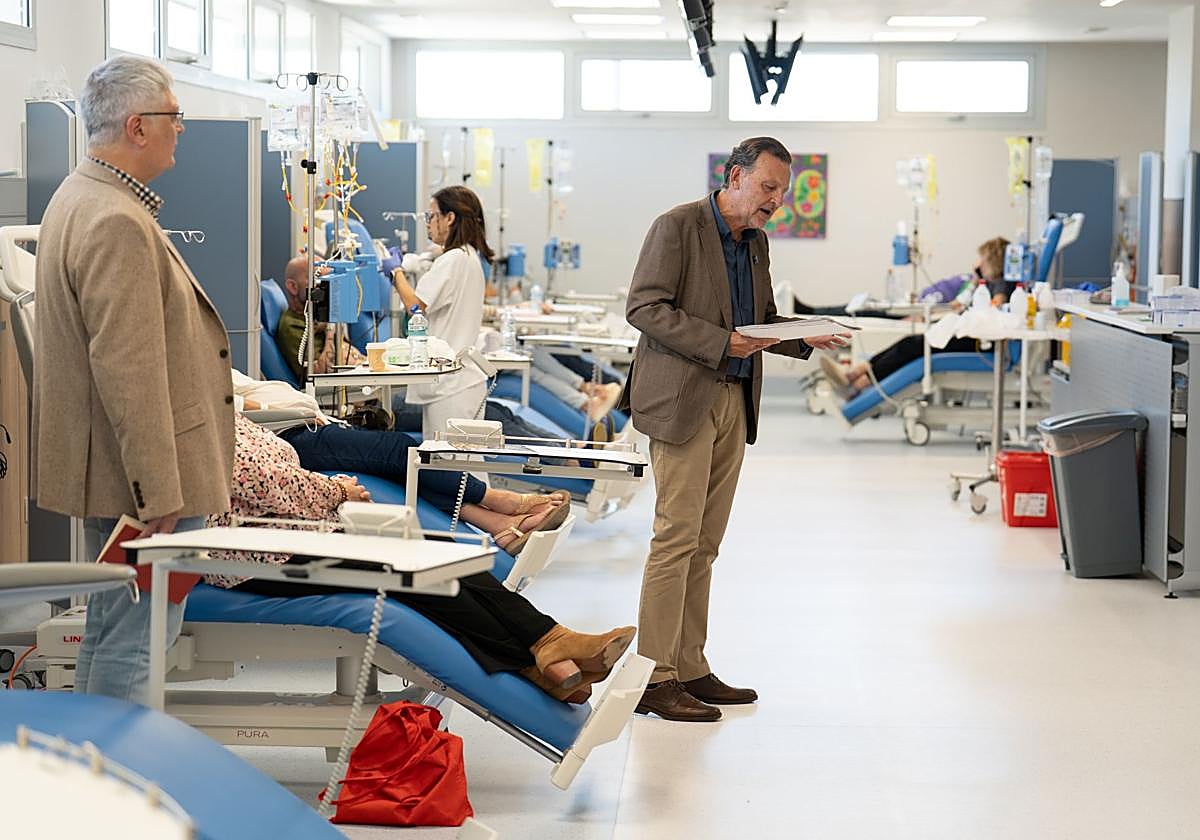
It was at the Costa del Sol University Hospital in Marbella where Sánchez participated in a recital organized by Marpoética, the poetry festival of the coastal city celebrating its ninth edition. There, alongside the poet Agustín Pérez Leal, author of three poetry collections and recipient of the Manuel Alcántara Prize, they toured the Hemodialysis, Radiodiagnosis, and Oncohematology departments reading some of their works to patients, companions, and healthcare workers. A unique experience that broke the routine of the long treatments that many of the patients must undergo.
"Initially, I considered both activities as independent; that is, I aimed to be a good doctor within the hospital and then, a good poet outside of it," he explains. "Now, having retired, I've realized that there has been a significant transfer between the two activities. I believe that poetry has helped me in my profession, it has helped me to be a better doctor, to use words as elements of companionship, of care," he details.
Humanization Process
Sánchez also participated in the humanization process of the ICU service at his hospital, introducing musical activities. However, he never thought about bringing poetry, probably because of his desire to be the best doctor and the prudence of being the author himself. "The first time I enter a hospital as a poet is in a university hospital five hours' drive from my city," he smiles.
But, although he was never there as a poet, his poetry was present during the night shifts, when he would sketch verses in the silence of the night, only interrupted by the rhythmic sound of vital signs monitoring machines.
He acknowledges that the specialization of medicine, as has happened in other disciplines, may have distanced it from humanism, so in his last years of practice, he endeavored to transmit what poetry had infused into his profession as a healthcare worker: "I believe it has made the humanist predominate over the scientist," he asserts.
In this regard, he explains that "medicine, although it has advanced and cures us, which is very important, sometimes lacks that human aspect, that time that needs to be dedicated to the patient to accompany them, to calm them" when a diagnosis turns their life upside down. "I wanted to pass this on to my colleagues when I was about to retire. My obsession in those last meetings was to convey to them the importance of humanity, the importance of giving patients opportunities, of welcoming in the ICU those who still have a chance, because six months of life is a lot, because three months of life is a lot," he narrates passionately.
"Sometimes, medicine cannot cure, there are diseases with no chances, but we can make a person's final moments pleasant, that people leave accompanied," he emphasizes, convinced that this has been his greatest learning in his more than four decades of practice.
Regarding the healing power of poetry, he is clear: "In all diseases, there are components of psychological healing. Beyond medicines and chemicals, a positive attitude influences, and that is what poetry does, it transmits hope, it places us in a position of resistance against the intrusions of the world. Poetry makes us strong in the face of adversity," he states. So much so that he assures that poetry saved him during the pandemic.
His participation in Marpoética with the recital at the Costa del Sol University Hospital in Marbella alongside Agustín Pérez Leal has been another way to continue with his healing work.

Latest news





Upcoming events
12
Nov
El Desembarco, la traición de Viriato at La Caja Blanca
12
Nov
HOMER El Mero Mero at Sala Trinchera Málaga
13
Nov
Marbella Startup Lab – Innovate & Collaborate
13
Nov
Candlelight: Coldplay & Imagine Dragons at Sala Fundación Unicaja María Cristina
13
Nov
Candlelight: Tribute to Ludovico Einaudi at Anantara Villa Padierna
Similar News

Málaga Airport Makes History with More Than Three Million Passengers in One Month
Málaga

Port of Málaga looks beyond its docks to support future growth
Málaga

Guide to the Virgen del Carmen Processions in Málaga and the Province
Málaga
