


Juan Manuel de Prada kicks off the 'Dialogues' series at Marpoética in Marbella with his initiatory journey through Poe, Cervantes, Borges, and Proust.
The writer defends the necessity of reading "inadvisable books" for your age and of remaining "faithful" to our ideas even if they are "defeated," and advocates for "the burning" of adaptations into contemporary Spanish of the classics.
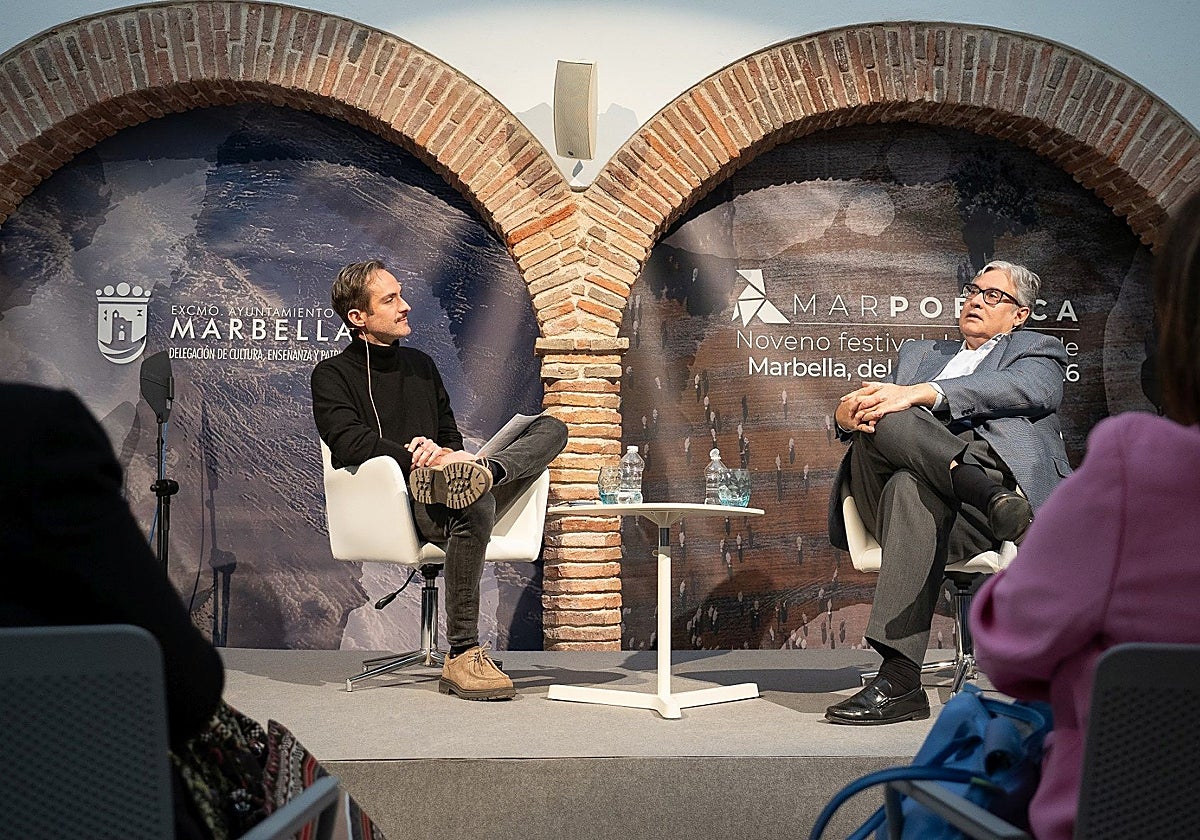

Writer Juan Manuel de Prada inaugurated this Monday, at the Hospital Real de la Misericordia, the 'Dialogues' series of the ninth edition of Marpoética ... with a presentation that delved intimately into the origin of his literary vocation. Under the title 'The Reader We Are', and accompanied by literary director Javier Vicedo, the author mapped a journey through four decisive works: 'Extraordinary Tales' by Edgar Allan Poe; 'Don Quixote de la Mancha' by Miguel de Cervantes; 'The Aleph', written by Jorge Luis Borges, and 'In Search of Lost Time' by Marcel Proust.
From the beginning, de Prada placed reading in the realm of the foundational: "I don't really believe in those people who start reading in their twenties, thirties, or forties. When you read at those times, your soul is less awake. When you are a teenager you are full of questions, full of concerns, full of bewilderment. And I think that's the moment when a book truly changes your life." Adolescence thus appears as the true threshold for the reader, the time when literature leaves an indelible mark.
A precocious reader, he acknowledged that "words marked my life with a red-hot iron." De Prada recalled a childhood permeated by reading as a form of knowledge and refuge. It was his grandfather who taught him to read before he even went to school, and the library in his town, explored "shelf by shelf," was his first territory of exploration.
"I read 'Extraordinary Tales' by Poe, secretly under the sheets with a flashlight at 10 or 12 years old; it left me in a state of wonderful panic"
Juan Manuel de Prada
Writer
This early bond with books was also marked by the intensity of the forbidden when his parents hid 'Extraordinary Tales' by Edgar Allan Poe in the bar cabinet to prevent, unsuccessfully, his access to the murky stories as a child. "I read it secretly under the sheets with a flashlight at 10 or 12 years old," he narrated. An experience "with the pleasure of the forbidden and the thrill of facing stories I had never read before." "They left me in a state of wonderful panic," he acknowledged. Because that is "the first work that hits me, disturbs me. With it, I discover that reading has the capacity to create other worlds that far exceed the real world." Years later, in a teenage re-reading, the discovery was the "technical mastery" of the author.
"The gospel in Spanish"
The journey continued with Miguel de Cervantes and his 'Don Quixote de la Mancha', an equally premature reading that De Prada undertook for the first time at 14 years old. "I read books completely unsuitable for my age, which is fundamental. Every reader should read books unsuitable for their age. One of the most monstrous and aberrant generations is children's literature. Children should not read children's literature, they need to read adult literature. Indeed, good children's literature, like 'Beauty and the Beast' or 'Alice in Wonderland', is not children's literature," he remarked.
Thanks to his early foray into 'Don Quixote', he discovered his "fountain of wisdom," from which he drank from 14 to 24 with a complete reading every summer, claiming its status as an inexhaustible work. In addition to its aesthetic dimension, he emphasized its moral scope, in line with Miguel de Unamuno, who defined it as "the gospel in Spanish." For the writer, the Cervantine novel constitutes "a school of life; of good living," capable of engaging readers of any age.
"Beyond whether the ideas we defend are defeated, we cannot betray them. We must remain faithful, even if it's not fashionable, they mock us, or it doesn't succeed"
Juan Manuel de Prada
Writer
"Beyond whether the ideas we defend are defeated, we cannot betray them. We must stay true to what we believe, regardless of whether it's fashionable, whether they mock us, or whether it doesn't succeed," de Prada pointed out, recalling how the knight refused to renounce his beloved Dulcinea, despite the defeat to Sansón Carrasco during his last adventure on the beach of Barcelona.
The chiseled phrases of Borges
The transition to Jorge Luis Borges marked the discovery of form. In 'The Aleph', the writer perceived "the use of the adjective, the musicality of his writing, the chiseled nature of the phrases with impeccable syntax." "It showed me that writing is not simply about telling but that it must be told in a certain way, and therefore, there are stories that may be forbidden to you because you cannot tell them in your style," he asserted, claiming the indispensable need for a personal narrative style.
Finally, the foray into Marcel Proust and his 'In Search of Lost Time' marked the access to a different dimension of the literary experience. An early and overwhelming read, it allowed him to understand that any subject matter can become literature: "The most trivial aspects of life recounted in a certain way become significant," he recalled, alluding to the famous scene of the madeleine soaked in tea as a trigger for memory to combat the fleetingness of time and death. "Words as a way to invoke the world," he summarized.
"Sometimes burning books is not as Nazi-like as it may seem. There are books that need to be burned. And the contemporary Spanish adaptations of 'Don Quixote' need to be burned all of them"
Overall, his presentation traced a journey through the classics as repositories of inexhaustible wisdom that must be read "as they were written." "In my time they gave an abridged, adapted reading, which is a sacrilege," he reproached. "That cannot be accepted, those books need to be burned. Sometimes burning books is not as Nazi-like as it may seem. There are books that need to be burned. And the adaptations of 'Don Quixote' need to be burned all of them. The translations into contemporary Spanish, what a shame! These books need to be burned because they are indecent," he censured in a staunch defense of great literature: "They are books that continue to speak to people of any generation, from any latitude, in any circumstance. Great literature is universal. When we read it, it always teaches us something and always challenges us. It challenges us when we are teenagers, it challenges us when we are elderly. It always has something for us."
Alongside Juan Manuel de Prada, the Dialogues series at Marpoética is completed by Marta Jiménez Serrano, author of the bestseller 'Oxygen', and filmmaker Fernando León de Aranoa.

Latest news





Upcoming events
12
Nov
El Desembarco, la traición de Viriato at La Caja Blanca
12
Nov
HOMER El Mero Mero at Sala Trinchera Málaga
13
Nov
Marbella Startup Lab – Innovate & Collaborate
13
Nov
Candlelight: Coldplay & Imagine Dragons at Sala Fundación Unicaja María Cristina
13
Nov
Candlelight: Tribute to Ludovico Einaudi at Anantara Villa Padierna
Similar News

Málaga Airport Makes History with More Than Three Million Passengers in One Month
Málaga

Port of Málaga looks beyond its docks to support future growth
Málaga

Guide to the Virgen del Carmen Processions in Málaga and the Province
Málaga
