


Marpoética brings poetry from the trail to the sea, turning Marbella into a literary stage.
The authors Andrés Neuman, Erika Martínez, and Elsa Moreno have brought the public closer to their way of understanding poetry.
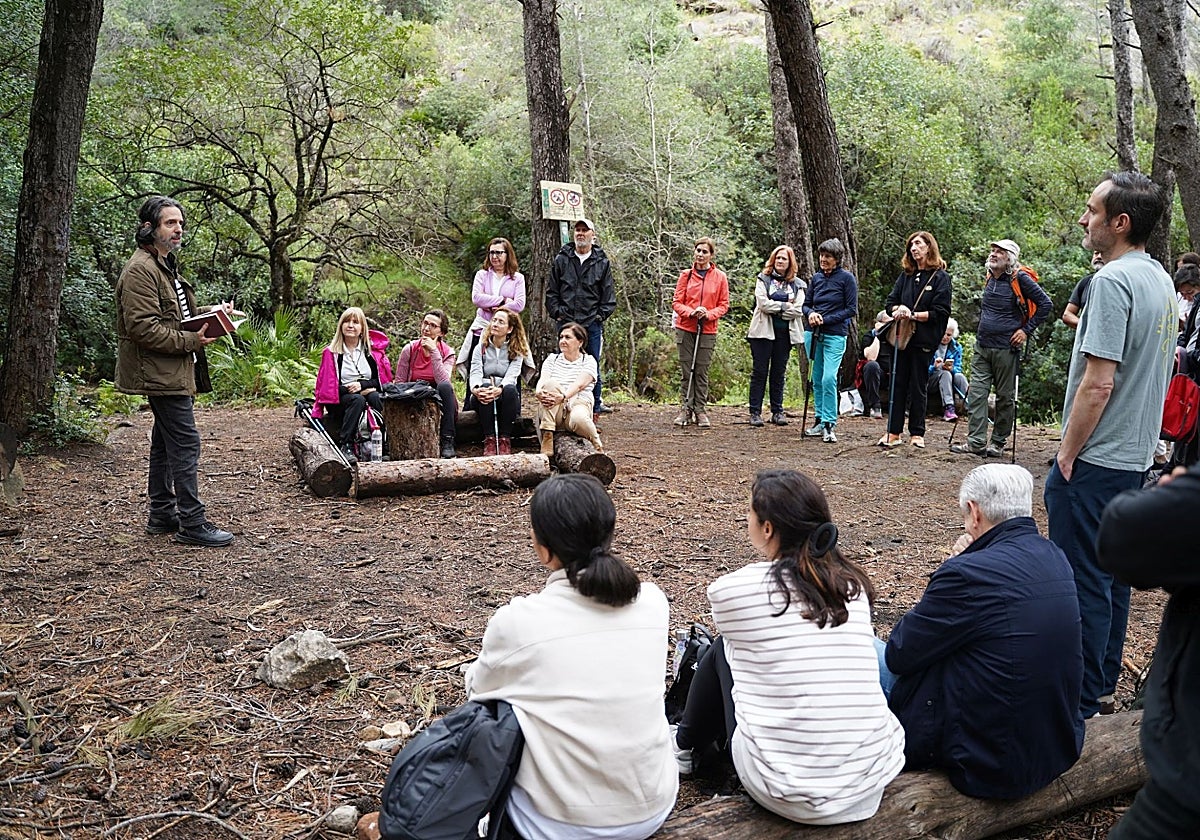

In its ninth edition, Marpoética has designed a poetic map that stretches from the mountains to the sea, taking the written word out of its usual academic packaging to present it directly to the citizens in new settings. A 'Poetic Trail' on the slopes of Sierra Blanca with author Andrés Neuman and the series 'Faenando versos', featuring two recitals aboard a catamaran by Elsa Moreno, Erika Martínez, Agustín Pérez Leal, and Samuel Díaz Castañeda, are the planned activities to overflow the margins of the book and return poetry to its status as a shared experience. This weekend, about thirty poetry lovers participated in the first of the proposals designed by José Antonio Morán, a retired Philosophy professor and a great connoisseur of the Marbella sierra, whose route followed the course of the Guadalpín river to the abandoned hermitage of Los Monjes and then descended through the area known as Hoya de las Papeletas. It was a circular route with four stops where Neuman reviewed the history of poetry from East to West, ending with his own poems.
"The beautiful idea that the festival had to create a 'Poetic Trail' is to engage the body, to mobilize it and have that feeling of reaching poetry and not just being in poetry. To achieve a certain state of communion with nature, but also a desire for rest and relaxation, to listen to a poem, which is like a haven after reaching a certain state of fatigue. That is, to earn the poem," expressed the renowned author.
"The body of nature, the environment can influence when reciting or listening to poems. When the theme of the poem and the environment coincide, a kind of harmony between what is said and what is felt can occur"
Andrés Neuman
Poet
"The body of nature, the environment can influence when reciting or listening to poems. When the theme of the poem and the environment coincide, a kind of harmony between what is said and what is felt can occur," he reflected on the experience. An initiatory path whose first stop was dedicated to haiku, a traditional Japanese poetic form, extremely brief, consisting of three lines of 5, 7, and 5 syllables, focused on nature, seasonal changes, and everyday life, capturing the present moment. "It tries to propose a sensory experience and that includes engaging all the senses in nature. A genre of the here and now," explained the writer, who started with verses by Sōgi, a precursor of haiku, followed by one of the most celebrated in history: "Is it that to the branch / the fallen flower returns / if it is a butterfly," by Arakida Moritake.
Expand
Elsa Moreno in the first session of the 'Faenando versos' cycle, a recital aboard a catamaran.The second stop was dedicated to Romanticism, with British John Keats and American Emily Dickinson as protagonists, alongside Federico García Lorca and his 'Preciosa y el aire' from 'Romancero gitano', which served to open a discussion with the audience. Contemporary poets occupied the third station of the trail, with Mary Oliver, known for her beautiful poems dedicated to nature, Louise Glück, winner of the Nobel Prize in Literature in 2020, and José Watanabe, a Peruvian poet of Japanese descent. A subtle way to close the circle before addressing the fourth and final stop with his own poems such as 'The Gardener', dedicated to his favorite memory: 'Planting a tree with my grandfather'; 'Cemetery Garden'; or 'My son stretches his hand on the threshold of sleep', among others. All of them, examples of the use of language as living matter and Neuman's ability to find the extraordinary in the everyday, starting from minimal scenes to open broader reflections on human feelings.
"I am unfamiliar with rootedness because my family's history is very migratory and filled with exiles. Writing is often the closest thing to home, although home and rootedness now is my son"
Andrés Neuman
Poet
Poetry in motion, like the life and work of Neuman, who moves between countries, accents, and genres, from novels to poetry and essays. "I am unfamiliar with rootedness because my family's history is very migratory and filled with exiles. I recognize myself more in movement, but it is a movement that often desires a rootedness it does not find and I wonder if this also has to do with the human condition in general, that there is a movement of searching and a need for settlement and between the nomadic and sedentary, our inner life also unfolds. Writing is often the closest thing to home, although this answer has already become outdated in my life because now I have a son and home and rootedness now is my son," he concluded.
"Let the metric of the sea enter my verses"
A movement that continued from the mountain to the sea. Yesterday, the first session of the 'Faenando versos' cycle took place, a recital aboard a catamaran that departed from Puerto Deportivo Virgen del Carmen, where the verses of Erika Martínez and Elsa Moreno resonated with the rhythm of the waves. "Let the metric of the sea enter my verses," was the wish fulfilled by the author, whose recital included references to one of the axes of her poetry, the body as a place where experiences are inscribed through scars or genealogies. With 'The House Above', 'Abolish', 'The Institution' or 'Load and Unload', she infused the atmosphere with the clarity of expression and conceptual complexity that define her.
Expand
Erika Martínez in 'Faenando versos'.For Erika Martínez, "literature is always a necessity, it chooses you." A solid author of aphorisms, she is clear that "writing is complicated in any of its forms, writing just enough is almost impossible and writing, in general, also," especially if the goal is to make the verses resonate with the listener. Following the Andalusian poet, Elsa Moreno unfolded all her scenic expressiveness on the catamaran, just with her body and the word. The author of 'Prendida' brought to the audience the invented concept of 'immanence' to appeal to the collective unconscious. Trained at the intersection of disciplines and formats, she presented a more performative recital in which the movement of the body was another mode of expression because "there are sensations that are transmitted through the body; there is knowledge and understanding that are transmitted through the body, without words," she said. A "very stimulating" experience for the young author who enjoyed "the noise of the sea in the background" as "a gift." To top off the experience, the boat sailed from Puerto Deportivo Virgen del Carmen while the audience mingled with the authors.
There is still one last chance to embark on this poetic journey. Next Saturday, April 18, the catamaran will set sail again in the farewell of 'Faenando versos', with poets Agustín Pérez Leal and Samuel Díaz Castañeda. A journey that completes a program that understands the territory as an extension of poetry and citizens as active readers.

Latest news





Upcoming events
12
Nov
El Desembarco, la traición de Viriato at La Caja Blanca
12
Nov
HOMER El Mero Mero at Sala Trinchera Málaga
13
Nov
Marbella Startup Lab – Innovate & Collaborate
13
Nov
Candlelight: Coldplay & Imagine Dragons at Sala Fundación Unicaja María Cristina
13
Nov
Candlelight: Tribute to Ludovico Einaudi at Anantara Villa Padierna
Similar News

Málaga Airport Makes History with More Than Three Million Passengers in One Month
Málaga

Port of Málaga looks beyond its docks to support future growth
Málaga

Guide to the Virgen del Carmen Processions in Málaga and the Province
Málaga
