


It is the only Japanese restaurant with a Michelin Star in all of Andalusia, located in Malaga, and it has updated its menu.
Nintai, one of Marcos Granda's restaurants, undergoes a deep renovation of its proposal. What is the cheapest Michelin Star in Malaga? One of its tasting menus costs less than 100 euros.
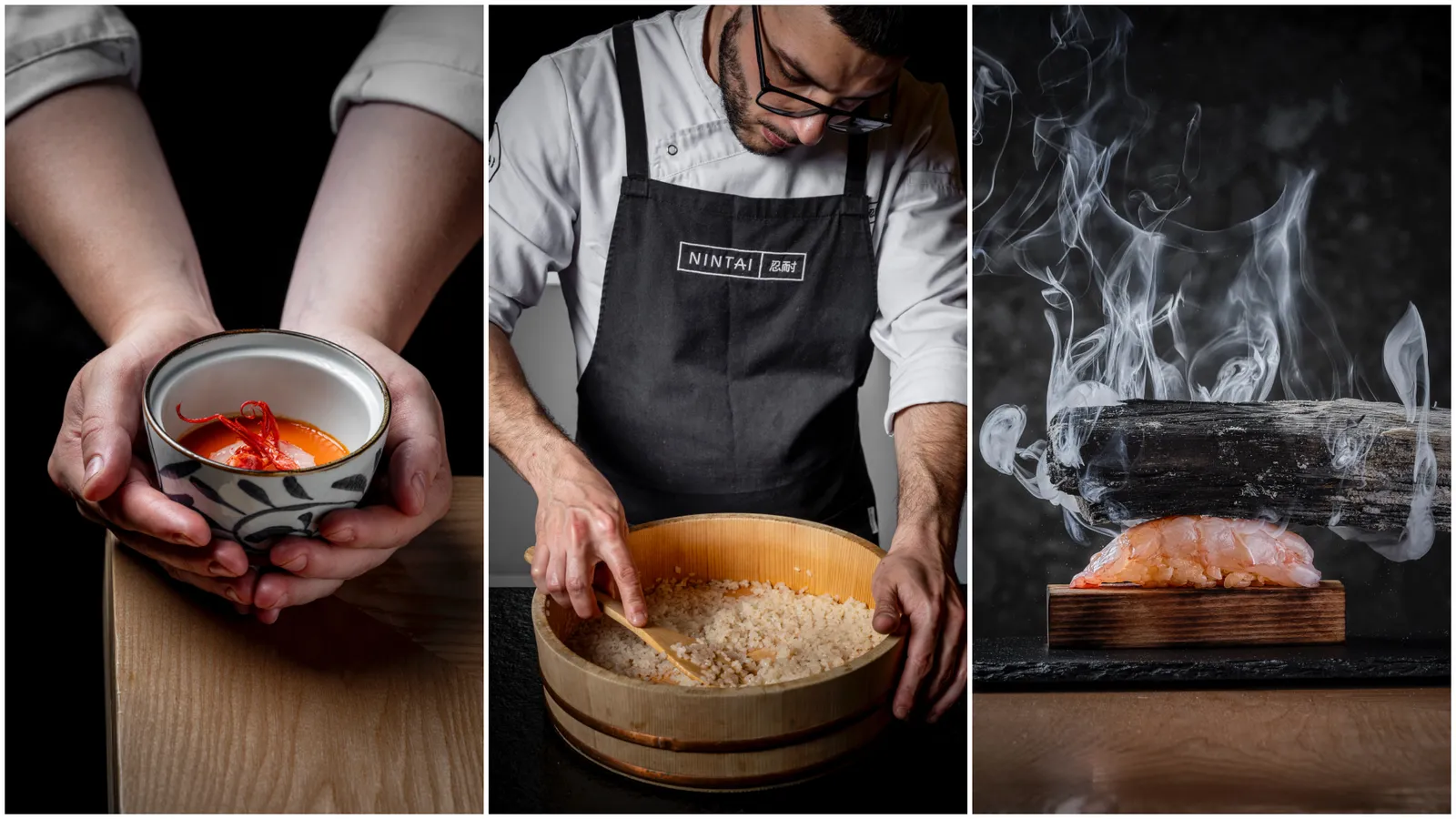

There are gastronomic experiences that go beyond the dish, constructed as a narrative that progresses step by step, almost silently, where each gesture holds meaning. On the Costa del Sol, this narrative takes a Japanese form, revolves around rice, and reaches its peak at a restaurant that has made precision its language. At Nintai, a project led by Marcos Granda following a personal trip to Japan, evolution has been constant since its opening in 2021.
Just a few months after its inception, this venue earned its first Michelin Star, establishing itself as the only Japanese restaurant with this distinction in all of Andalusia. Now, five years later, the establishment presents a new culinary proposal that summarizes its journey: the Ayumi omakase menu.
A Menu Reflecting the Journey
The new menu Ayumi, meaning "the journey traveled," encapsulates the evolution of the restaurant over the years. It is a proposal that relies on continuous learning, refined technique, and absolute respect for the product.
Pieces from Nintai. / Mikel PonceThe experience is structured as a sequence in which sushi becomes the central focus. Each piece is crafted from shari, the rice, seen as the fundamental base upon which the entire culinary discourse is developed. From there, the menu progresses with its own rhythm, alternating bites that provide contrast and depth.
Following the omakase philosophy, the proposal is not static. It evolves based on the season, the quality of the available fish, and the moment's sensitivity, making each service a unique experience, marked by the kitchen team's interpretation.
Precision as a Gastronomic Language
Leading the kitchen are Manuel Bedoya and Alberto Igeño, linked to the project from its beginnings. Their work focuses on an execution where the product, technique, and timing play a pivotal role.
Manuel Bedoya and Alberto Igeño, chefs at Nintai. / Mikel PonceIn this new stage, Nintai's kitchen opts for greater refinement. Complexity gives way to precision, prioritizing the purity of flavors and the harmony of the whole. The result is a proposal that seeks to move through apparent simplicity and technical control.
The development of the menu is accompanied by an execution in the dining room attended to in detail, directed by Christopher Manchado, who orchestrates the rhythm of the experience and strengthens the connection between kitchen and diner.
Omotenashi: Hospitality as a Pillar
Beyond the kitchen, one of the elements that defines Nintai's identity is its focus on hospitality. The restaurant draws inspiration from the Japanese concept of omotenashi, an understanding of service based on intuitive attention and anticipating the needs of the customer.
The space at Nintai. / Mikel PonceThis approach translates into an experience that unfolds like a ritual, from the welcome to the final gesture. Each element is designed to place the diner in an absolute present, where attention to detail and coherence of the whole play a central role.
With the menu Ayumi, the restaurant reinforces this philosophy, consolidating a model in which gastronomy and hospitality advance in parallel.
A Cellar Designed to Accompany the Journey
The culinary proposal is complemented by a cellar that brings together a wide selection of references. Among them are nearly a hundred champagnes, mostly from small producers, along with recognized labels such as Egly Ouriet, Bollinger, or Salon.
This is supplemented by more than 150 national and international wines, including Japanese references, as well as a selection of high-quality sakes, with additions from houses like Dassai Future Farmers.
The restaurant offers two pairing options that accompany the menu Ayumi. On one hand, the Harmony option, with a more limited selection of glasses, and on the other, the complete Pairing, designed to accompany each course with a more extensive proposal that includes wines, sakes, or non-alcoholic alternatives such as Japanese teas and kombuchas.

Latest news





Upcoming events
12
Nov
El Desembarco, la traición de Viriato at La Caja Blanca
12
Nov
HOMER El Mero Mero at Sala Trinchera Málaga
13
Nov
Marbella Startup Lab – Innovate & Collaborate
13
Nov
Candlelight: Coldplay & Imagine Dragons at Sala Fundación Unicaja María Cristina
13
Nov
Candlelight: Tribute to Ludovico Einaudi at Anantara Villa Padierna
Similar News

Málaga Airport Makes History with More Than Three Million Passengers in One Month
Málaga

Port of Málaga looks beyond its docks to support future growth
Málaga

Guide to the Virgen del Carmen Processions in Málaga and the Province
Málaga
