


Ten curiosities that will make you visit Alpandeire: mummies in its church or the wall that wanted to divert Napoleon's troops
In addition to being the hometown of Fray Leopoldo, this town in the Genal Valley is known today for the recovery of owls in their habitat and for having the 'cathedral of the Serranía'.

Alpandeire is not just the town where Fray Leopoldo was born. This small municipality in the Genal Valley, in the heart of the Serranía de Ronda, hides much more than meets the eye. Among its streets and natural surroundings, surprising stories, remnants of different eras, and phenomena that catch the attention even of those who are well-acquainted with the interior of the province of Málaga coexist. From a church disproportionate to its size to mummies preserved inside it, to a wall built to stop Napoleon's troops or a subsoil capable of expelling water with unusual force after the rains.
Added to all this are unique traditions, such as the Huerto del Niño festival, prehistoric traces in the form of dolmens, and current projects like the recovery of the common barn owl. Not to forget the deep devotion to Fray Leopoldo, which continues to mark the day-to-day life of the municipality. This set of curiosities makes Alpandeire one of those destinations that, beyond its size, justify a getaway practically at any time of the year. Here are ten reasons that explain why.
Upon arriving in Alpandeire, something baffling is its church. Not for its beauty, but for its size. In a village that today barely exceeds 250 inhabitants—and that was never a large population—a monumental temple with two towers stands out, completely breaking the scale of the village. It is no coincidence that for years it has been known as the 'cathedral of the Serranía'. Its origin dates back to the 18th century, when a new building was erected without the limitations of the previous one and with the decisive impulse of influential neighbors and the parish priest himself. The result was a temple that, even today, continues to astonish due to its enormity.
Inside the parish of Alpandeire, one of the most unique curiosities of the Genal Valley is preserved: two mummified bodies about three centuries old. They are located in the area where the temple's cemetery used to be and are notable for their good state of preservation. It has been transmitted in the village that they could belong to a couple who contributed financially to the construction of the church. Regarding their preservation, there are two hypotheses: that they were intentionally embalmed or that the natural conditions of the environment have favored their conservation over time.
In 1810, during the War of Independence, the residents of Alpandeire erected a large stone barrier to try to stop the advance of Napoleon's troops. Thus was born the so-called 'wall of the French', a trench almost 1,400 meters long built rudimentarily to block the cavalry's passage. However, the effort was unsuccessful: the soldiers managed to bypass the obstacle using the Infiernillo road and eventually entered the village. Today, more than two centuries later, this wall is still partially preserved as one of the most striking vestiges of that historical episode.
On the outskirts of the urban area of Alpandeire, a curious stone column is preserved that never fulfilled its original function. It is a pillory, an element used to display the executed, but in this case, it was a symbolic gift from King Fernando VII in 1814. With it, he wanted to acknowledge the involvement of the town in the War of Independence, both for the contribution of neighbors and for the economic effort made. Paradoxically, when it arrived in the municipality, these types of structures were already out of use, so it was never used as a punishment instrument and today forms part of the local historical heritage.
Alpandeire is deeply marked by the figure of its most illustrious neighbor, Fray Leopoldo, who was not only born there in 1864 but also spent his childhood and a good part of his youth in the village. His legacy can be explored today through various visitable spaces, starting with his birthplace, which is preserved and can be visited, and continuing through the numerous sculptures, plaques, and tributes scattered throughout the urban area. Beyond the core of the village, there is also a hiking trail that follows the path that the blessed himself took between Alpandeire and the Jimera de Líbar station, from where he traveled to Granada. Added to this are the pilgrimages and events held every June around his figure, a reflection of a devotion that remains very much alive and makes the municipality a reference point for many faithful.
Alpandeire has been a protagonist in recent years for an environmental project as striking as it is necessary: the reintroduction of the common barn owl, a bird that had disappeared from its environment more than a decade ago. Thanks to the initiative of the Rastrea association, with the support of the City Council and other entities, several specimens have already been released that fly over the village at nightfall. Some, like the first of them, have even been spotted and photographed by residents. In addition, nest boxes have been installed, and measures have been promoted to favor their adaptation, such as the reduction of chemical products. The goal is to consolidate a stable population that returns to Alpandeire one of its most characteristic stamps.
The municipal area of Alpandeire hides a heritage much older than it appears at first glance. In its surroundings, several dolmens are located, dating back between 3,000 and 4,000 years, built between the Neolithic and the Copper Age. The most well-known are those of Encinas Borrachas, Montero or Fuente de la Piedra, and the so-called 'Giant's Tomb', a popular name that refers to its large dimensions. Located in the vicinity of the road between Ronda and Algeciras, these funerary monuments evidence human presence in the area since prehistoric times and make Alpandeire an enclave of great archaeological interest within the Serranía.
Among the most deeply-rooted traditions of Alpandeire is the celebration of the Huerto del Niño, one of its oldest and most unique festivities. It takes place on Easter Sunday and revolves around the procession of the Child Jesus, in a day marked by a festive atmosphere and community participation. One of the most symbolic moments is the encounter between the Virgin and the Child in the town square, which puts the finishing touch to the celebration. In addition, during this festival, the stewards and stewardesses, key figures in its organization, are chosen. The tradition also has an added historical value: the image of the Child of the Orchard was the only one saved from being burned during the Civil War.
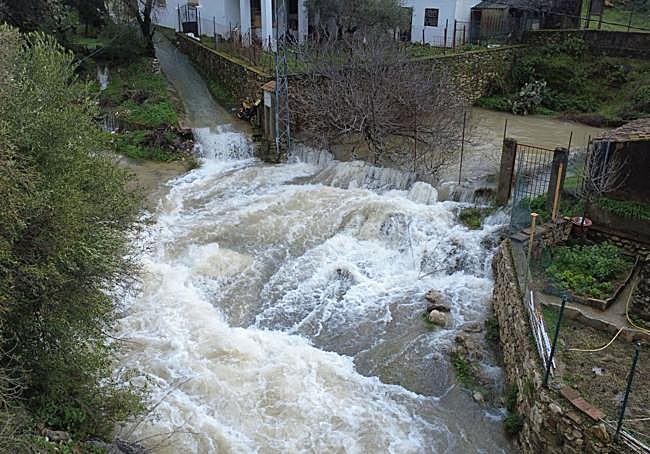
Alpandeire is also a territory marked by the force of water, especially after episodes of intense rain. At those times, one of its most surprising places comes into action: the Pozancón, a large natural well about twenty meters in diameter that expels water with spectacular force, as if it were a real "volcano." This phenomenon is related to the complex underground system of the Jarastepar limestone sierra, which accumulates and channels enormous amounts of water. A few meters away, other springs appear, and in the urban area itself, water springs up at different points. All this makes the subsoil of Alpandeire a real hydrological mystery that, after each storm, offers a spectacle unusual in the Serranía.
The sierra of Alpandeire was the scene of a tragedy that still remains in the memory of many elders. On November 1, 1954, a military plane crashed in the area, in dense fog and rain, causing the death of its 12 occupants, including several military pilots. That day deeply shocked the residents, many of whom participated in the rescue and recovery of the bodies. Today, at the site of the crash, a cross stands to remember the victims and turns this point of the sierra into a space of memory. Those who travel through this mountainous environment not only encounter imposing landscapes but also the memory of one of the most tragic episodes in the recent history of Alpandeire.

Latest news





Upcoming events
12
Nov
El Desembarco, la traición de Viriato at La Caja Blanca
12
Nov
HOMER El Mero Mero at Sala Trinchera Málaga
13
Nov
Marbella Startup Lab – Innovate & Collaborate
13
Nov
Candlelight: Coldplay & Imagine Dragons at Sala Fundación Unicaja María Cristina
13
Nov
Candlelight: Tribute to Ludovico Einaudi at Anantara Villa Padierna
Similar News

Málaga Airport Makes History with More Than Three Million Passengers in One Month
Málaga

Port of Málaga looks beyond its docks to support future growth
Málaga

Guide to the Virgen del Carmen Processions in Málaga and the Province
Málaga
