Costa del Sol News
Among the literary and historical works prior to the 20th century that contain references to Marbella, one by José Bisso is seldom mentioned: "General Chronicle of Spain, Illustrated and Descriptive History of its Provinces, a work edited by well-known writers from Madrid, the provinces, and America." It was published by the editors Rubio, Grilo, and Vitturi in 1869. José Bisso was a journalist and writer from Málaga who spent much of his career as an editor for 'La Época'. He was born in 1830, but according to sources, he died in either 1889 or 1893. In the section dedicated to the province of Málaga, in addition to extensively discussing the administrative division, he briefly analyzes the most important towns and cities.
The total population of the province was 108,874 residents, equivalent to 446,659 inhabitants. Marbella had 1,418 residents or 6,698 inhabitants. Estepona had a larger population with 2,355 residents equivalent to 8,790 inhabitants.
He fleetingly refers to the geographer El Isidri, who describes Marbella as "a small but well-populated city with an abundant production of figs."
He highlights the conquest by the Catholic Monarchs in either 1485 or 1488 and "repopulated by Christians, it did not escape the convulsions suffered by all the towns in that part of Andalusia during the uprising and rebellion of the Moriscos. After these were expelled, the inhabitants of Marbella devoted themselves to the arts, industry, and above all to trade and agriculture, living a happy and peaceful life full of the comforts offered by the abundant products of their land and the riches brought by the sea."
Regarding its location at the foothills of the Sierra Blanca, he makes an interesting comparison: "From whose summit, as from Montjuich in Barcelona, one can see a vast and beautiful panorama." He describes, in a poetic manner, that to the right one can see the Rock of Gibraltar which "seems placed in the middle of the waves and resembles an immense ship sailing the seas with sails unfurled." The portrait of the eastern area focuses on "its sandy beach, populated with shacks and small fishing boats, which to the sound of monotonous, but sweet and simple melodies, draw from the liquid element nets loaded with the most tasty and exquisite fish known in Spain."
He goes into detail describing the countryside of Marbella, highlighting the vineyards and olive groves, gullies of orange and pomegranate trees, wine presses, farmhouses, villas, orchards, and all kinds of trees.
As for the urban layout, "Marbella had 980 very beautiful houses, distributed in quite clean and regular streets. Its Constitution Square, large and square, has a magnificent stone fountain and it also houses the Town Hall and the public jail."
He also notes the existence of two public boys' schools, another two paid for by private individuals, a college where Latin is taught, an academy for girls, and several private schools run by ladies.
These establishments governed by ladies lasted until the 20th century, known as 'amigas'. The chapter on charity was limited to the Hospital de la Encarnación, today the site of the Spanish Engraving Museum.
He cited the three convents of Marbella: the ruined San Francisco; the Santísima Trinidad, used for housing; and San Juan de Dios, where the primary education schools were located.
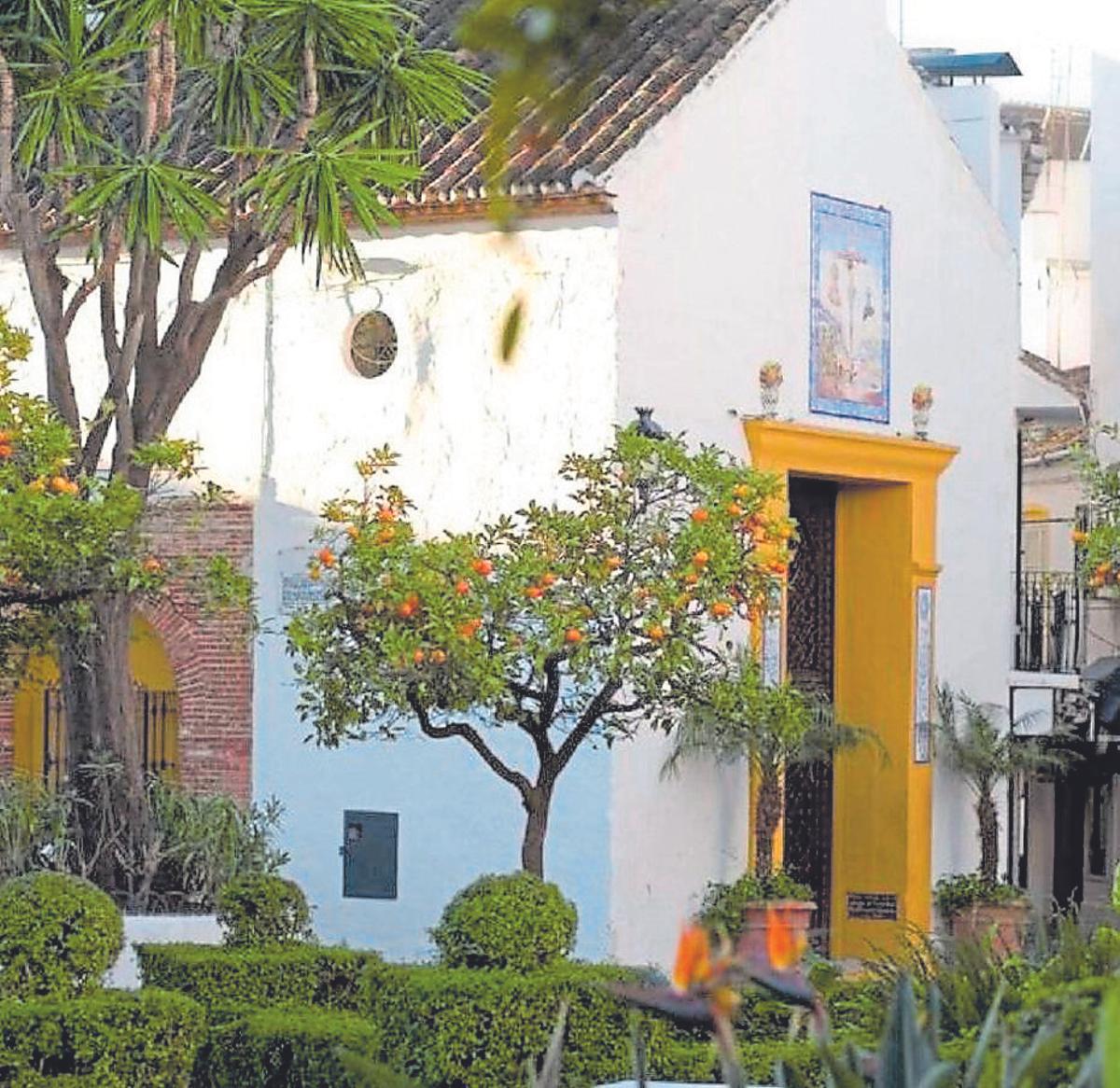
As for the hermitages, José Bisso only mentions three within the town and two outside. The first named La Encarnación, Santiago, and Santo Cristo and the outer ones, Calvario and Los Monjes. He mentions nine public fountains and some in private houses.
Drinking water was brought in through an aqueduct from a place known as Puerto Rico, half a league from the city. He highlights the existence of a freshwater spring on the seashore, known as 'La Fontanilla'. Mention is made of the lead and iron mines of Sierra Blanca; the two foundry factories, the El Ángel ironworks, and the La Concepción factory, owned by the Heredia family. La Concepción had three blast furnaces, of which, usually, only one was in operation.
They estimated about thirty-five thousand workdays per year. The main agricultural production focused on the cultivation of wheat, barley, corn, chickpeas, rye, carob, figs, raisins, grapes, oranges, lemons, pomegranates, vegetables, acorns, and good pastures. Livestock also held some importance, mainly goats, cattle, and pigs, with abundant big and small game and poultry.
'The Chronicle of the Province of Málaga', by José Bisso, at this point in the 21st century, can primarily be understood from a literary perspective but remains a collection of data and appreciations that constitute an excellent portrait of the area in the second half of the 19th century.