


Metro strike on the key day of Holy Week in Málaga: packed trains and long waits
The workers speak of an "absolute success" of the strikes and warn of more mobilizations to get the company and the government to sit down and negotiate.
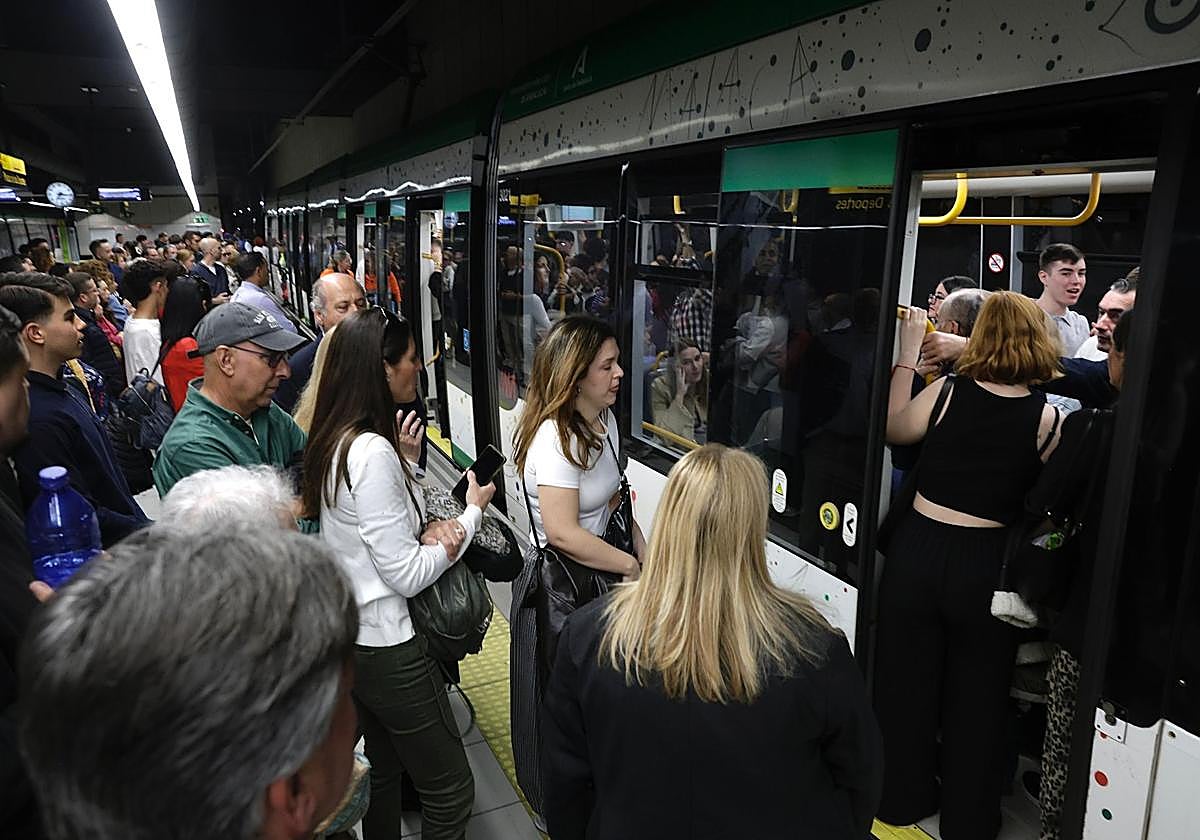

The big day of Holy Week in Malaga, Holy Thursday, has become a festive occasion for many more people than before, with the Legion parading ... through the streets, with Christ of Mena waiting for the fervor of its faithful and with Esperanza also waiting for her turn, the residents of the capital and visitors take to the streets... and to public transport to reach the official route. However, on this Thursday afternoon, from six to nine at night, the metro workers are on strike to demand, among other improvements, wage parity with their colleagues from the Seville subway. Thus, the platforms saw crowds, as well as on the escalators and when entering the trains, which sometimes passed through the stations—especially those closest to Atarazanas, from Barbarela, for example—without opening their doors, because they were full. Up to three or four trains in a row could pass without being able to pick up hardly any passengers.
At five-thirty in the afternoon, from La Unión station towards Atarazanas, the metro on line 1 was already bursting, though not because the passengers were responding to a strategy to get ahead of the strike hour and avoid its effects, namely, the reduction of frequency to almost half. However, what was about to happen was being discussed: "Just on Monday, Wednesday, and Thursday, the busy days of Holy Week, they called the strike to apply pressure." And another passenger replied: "It's always the ordinary people who pay."
At six in the evening, the Andalucía Tech stop was packed with people who had left their cars nearby. The train arrives. It is the last stop on that line. But there are quite a few people, almost everyone there, who do not get off. Why? Rafael Galacho answers saying that since he could not get on the train towards Atarazanas at La Unión, he decided to take the train going in the opposite direction and therefore empty, not get off the wagon, and thus reach his destination, even if it took twice as long. "This is not because of the strike, it's because the metro has become too small, the population of Malaga has grown a lot," Galacho commented. Monica Páez and family opted for the same from Barbarela: "We have already missed two trains to Atarazanas," they lamented. "We are going to take more than half an hour to go and return," complained their daughters.
Alfonso P. and Carmen B., meanwhile, agreed that more trains and carriages are needed in the Malaga metro, and also criticized the barriers of the official route: "All this hustle and bustle and in the end, we are only going to smell Holy Week, because seeing it... little." "The workers have taken advantage of the processions to pressurize. The strike doesn't affect much. Instead of four and a half minutes of waiting, it's seven or eight," commented Yolanda Báez, from Marbella and visiting Malaga. Although a metro worker on minimum service did attribute the waits and queues to the strike: "Now we are running half the trains that would be normal." Cintia Alcón, a passenger in this case from line 2 who could not catch a train to the center and opted to get on the one going towards the Sports Palace to use the same strategy as the passengers from line 1 who instead of going directly to Atarazanas went to Andalucía Tech, confirmed what the worker said: "In my life, I have had to do something like this. If now the metro takes twice as long to pass, it is logical that this happens. But it is normal to want to strike when it hurts the most." Lola Calderón's memory told her something else: "The same thing happened to me during Christmas, we had to go from the Island to the Sports Palace. Malaga has grown a lot, but not the public services."
"Absolute Success"
The company committee described the adherence to the three days of strike called during Holy Week as an "absolute success." According to union data, 100% of the staff called to the strikes participated in the mobilizations. "Despite the minimum services decreed, the infrastructure was overwhelmed by a demand that exceeded the operational capacity of the trains in circulation, creating situations of great saturation at the main stations," stated the committee's communication at the end of yesterday's strike. The document also emphasizes that the occupancy of the trains reached levels close to 150%. On the other hand, the Andalusian Government made a brief assessment of the partial strike, highlighting that it unfolded without incidents, complying with the minimum services set at 60% and with staff adherence that lowered to 90%. The regional government also noted that there were "some occasional agglomerations on line 2, especially at the Sports Palace station."
"We deeply regret that many people from Malaga and visitors have been left on the platform with their ticket paid without being able to get on the train; it is the direct consequence of a management that prefers conflict before sitting down to negotiate a quality service and dignified conditions," continues the statement from the representatives of the metro workers, which also denounces the "lack of negotiating will" of the company and the Andalusian Government.
The strikes have had an impact on the number of passengers, according to data from Evaristo Castillo, delegate of Comisiones Obreras at Metro de Malaga: until 8:45 p.m. this Thursday, 59,000 people had traveled on the subway, compared to 100,000 from a year earlier (with three more hours of service, until midnight).
The strike sought sectoral wage parity with the Metro of Seville, in addition to the updating of remunerations with the CPI, the regulation of the maximum driving time, which includes breaks for night staff, and guarantees for workers who reach the age of 62 to access partial retirement.
After these three days of partial strikes during Holy Week, the president of the company committee, Alexis Martín, from CSIF, indicates that they have not heard from the company or the regional government. So they do not rule out new measures of pressure to advance in the negotiations. And, in the meantime, the representative of Comisiones Obreras, Evaristo Castillo, advances the possibility of an indefinite strike: "The staff is very committed. We want them to sit down to negotiate."

Latest news





Upcoming events
12
Nov
El Desembarco, la traición de Viriato at La Caja Blanca
12
Nov
HOMER El Mero Mero at Sala Trinchera Málaga
13
Nov
Marbella Startup Lab – Innovate & Collaborate
13
Nov
Candlelight: Coldplay & Imagine Dragons at Sala Fundación Unicaja María Cristina
13
Nov
Candlelight: Tribute to Ludovico Einaudi at Anantara Villa Padierna
Similar News

Málaga Airport Makes History with More Than Three Million Passengers in One Month
Málaga

Port of Málaga looks beyond its docks to support future growth
Málaga

Guide to the Virgen del Carmen Processions in Málaga and the Province
Málaga
