


Crowded trains and long lines to catch the subway due to the strike this Holy Monday in Málaga
Some users have to wait for up to three rounds before they can board, and others give up and look for alternative means to reach the Center.
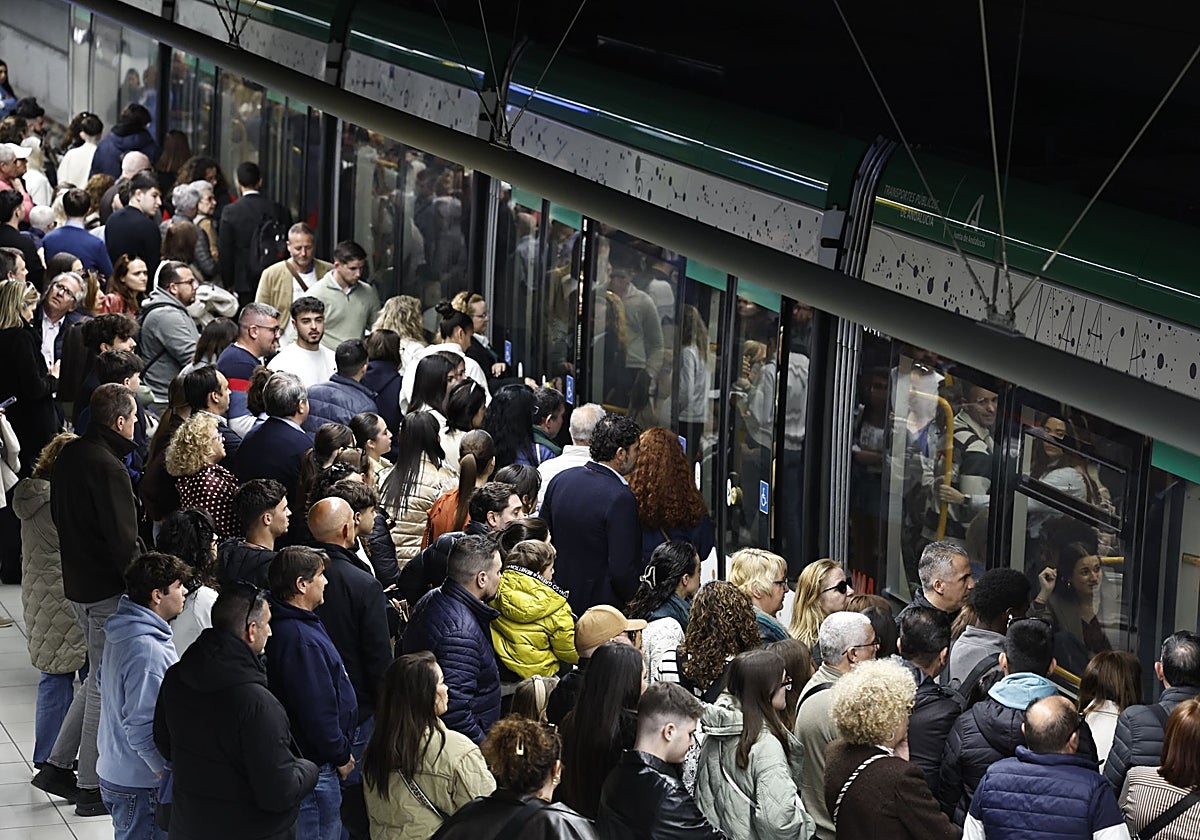

This Holy Monday was particularly challenging at the Málaga metro stops. This day is usually the busiest of the year, and the 2025 Holy Week set a new record for the highest number of users in a single day (falling on April 14th), with a total of 113,880. This year, it is very unlikely that this figure will be reached, given the situation experienced at the stops due to the partial strike called by the workers.
Being considered an essential service, especially during Holy Week in the capital, the regional government has imposed high minimum service requirements of 60% during the strike hours from 5:30 PM to 8:30 PM.
Despite this, the situation has been difficult for users. SUR has visited some of the main stations to assess the impact. The route starts at La Luz-La Paz, to gauge the situation at an intermediate stop. From the very beginning of the strike, the trains arrive almost full, nobody gets off, and they only admit a few of those waiting on the platform.
On Holy Wednesday, the strike will be from 5:00 PM to 8:00 PM; and on Holy Thursday, from 6:00 PM to 9:00 PM
The rest are torn between several alternatives. The quickest rush to the platform opposite, aiming to travel in the opposite direction (towards Palacio de los Deportes) to secure a spot when the same train makes the return trip towards the Historic Center. Others, on the other hand, take a position at the front of their respective platform (towards Atarazanas) and wait patiently for the next train, hoping to find the rare available space. And there is still a third group: those who give up and leave the station, either to look for an alternative means of transport or to go back home to watch the processions on TV...
"We knew there was a strike today, we came early but seeing the situation we will head towards Martín Carpena, because when it arrives we won't fit," say Isabel and Antonia, who were already left out of the previous train and are now debating their next move. The former comes from Benalmádena and has parked her car at La Paz, where the latter lives. "It's also impossible to get on the Cercanías; I suffered it last year."
Travel in the opposite direction
"Ah! So there is a metro strike," exclaims Miguel, who is trying to reach the official route along with Loli and little Leo, who is experiencing his first Holy Week. "In the one that passed earlier, we didn't even try to get in, especially with the stroller." And so they wonder: "The platforms are very long but the trains carry very few carriages, they could put some more." Among those gathered are also Laura and her daughter, who turn around at that moment and decide not to travel. "It's just impossible to get on the metro today," they lament.
The next stop for SUR is at the Palacio de los Deportes station. There, the overcrowding is even greater. The stop next to Martín Carpena is the head of line 2, and at these hours two phenomena converge: those entering through the station entrance, both locals and many residents of Greater Málaga, who have parked their cars in the stadium's parking lot and intend to reach the Center by subway. Although, in reality, they barely manage to get on board, as the trains come full of travelers from the intermediate stations on the Carretera de Cádiz, who have taken it in the opposite direction to secure a spot at the start of the return trip to the Center.
In conclusion, at this point, there is a significant overcrowding, where travelers take two or even three departures to manage to get on. Some witnesses describe a very similar scenario on line 1, at the surface stops of the University of Málaga campus, which many also use these days as parking to make a transfer.
The partial strikes by the workers will still be repeated on two more occasions during Holy Week: Holy Wednesday (April 1st), from 5:00 PM to 8:00 PM. And Holy Thursday (April 2nd), from 6:00 PM to 9:00 PM. On these same days, there will be gatherings of the staff at El Perchel station, next to María Zambrano.
Specifically, at this Monday's gathering, Alexis Martín, president of the Málaga Metro workers' committee (CSIF), presents the reasons for this mobilization: "The company does not want to sit down with the workers, they made a proposal last Thursday and it was worse than the one that had been voted on two weeks before and was rejected by 70% of the staff. We are forced into this strike day on Holy Monday, which is the day that moves the most metro users, but the company has no intention of sitting down, as it has shown these days, nor does the Andalusian regional government, which does not seem to be mediating in the situation."
Evaristo Castillo, representative for CCOO on the committee and also a convener of the mobilizations, estimates that, given that the minimum services are 60% and the expected frequency of passage was 4 and a half minutes in this time interval, with the strike it has gone to more than double: "On line 2 it is 8 and a half minutes, although it is probably going to 9 or 10 minutes because there are quite a few people. And on line 1 it is seven and a half minutes. People from Palacio de Deportes can no longer get on, and the same happens on line 1 in the surface stretch."

Latest news





Upcoming events
12
Nov
El Desembarco, la traición de Viriato at La Caja Blanca
12
Nov
HOMER El Mero Mero at Sala Trinchera Málaga
13
Nov
Marbella Startup Lab – Innovate & Collaborate
13
Nov
Candlelight: Coldplay & Imagine Dragons at Sala Fundación Unicaja María Cristina
13
Nov
Candlelight: Tribute to Ludovico Einaudi at Anantara Villa Padierna
Similar News

Málaga Airport Makes History with More Than Three Million Passengers in One Month
Málaga

Port of Málaga looks beyond its docks to support future growth
Málaga

Guide to the Virgen del Carmen Processions in Málaga and the Province
Málaga
