


The Phoenicians, the first discoverers of the coast of Malaga
A study shows that the arrival of Eastern traders and settlers drew the indigenous population to the first maritime line of the bay.
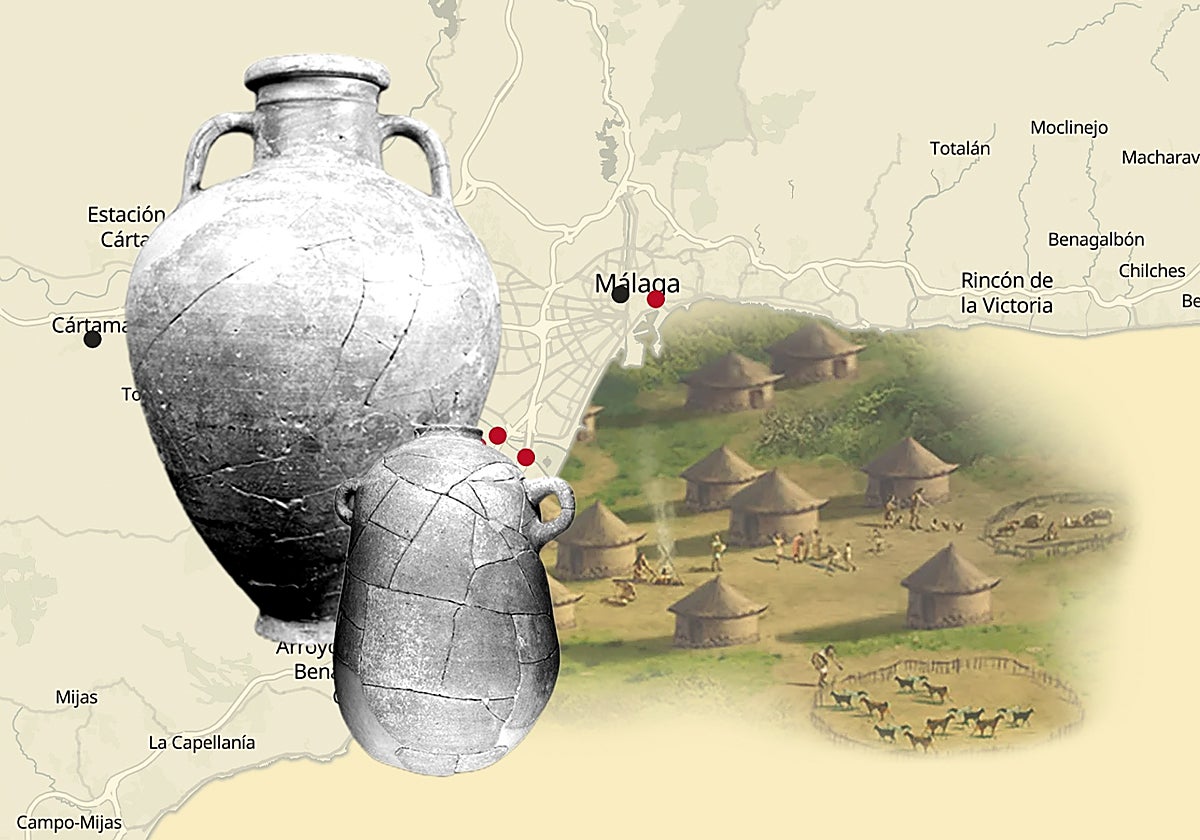

The parallelism does not lack its historical nod, though it might be more accurately described as archaeological. All those foreigners arriving at the Costa del Sol since the mid-20th century in search of the warmest sun have their precedent in the Phoenicians, who were the first 'tourists' of our coast. Except they did not come to rest, but to trade and, as now, to settle down. A people of maritime and mercantile culture, the first place they settled in the Bay of Malaga was La Rebanadilla, the oldest in the Iberian peninsula together with Huelva, and which, according to the latest carbon-14 research, dates back to the late 10th century BC. This prompted the coastal approach of the native populations, more interested in livestock and agricultural exploitation than in maritime resources. A phenomenon that experts have dubbed a "calling effect" that would lead to the origin of the current city of Malaga.
"Before the Phoenician settlement on the coasts of Malaga, local populations settled inland, but from the late 10th century BC, when the eastern colonists settled in La Rebanadilla, there was a movement of these native groups who came into direct contact with the Phoenicians," explains Bartolomé Mora, Professor of Archaeology at the University of Malaga. Together with his colleagues José L. Caro and José Suárez –director of the Cerro del Villar site–, they posed a question: Were there indigenous settlements on the frontline when the Phoenicians arrived? The answer is in the study 'Chronology and Temporality of the Beginnings of the Iron Age in the Bay of Malaga', published in the latest issue of the prehistory and archaeology journal 'Spal', which, using new carbon-14 datings of Phoenician and indigenous remains, confirmed that the approach to the coast by the natives occurred after the arrival of the eastern colonists.
Unlike in Huelva, where the Phoenicians contacted settlements already organized near the shore, Malaga presents different and unique dynamics in that archaic Phoenician stage. "The oldest dates of the indigenous habitat of San Pablo –in the Trinidad neighborhood– resemble those we have in the La Rebanadilla sanctuary created by the Phoenicians in the coastal environment," explains archaeologist José Suárez, establishing the arrival of the eastern civilization by settling at the mouth of the Guadalhorce –where the second runway of the Malaga Airport is currently located–, while the contemporary indigenous settlement in the bay is located in the area of Guadalmedina, but disappears at the end of the 8th century BC.
"I like to think about the coincidence that most people arriving in Malaga today do so via the Airport, whose runway is precisely located at La Rebanadilla. It's curious that the main entry point for foreigners continues to be the same place where the first inhabitants from abroad settled," Suárez highlights about this entry point with archaeological antecedents. Except that space did not look like a runway, but rather an island where ships could dock, as at that time the same area was an islet at the mouth of the Guadalhorce, now filled in and about eight kilometers from the current shore. Subsequently, the Phoenicians sought new territory nearby to develop even closer to the sea, and that place was Cerro del Villar, in the same estuary of the river and with very specific conditions.
"We find that the local population joins the new project of the Phoenician community, an ambitious space with urban planning and eastern organization, but that integrates the indigenous people," the archaeologist continues with the chronology and adds that the predominant settlement in the bay of Malaga in the 7th century BC is the new island of Cerro del Villar. In that century, there is also evidence of a Phoenician sanctuary on Císter street, "but the area of Guadalmedina is a secondary space," he clarifies. A chronological map that, linking with the latest excavation campaigns at the mouth of the Guadalhorce, changes again in the 6th century BC when the problems of flooding in the Phoenician colony lead to the relocation of the main nucleus to Guadalmedina and to Malaka, leaving the old island as an industrial subsidiary area of the new emerging centrality in what today is the old town of the capital.
The innovative results of this research are linked to the use of radiocarbon tests, a system that is becoming established and applied to chronologies that until now were obtained with the traditional study of ceramics. Thus, this technique for measuring the age of organic materials uses as base material remains obtained from seeds, bones, spines, coals, and even shells from archaeological sites. "We could say that radiocarbon is a 'hidden clock' in living beings that allows us to approximately know the time of their death," explain the researchers of this study now applied to the settlements located in the vicinity of the Bay of Malaga.
The basis of these tests is that both humans and animals and plants absorb during their life a carbon isotope called carbon-14, which is mildly radioactive. In the case of living beings, this isotope is housed in the bones, but upon death, this absorption stops, so from that moment, it acts as that natural 'clock' that allows us to know the dating of archaeological findings with organic remains. Framed in R&D projects, the research with the radiocarbon methodology has brought to the table the settlement trends in the Bay of Malaga at the end of the Bronze Age, while refining the oldest chronology that places the use of La Rebanadilla by the Phoenicians at the end of the 10th century BC, which represents a divergence of several decades with respect to the mid-9th century BC proposed by ceramics.
"That arrival of the Phoenicians and their establishment by the sea is what we have called a 'calling effect' as it caused the population centers that were inland to increasingly approach the coast," says Professor Bartolomé Mora, who draws on a big screen metaphor and recalls the 'westerns' to illustrate that phenomenon. "The best example is the fort in those movies, around which the Indians' tents were set up with whom they traded and worked," concludes the archaeologist and cinephile.

Latest news





Upcoming events
12
Nov
El Desembarco, la traición de Viriato at La Caja Blanca
12
Nov
HOMER El Mero Mero at Sala Trinchera Málaga
13
Nov
Marbella Startup Lab – Innovate & Collaborate
13
Nov
Candlelight: Coldplay & Imagine Dragons at Sala Fundación Unicaja María Cristina
13
Nov
Candlelight: Tribute to Ludovico Einaudi at Anantara Villa Padierna
Similar News

Málaga Airport Makes History with More Than Three Million Passengers in One Month
Málaga

Port of Málaga looks beyond its docks to support future growth
Málaga

Guide to the Virgen del Carmen Processions in Málaga and the Province
Málaga
