


This is Europe's most advanced mobile emergency management coordination center
Advisor Antonio Sanz stated in his opening that "it will allow saving lives with more technology, coordination, and response capability."
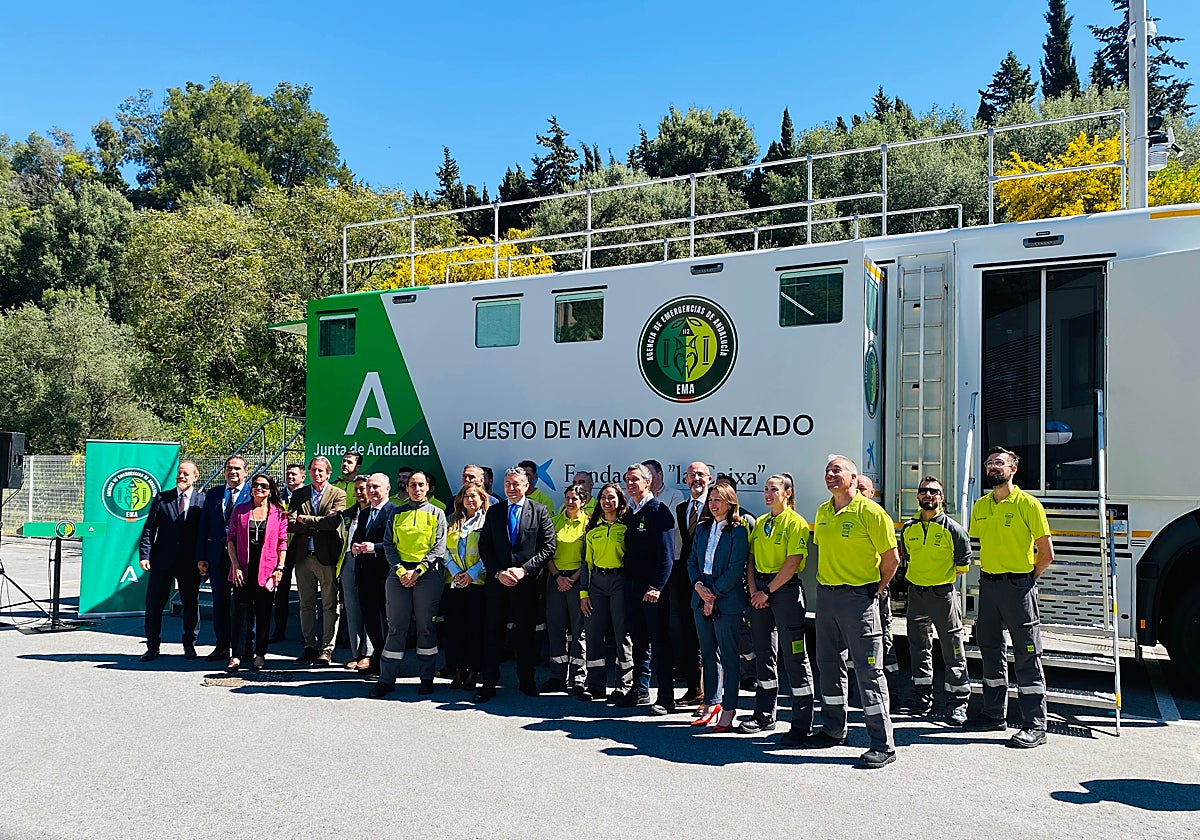

Andalusia now boasts what is considered "the most advanced mobile emergency management coordination center in Europe," according to the responsible commissioner, Antonio Sanz. This is the new Advanced Command Post (ACP), unveiled at the coastal base of the Andalusia Emergency Group (GREA) in Benahavís, envisioned as a key infrastructure for operational management of major emergencies directly on the field.
The device, driven by the Andalusia Emergency Agency (EMA) and funded by La Caixa Foundation, was designed by the Andalusian company Iturri to address increasingly complex scenarios. "The last few months have been particularly demanding in terms of emergencies, both from natural and technological risks, which requires anticipation, planning, qualified professionals, and advanced technology applied to decision-making," explained Commissioner Sanz during its presentation.
Its design meets a key need in emergency management: to transfer strategic coordination capacity to the field without depending on fixed infrastructures. "We present much more than a specialized truck; it is a new capability to protect lives and better coordinate those who protect us," stressed Sanz.
Autonomous in any scenario
The ACP functions as a comprehensive coordination center capable of operating autonomously for hours or days at any point in the territory. Built on a high-capacity chassis, the vehicle exceeds 11 meters in length and 4 meters in height and features a lateral hydraulic expansion system that allows its width to be extended up to 4.5 meters, creating a high-performance operational workspace.
Inside, the ACP is structured into two distinct areas. On one hand, an operations room equipped with integrated workstations, industrial computer systems, and large-format screens that allow for the visualization of operational cartography, aerial images, and real-time weather data.
On the other, a strategic coordination room prepared for high-level meetings, with videoconferencing systems and direct connections to command centers and authorities.
One of the key elements is its multiband communication system that allows integrating communications from various operations such as medical emergencies, civil protection, security forces, or firefighting, in addition to data networks and satellite connections. This connectivity ensures functionality even in areas without conventional coverage.
The vehicle also includes telescopic masts with high-definition cameras, its own weather station, wireless video transmission, and advanced audiovisual management systems, which provide a global and real-time view of any emergency.
Energy autonomy in extreme situations
The ACP is prepared to operate in adverse conditions without depending on external supplies. It features electric generators, uninterrupted power supply systems, and automatic stabilization technology that allows for rapid deployment in complex terrains.
Perimeter LED lighting facilitates night interventions, while its computer systems allow for the creation and printing of operational cartography on the field, a key aspect in decision-making during prolonged emergencies.
The vehicle's design also focuses on the performance of the professionals working in it. It includes thermal and acoustic insulation, advanced air conditioning, ergonomic spaces, and accessibility for people with reduced mobility.
"It is a vehicle designed for those who make decisions in the most critical moments," highlighted Sanz, who emphasized that "improving the working conditions of emergency professionals directly contributes to a more effective response."
"It will allow for the management of major emergencies on the field with more technology, more safety for the teams, and greater response capacity. It is, undoubtedly, a center to save lives," he affirmed.

Latest news





Upcoming events
12
Nov
El Desembarco, la traición de Viriato at La Caja Blanca
12
Nov
HOMER El Mero Mero at Sala Trinchera Málaga
13
Nov
Marbella Startup Lab – Innovate & Collaborate
13
Nov
Candlelight: Coldplay & Imagine Dragons at Sala Fundación Unicaja María Cristina
13
Nov
Candlelight: Tribute to Ludovico Einaudi at Anantara Villa Padierna
Similar News

Málaga Airport Makes History with More Than Three Million Passengers in One Month
Málaga

Port of Málaga looks beyond its docks to support future growth
Málaga

Guide to the Virgen del Carmen Processions in Málaga and the Province
Málaga
