Costa del Sol News
There are two engineering plans in which the Paseo de la Alameda in Marbella appears: one from 1792 for the projected fishing port and another from 1869 for the Iron Pier project, which would serve as a dock for the mineral from the El Peñoncillo mine. The first plan shows ten rows of trees, and the second depicts an urbanized street mentioned by Pascual Madoz. In addition to the Iron Pier, the English company that exploited the iron and lead mines of Sierra Blanca began constructing a mining railway in 1870, named 'San Juan Bautista', whose rails were still visible, well into the 20th century, crossing the main road (Ricardo Soriano).
Mr. Guillermo Lonsdale, one of the partners of the railway's owning company, requested the City Council to sell him a plot of 5,704 square meters that was part of the Alameda lands. The company 'The Marbella Iron Ore' needed this space, located between the avenue of poplars and La Marina, to build the mineral warehouses, the company offices, and the railway terminal. The Council agreed to the request, it seems, because it received strong pressure from the company, suggesting that if the request was not met, the jobs of many Marbellans working in the mine were at risk. They had to pay 14,270 reales, in addition to an offer to place an iron fence around the Paseo de la Alameda, which saw its area significantly reduced.
The sale document stated that the money should be used "exclusively for the planned reform of the Alameda and a fish market that this town lacks." The British company also committed to installing the necessary level crossings and relocating the Cruz del Mentidero and the niche of the Cristo de la Alameda.
In 1942, under the mayor and president of the Managing Commission of the City Council Enrique Belón, part of the estate was recovered, demolishing the old buildings that blocked access to the beach and opening an avenue named José Antonio, which is now called Avenida del Mar, where sculptures attributed to Salvador Dalí are located. Previously, in the 1930s, the side walks were paved, which until then had been dirt paths.
The Cruz del Mentidero was three meters high. An inscription informed that it was Mayor Don Álvaro Martínez Cordero who placed it in the Llanos de El Fuerte in 1643. Around it were four masonry benches that invited conversation and gathering. It was demolished, for unknown reasons, at the beginning of the 20th century.
According to the historical researcher Don Fernando Alcalá, reproducing the testimony of the journalist Luis Sánchez de Góngora, in that place, stone-throwing fights among groups of boys were frequent, a recurring event in 19th-century Marbella, which led various mayors to issue edicts in an attempt to end the problem.
Among them, Don Pedro de Artola y Villalobos in 1869, who, "concerned about the frequent stone-throwing fights that the youth sustain in different parts of this town, obstructing the free passage of people, endangering them and causing damage to buildings," decided to act. In the edict, according to the Penal Code and Regulation, the parents of these youths commonly involved in street stone-throwing were held responsible.
In the eastern area of the Paseo de la Alameda, the old fountain known as 'la pila', with its six pinnacles topped by pots, still exists. It occasionally had colorful fish and was a popular spot for Marbellans to take photographs, either with personal cameras or with professional photographers who were also present at the location.
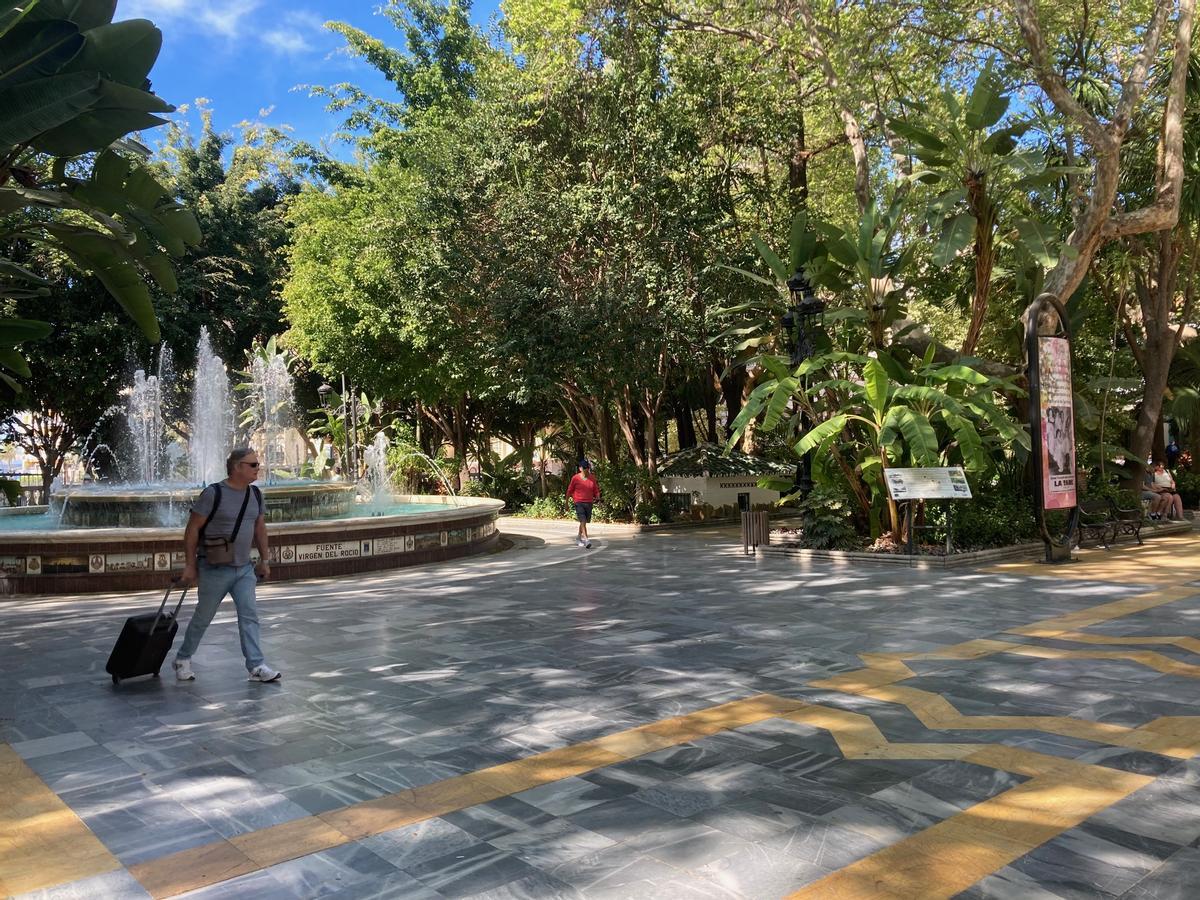
At the beginning of the 1990s, a new fountain dedicated to the Virgen del Rocío was placed in the center of the Alameda, consisting of two circles decorated with tiles depicting motifs related to various Rocío brotherhoods from Andalusia and beyond. An inscription records the origin: "cybernetic fountain donated to the town of Marbella by Don Serafín Mayoral Márquez, August 1991."
When travelers from the 18th and 19th centuries viewed the Alameda de Marbella, they could enjoy excellent views that allowed them to appreciate the beauty of the sea and the mountains; the buildings were all of low height. The impact of the Alameda on the daily life of the city was decisive. It was the quintessential socialization place, especially for young people. It served as a meeting zone for groups of friends and a forum where contacts were often made, frequently leading to romance and marriage.