


This is the prototype of the perfect house to live in Málaga
Researchers at UMA are testing mud solutions in a bioclimatic house, which cools the interior by up to 10 degrees without using energy.
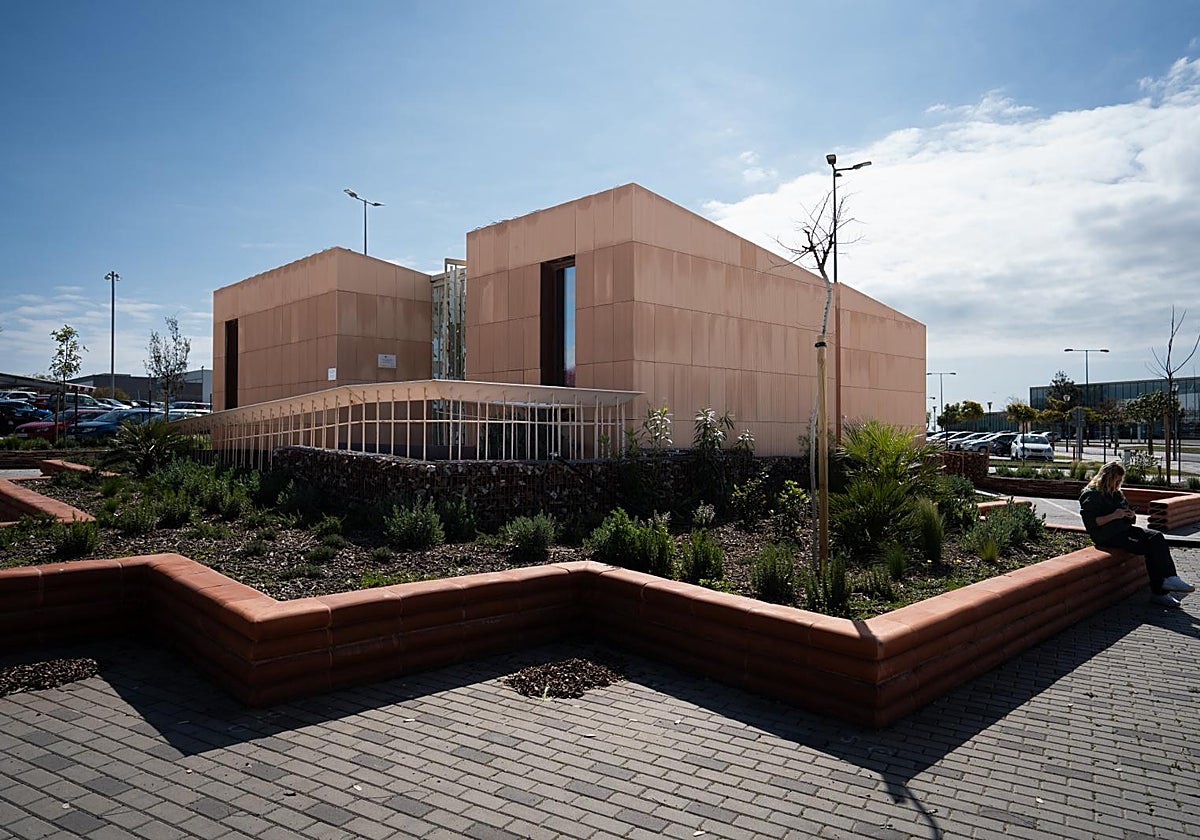

On the asphalt of a parking lot in the expansion area of the Teatinos campus of UMA. Hidden among modern, tall buildings ... covered in glass, stands a small, low, reddish structure that breaks with everything around it...
The Casa Patio project is a research prototype made possible through the collaboration of various faculties and private companies. In fact, it is a "livable laboratory," aiming to demonstrate how it is possible to live in such a warm area with perfect thermal comfort, without using a single watt of air conditioning. Even in the midst of the worst heatwaves, when the mercury soars for days and the air becomes unbreathable.
Expand
Detail of the clay lattice. ÑITO SALASThe initiative, driven and funded by the Malaga company Todobarro, with support from CDTI, owes its original structure and the reservation of the land where it stands to a previous initiative: the so-called Casa Lab Patio 2.12. This house was originally designed by UMA architects Ferrán Ventura and Marisa Bandera, along with a group of students, with the aim of competing in a prestigious international architecture competition.
"On that basis, which had many active energy consumption elements to maintain comfort, we have transformed it with passive bioclimatic materials, and surrounded it with a green island to demonstrate that we can have well-being without energy consumption," explains Pedro Guerrero, who is a researcher, secretary of the UMA Chair on Climate Change, and coordinator of the project.
An oasis under the sun
The Chair, led by botanist Enrique Salvo, collects real-time measurements of temperature and humidity, among other factors, thanks to a weather station and a network of sensors inside the home. According to initial data, with the measures that have been implemented, an indoor thermal sensation of between 5 and 10 degrees less than the outside is achieved.
Expand
Vertical garden. ÑITO SALASAnd curiously, the system becomes more efficient as the heat becomes more extreme: "The hotter it gets, the greater the temperature difference achieved and the more pleasant the stay inside," Guerrero states. "We have a constant comparison of data and the only energy consumption is the minimum necessary to operate the solenoid valves that open and close the water for the sprinklers, nothing more."
The key to this thermal miracle lies in its clay lattices, shaped like blades to increase contact with the air, which are soaked by drip irrigation. When air flows through the wet ceramics, natural cooling occurs through evaporation, an ancient technique now perfected by Todobarro, with 3D printing techniques and bioclimatic designs.
"In summer, when we reach a certain temperature, the lattice gets soaked, the air passes through and brings much more relative humidity inside." Additionally, these shapes are designed to achieve the Venturi effect, which acts as a "natural fan" and naturally dissipates the hot air to the outside of the building. The lattices are strategically oriented according to the prevailing winds in that part of the capital.
To this, other elements are added, such as a vertical garden with plants on one of the walls, which also waters automatically when necessary and helps regulate the temperature of the rooms. The philosophy is clear: to take traditional architecture and bring it to the forefront.
"We investigate bioclimatic solutions based on ceramics and new 3D printing technologies, to see how the combination of vegetation, water, and clay works to control the comfort index in a passive way," Guerrero points out while walking through the room, where, indeed, the temperature is noticeably lower than outside during the midday hours of this report.
Circular economy
Outside, the Casa Patio breaks the gray and mirror effect of the facades of the modern buildings in the expansion of Teatinos. The project includes a green island with native vegetation resilient to heat; soon, a large grapevine will be added, which will amaze one side of the garden and in the future will cover the construction as a whole, as a natural canopy over the roof.
Even waste has found a place in this space. "To reach the design pieces of the lattices, many leftovers were generated. We have reused them to create gabions (dry stone walls) that surround the flowerbeds." This aerates the roots and creates biotopes for fauna, popularly known as insect hotels. Moreover, the project champions handmade urban furniture with ceramic benches cut with wire in Vélez-Málaga.
For the Chair on Climate Change team, the Casa Patio is the necessary counterpoint to the prevailing conventional architecture. In contrast to most of the modern buildings on the campus, based on high energy consumption, this mud refuge proposes a return to the earth to survive the increasing heatwaves brought about by climate change.
A research hub on sustainable construction
The Casa Patio is not just a temporary experiment, but is destined to become the epicenter of sustainable construction in Malaga. Thus, the building will be refurbished to house the headquarters of three institutions: the UMA Chair on Climate Change; the Bilba Chair of Advanced Environmental Architecture; and the Todobarro foundation. "It will become a hub of bioclimatic research and circular economy, from which many solutions for current construction and for reducing household energy consumption will emerge," states Pedro Guerrero.

Latest news





Upcoming events
12
Nov
El Desembarco, la traición de Viriato at La Caja Blanca
12
Nov
HOMER El Mero Mero at Sala Trinchera Málaga
13
Nov
Marbella Startup Lab – Innovate & Collaborate
13
Nov
Candlelight: Coldplay & Imagine Dragons at Sala Fundación Unicaja María Cristina
13
Nov
Candlelight: Tribute to Ludovico Einaudi at Anantara Villa Padierna
Similar News

Málaga Airport Makes History with More Than Three Million Passengers in One Month
Málaga

Port of Málaga looks beyond its docks to support future growth
Málaga

Guide to the Virgen del Carmen Processions in Málaga and the Province
Málaga
