


Rafatal films the soul of the puppets from El Espejo Negro
The documentary, which premieres on March 8 at the Malaga Festival, covers the more than 35 years of the historic company of Ángel Calvente.
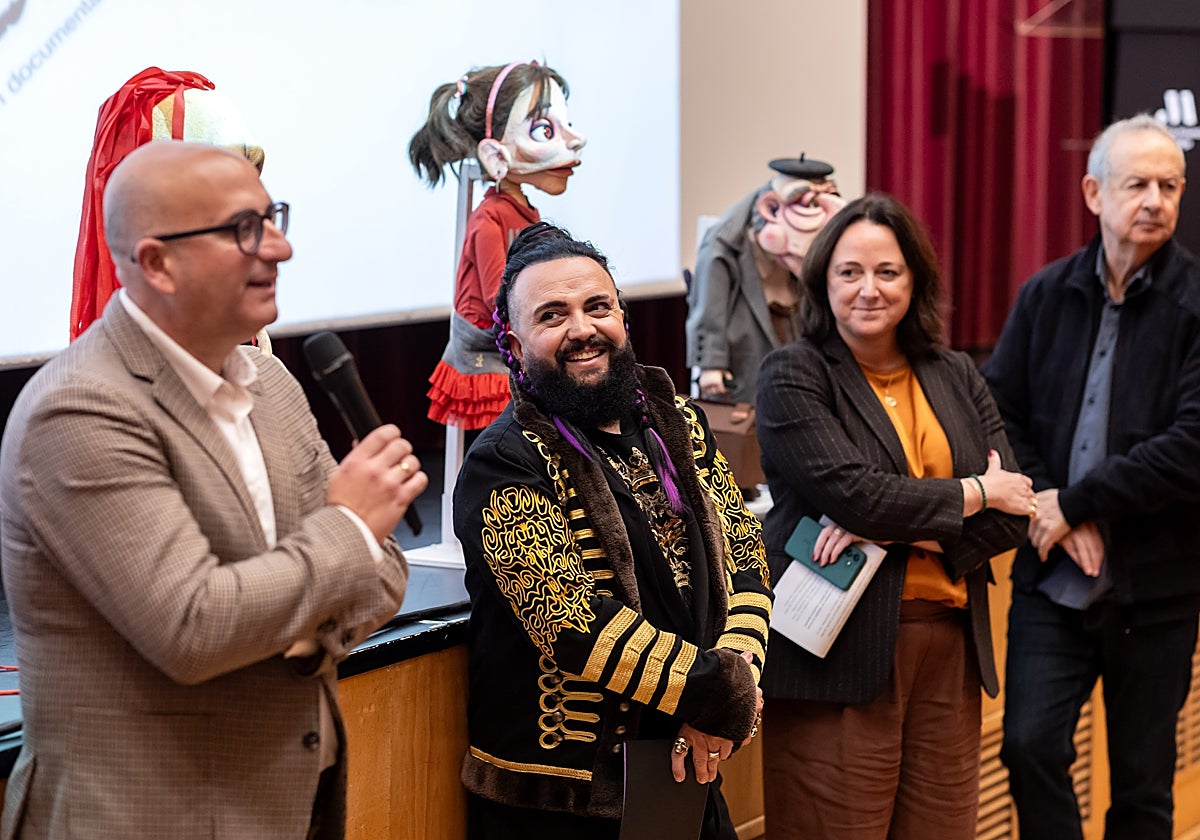

An invisible thread. A puppet already alive, though still, on the table. It only takes someone to look at it closely for it to start moving... to pulse, to tell its story. There is a place in Málaga dedicated to showing that puppets "have their own soul" for more than 35 years. El Espejo Negro, the only Andalusian puppet theater company with three Max Awards. Founded in 1989, out of a family passion for art, it transcends to the screen at the next Málaga Festival by the hand of Rafatal with the aim of "dignifying a profession that for decades has expanded from local to international without losing its roots or accent."
The director from Málaga, Rafael Robles Gutiérrez, known as Rafatal, presents 'Through El Espejo Negro', 88 minutes produced by Nina Films with participation from Canal Sur Televisión, Diputación de Málaga, and the City Council of the capital. It will premiere next Sunday, March 8 at 16:00 hours, within the framework of the 29th Málaga Festival at the MVA Cultural Center, which also served this Monday as the stage for the documentary's presentation. The film delves into the history of the puppet company El Espejo Negro and its creator, Ángel Calvente, accompanied by his partner Carmen Ledesma and his son Laís Calvente, the natural heir of the company. A journey from the origins to the generational handover of a shared devotion.
Expand
Manuel Mestanza during the presentation of 'Through El Espejo Negro' at the MVA. Diputación de MálagaRafatal defined the project as his "first biopic" and emphasized the intention to look towards local talent. "Through El Espejo Negro we want to value all the people from Málaga who have not had to leave the city to be valued as artists." The filmmaker, with more than seventy awards in his career, insisted that the company has a "universal language, that of emotions." Capable of traveling the world. "From Canada to Japan." What more useful than emotions to enliven puppets designed to show latent reality. The documentary, Rafatal explained, gives unusual protagonism to the puppets themselves. They dialogue with the interviewees and penetrate the intimacy of the group. "Not only are the people protagonists; the puppets have history," he pointed out.
From the Diputación, Manuel Mestanza highlighted the suitability of the director for the project: "No better person than Rafatal could have been chosen." The deputy also emphasized the difficulty of capturing a trajectory like that of the group: "Supporting the most awarded theater company and that they continue to surprise from their beginnings is very complicated." For her part, the Councilor for Culture, Mariana Pineda, focused on the family nature of the artistic project: "It is a structure sustained by Málaga talent and a personal bet that starts from family budgets." This allows, she says, culture to "advance, spread, and continue in subsequent generations."
A family on stage
Ángel Calvente, visibly moved after a dedication to his family and professional legacy, claimed the deep sense of his craft. "To dignify the world of the puppet," that has always been his goal. He remembers the origins of his company, born in 1989, "when only the two of us believed in it," referring to Carmen Ledesma. "Puppets are the total actors. They are my children." The creator also defended the ethical dimension of theater: "You have to be brave. Theater is made to claim what one wants." And he thanked the local recognition: "That is the gift, the support of my Málaga." A city that, despite not having been born in it, he feels fully his own. "El pitufo, the beach, the neighborhoods of La Luz, La Paz, or La Victoria," a journey through the Costa del Sol, also transferred in his works.
Carmen Ledesma summarized the shared journey. 48 years alongside Ángel. "An extensive and very rewarding journey." Her son, Laín Calvente, emphasized the perspective of the documentary: to show not only the stage, but "the human factor" that sustains the project. For his part, the programming manager of the Málaga Festival, Moisés Salama, highlighted the formal discoveries of the film and the affinity between director and company. "For such a peculiar and rebellious company, with humor, who better than Rafatal to pay tribute to it," he assures.
The documentary was presented alongside its poster and trailer, with the announcement of new surprises that will be revealed at its premiere. Rafatal left the certainty that, despite its journey, the story of El Espejo Negro does not look to the past, but is still to come. Next Sunday, March 8, at the Málaga Festival, the puppets will tense their invisible threads to do what they do best. Take the floor.

Latest news





Upcoming events
12
Nov
El Desembarco, la traición de Viriato at La Caja Blanca
12
Nov
HOMER El Mero Mero at Sala Trinchera Málaga
13
Nov
Marbella Startup Lab – Innovate & Collaborate
13
Nov
Candlelight: Coldplay & Imagine Dragons at Sala Fundación Unicaja María Cristina
13
Nov
Candlelight: Tribute to Ludovico Einaudi at Anantara Villa Padierna
Similar News

Málaga Airport Makes History with More Than Three Million Passengers in One Month
Málaga

Port of Málaga looks beyond its docks to support future growth
Málaga

Guide to the Virgen del Carmen Processions in Málaga and the Province
Málaga
