


'The Fair of the Dove' or The World of Yesterday
The lyric sainete by Bretón and de la Vega brings to Cervantes the nostalgia of the mythical Apollo.
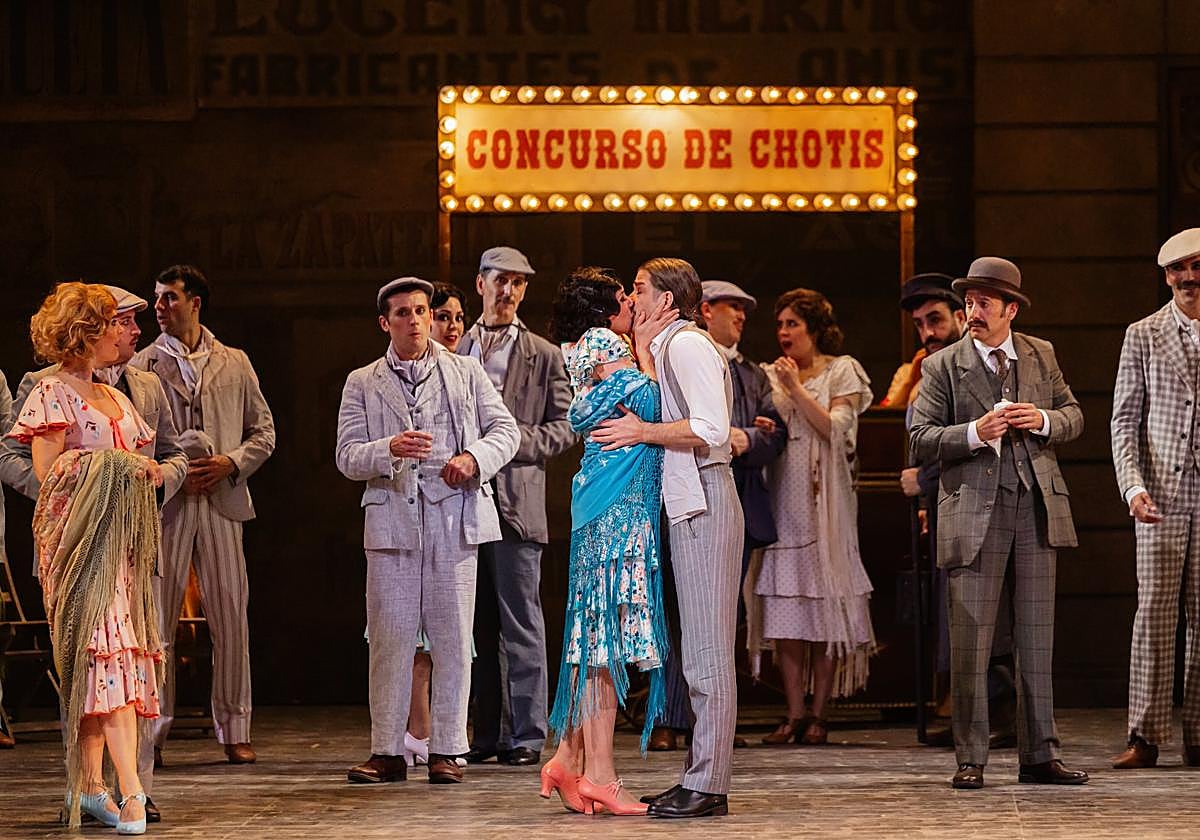

Last Friday the 27th, the first of three performances of 'La verbena de la Paloma' took place at the Cervantes Theater as part of the XXXVII Lyrical Season. This production, originating from the Teatro de la Zarzuela in Madrid and directed by Nuria Castejón, was premiered in the capital in 2024. With set design by Nicolás Boni, it has already been extensively staged in numerous national theaters.
This beloved sainete by Tomás Bretón and Ricardo de la Vega is preceded in this production by a comic-lyrical prologue titled 'Goodbye, Apollo', which shows a company rehearsing in 1929 at the legendary Teatro Apolo in Madrid (where 'La verbena de la Paloma' premiered in 1894), shortly before its definitive closure. This prologue, skillfully planned and written by poet, playwright, and actor Álvaro Tato, serves as a pretext to perform a brief anthology of the género chico with excerpts from works by Bretón himself, Jacinto Guerrero, Federico Chueca, Joaquín Valverde (father and son), José Serrano, and Tomás López Torregrosa. It thus represents theater within theater, with nods to the political reality of the time, such as the dictatorship of Primo de Rivera or the suffragist movements that would eventually lead to the approval of women's suffrage in 1931.
In zarzuela, where spoken and sung elements alternate harmoniously, the overall assessment of the production can distinguish between purely theatrical appreciation and the more distinctly musical and lyrical aspects. In both respects, the balance is highly positive, and the brilliance of the final achievement was not overshadowed by minor incidental mishaps during the performance (a sonnet with uneven scansion at the end of the prologue, some erratic lines of text...). The projective geometry of the performance resolutely works: the dynamics are fluid, the intertwining of the dialogues precise, the diction clear, the lyrical curve of romanzas and concertantes—rarely demanding in the case of Bretón, a connoisseur of the most ambitious musical theater of his time—reaches heights worthy of Rossini, Verdi, and even Wagner, all within a vivid scenic framework that transports to late 19th century Madrid.
This beloved sainete by Tomás Bretón and Ricardo de la Vega is preceded in this production by a comic-lyrical prologue titled 'Goodbye, Apollo', showcasing a company rehearsing in 1929 at the legendary Teatro Apolo in Madrid.
Borja Quiza was splendid in his role as Julián: confident, profound, clear, with Verdi-like baritone dramatism. Carmen Romeu, as Susana, captivated with her deep, pleasantly dark timbre, agile on stage, vibrant in her finishes, authentically Madrid-style without affectation. Lara Sagastizábal was professional and correct in her role as Casta. The comedic Don Hilarión, played by Barcelona's Antonio Comas, stood out for his athletic agility, perhaps somewhat uncharacteristic of the sly, ailing apothecary, but in any case agreeable and musically convincing, adding to the colorful overall equation. Milagros Martín (Señá Rita) amply demonstrated quality honed by decades of experience in zarzuela: her portrayal of the character displayed a range of authenticity hard to match. Aunt Antonia, played by Gurutze Beitia, contributed with her undeniable and robust comic flair. Gerardo López, from Málaga, crafted a magnificent Don Sebastián (previously the photographer in the prologue), achieving a very successful integration of acting and lyrical elements. In terms of diegetic music, which the characters of the sainete listen to along with the audience, the contribution was very flavorful: like the famous flamenco soleá of the second act, performed from inside the so-called Café de Melilla and sung by Sara Salado with great artistry and Cristina Arias danced with fiery agility (all accompanied by Málaga's Ángel Campos on piano). In the purely theatrical domain, Rafa Castejón was a reliable tavern keeper (previously the stage director in the prologue), and the rest of the actors, dancers, and extras splendidly contributed to the overall effectiveness.
In a production like this, where the interaction between stage and orchestra pit, between scene and orchestra is doubly necessary—not only because of the natural dynamics of accompanying the voices but also due to the playful component the orchestra acquires during the comic-lyrical prologue, with continuous interruptions and calls for the orchestral director's theatrical intervention—the work of José María Moreno leading the OFM was very commendable, with the level of precision required of such a delightful lyrical toy. From the resident Choir of the Cervantes Theater of Málaga – Intermezzo, directed by Pablo Moras, it can be said that their enthusiasm and commitment continue to transform, as has been customary, into finishes of magnificent professionalism.

Latest news





Upcoming events
12
Nov
El Desembarco, la traición de Viriato at La Caja Blanca
12
Nov
HOMER El Mero Mero at Sala Trinchera Málaga
13
Nov
Marbella Startup Lab – Innovate & Collaborate
13
Nov
Candlelight: Coldplay & Imagine Dragons at Sala Fundación Unicaja María Cristina
13
Nov
Candlelight: Tribute to Ludovico Einaudi at Anantara Villa Padierna
Similar News

Málaga Airport Makes History with More Than Three Million Passengers in One Month
Málaga

Port of Málaga looks beyond its docks to support future growth
Málaga

Guide to the Virgen del Carmen Processions in Málaga and the Province
Málaga
