


An exhibition at UMA explores the links between architecture and family
The artist Lucía Navas presents her exhibition 'Beam, foundation; cane, guard', which captures the remnants of a family farmhouse

There are houses that do not collapse even when the roof gives way. Houses that, even warped by humidity and the passage of years, remain standing because someone insists on supporting them. The protagonist of this story has no voice, but it creaks. It does not walk, but it endures. It is over a hundred years old and holds, among tired beams and canes, a memory that does not accept ruin as a destiny but as a question. In it, each crack is a clue and each repair a form of affection.
The Chema Cobo exhibition room at the Faculty of Fine Arts is the place that hosts the story of this house—or rather, a farmhouse—and Lucía Navas, a graduate from the same faculty and a student of the Master's in Art and Creation Research at Complutense, is the one who tells it through the exhibition 'Beam, foundation; cane, keeper'.
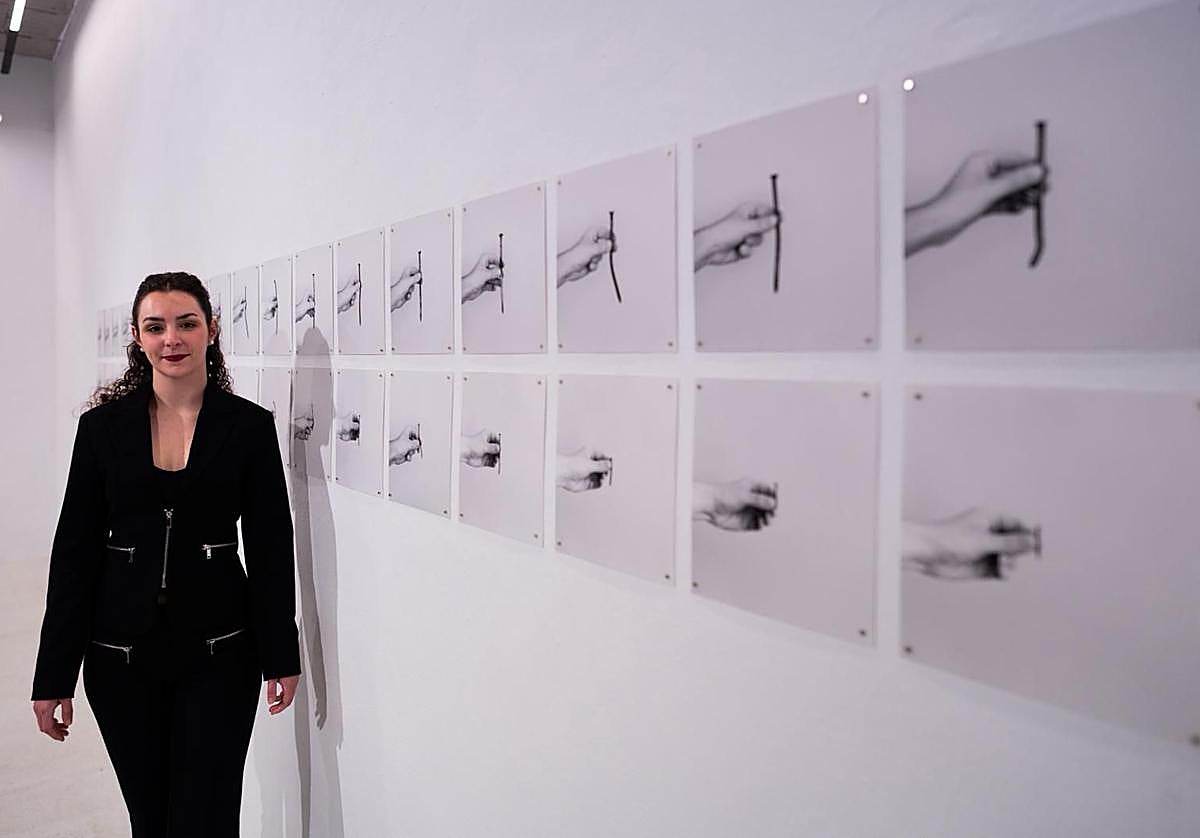
Mainly photographic, the exhibition constructs an allegorical system that dissects the territory from the detail. The artist shifts the gaze from the macroscopic to the microscopic, understanding the trace as a way of accessing the space. It is not about offering solutions or closing meanings, but about inhabiting the indeterminate and understanding how emotional bonds are generated with certain places simply by frequenting them.
The origin of the project is not abstract. It arises from the rehabilitation of a family farmhouse over a century old. The renovation, initiated by the artist's parents, becomes a creative trigger when the architectural intervention begins to be read as language. "I found a very fertile ground to draw from," explains Navas.
Expand
Ñito SalasThe roof concentrates a good part of the narrative. For decades it was a shelter; over time, it became a threat. The wooden beams began to deteriorate, water made its way, and the structure began to warp. The first thing to be reformed was precisely what seemed doomed to fall. This inversion of the usual order—starting from the top to support what is underneath—, the artist assures, is what articulates the meaning of the show: to restore not to transform into something different, but to return to the point of origin.
Conservation and transformation are not opposing terms. The artist works from a transformation that implicitly carries the will to preserve. It is not about turning the house into another architecture, but about maintaining it. To ask why someone decides not to let a house ruin when it could be demolished and start anew.
Story of Her Grandparents
The answer refers to affection. Not an affection that is restored like a wall, but one that endures. The house is imbued with the life experience of the artist's mother, born and raised on the estate, inheriting a story that began with her grandparents. He, a foreman dedicated to the cultivation of sugar cane; she, a caretaker of the former owners. The word 'cane' in the title refers both to her grandfather's agricultural past and to the very framework of the house. 'Keeper', as a tribute to her grandmother.
In the room, the photographs dialogue with material fragments of the farmhouse itself. Navas is interested in there being a true relationship between image and matter, that what the photograph points to is also physically present. The material "contains an emotional feeling" of the house itself. Bringing it to the exhibition space allows the viewer not only to look but to confront the tangible weight of that history.
Ruin here does not appear as an end, but as a possibility for analysis. More than building something new, the artist seeks to explore where deterioration comes from and where it leads. In a time marked by speed and a gaze projected towards the future, the gesture of praising the past and building slowly is posed as an act of resistance against dominant dynamics.
"I want the visitor to feel lost," assures Navas. Only by relating the pieces does meaning articulate. Materially, she defines her work as "a photograph that goes beyond the surface," and conceptually, "cold, though emotional and sentimental."
'Beam, foundation; cane, keeper' is not only the public presentation of an expanded academic project and the beginning of an individual trajectory. It is the confirmation that a house can be sustained on something firmer than wood or concrete. From the highest tile to the most hidden foundation, what keeps this building standing is a bond. And as long as that bond persists, ruin will not be a fall, but memory in construction.

Latest news





Upcoming events
12
Nov
El Desembarco, la traición de Viriato at La Caja Blanca
12
Nov
HOMER El Mero Mero at Sala Trinchera Málaga
13
Nov
Marbella Startup Lab – Innovate & Collaborate
13
Nov
Candlelight: Coldplay & Imagine Dragons at Sala Fundación Unicaja María Cristina
13
Nov
Candlelight: Tribute to Ludovico Einaudi at Anantara Villa Padierna
Similar News

Málaga Airport Makes History with More Than Three Million Passengers in One Month
Málaga

Port of Málaga looks beyond its docks to support future growth
Málaga

Guide to the Virgen del Carmen Processions in Málaga and the Province
Málaga
