


Melilla: The African Holy Week That Will Remind You of Malaga
The autonomous city celebrates its Passion with many nods to the Malaga brotherhood culture.
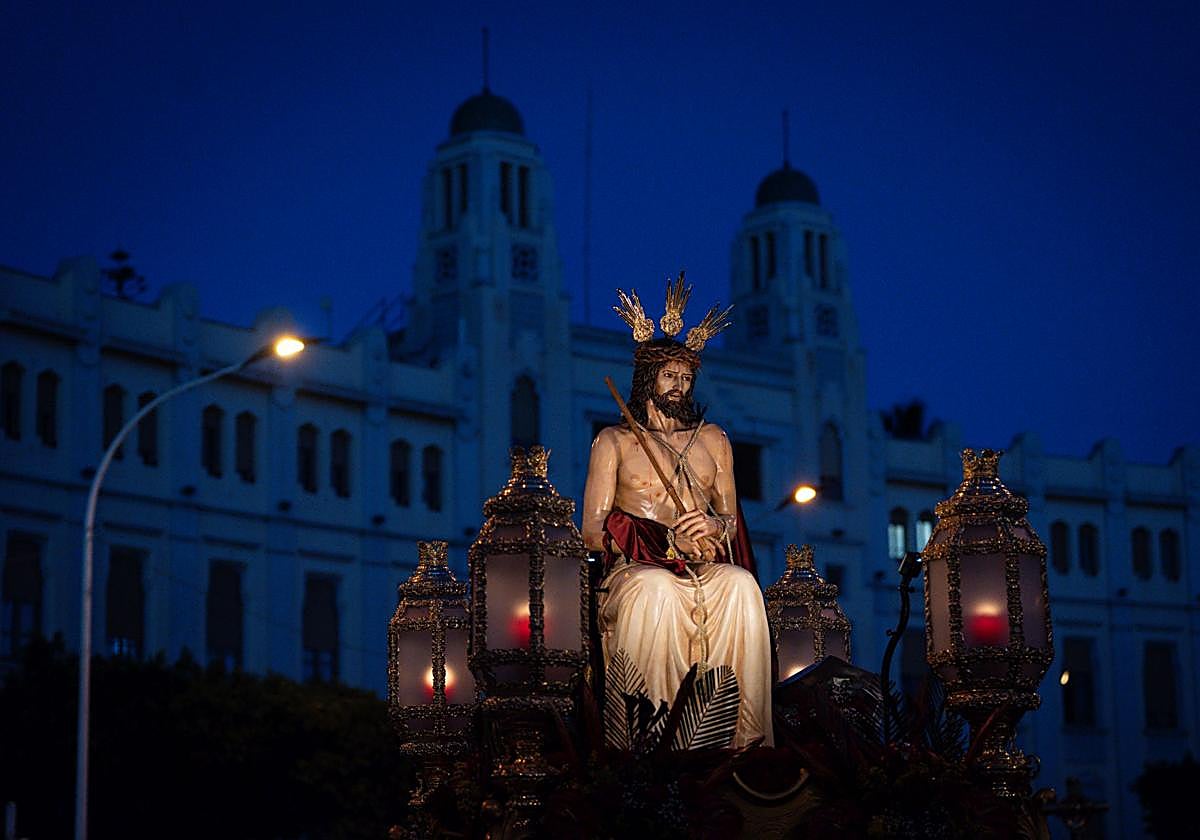

It often goes unnoticed that devotion crosses the Mediterranean to pulse with overwhelming force in North Africa itself. Melilla and ... Malaga not only share a diocese, but in an embrace of faith, they also share their patroness: the Virgin of Victory. With this thread of devotion, the five brotherhoods of Melilla sustain a Passion that, for many from Malaga, sounds like a distant celebration, from another map. However, looking at the Melillan calendar with brotherhood eyes is to discover a captivating mirror game. Melilla does not "imitate" Andalusia: it carries it within and returns it transformed into a Holy Week with many nods to the Malagan brotherhood culture.
The connection starts on Palm Sunday. In both cities, the Pollinica opens, sharing a luminous pulse of palms and emotion. Beside it walks María Santísima de Gracia y Esperanza, that green presence that, in the Andalusian imaginary, is not just an image, but a way of being in the world. But in Melilla, the incense and sea breeze blend when the earth trembles with the Tercio Gran Capitán I of the Legion. Listening to El novio de la muerte there is not just hearing a march; it is witnessing a prayer in martial step, sung at full lung, while the thrones move among the palm trees of Hernández Park. It is the same intensity, the same chill that a person from Malaga feels when the legionnaires disembark to accompany Christ of the Good Death in Santo Domingo.
Expand
Javier RamírezHoly Monday dazzles with its whiteness. If in Malaga the Cautivo moves from Trinidad commanding silence, in Melilla this whiteness is embodied in Our Father Jesus before Pilate, "La Sentencia." Here awaits the surprise: it advances on a float that changes the cadence. We are before a Cautivo in Sevillian step. Andalusia summarized: Malaga in the heart and another way of walking, in perfect balance. On Holy Tuesday, Our Father Jesus Humiliated, with his burgundy velvet cloak, inevitably recalls the austere aesthetics of the Students.
Holy Wednesday offers a unique scene: the Brotherhood of the Nazarene leaving from the Bullring, the "Mezquita del toreo." The Nazarene exudes Malagan grandeur in its throne and in its way of walking, while María Santísima de los Dolores provides the counterpoint, swaying on the costal. Two traditions embraced by the Levante breeze, reaching their climax in the thrilling encounter at the end.
Expand
Javier RamírezHoly Thursday is perhaps the great emotional bridge between both sister cities. The captive of Melilla begins his exit surrounded by a crowded and popular neighborhood that is pronounced with immense devotion in Malaga: the neighborhood of Victoria. During its journey, the night revives a breathtaking moment with the release of a prisoner, a moment that causes the same lump in the throat for someone from Malaga as when El Rico gives his blessing in the Bishop's Square. And the connection goes beyond the symbolic: a beautiful historical note reminds us that the Captive of Melilla and Jesus El Rico were born from the same hands, those of the sculptor José Navas Parejo.
Expand
Javier RamírezFollowing the Lord, light is made. The Virgin of Rocío, known as the "Bride of Melilla," radiates in the darkness, inevitably evoking the "Bride of Malaga." Moreover, the nods continue: they procession the Flagellated and Our Lady of Greater Pain (a direct echo of our Royal Merged Brotherhoods), and the brotherhood member with a good memory will stop, moved, before the Christ of Peace. This image moves imposingly on what was, for decades, the throne of the Resurrected of Malaga. It is pure brotherhood poetry: a heritage of carved wood that has crossed the sea to travel from glory to death, writing a new and beautiful page in its history.
Expand
Javier RamírezHoly Friday closes with the Solitude of Our Lady, with a recollection that inevitably transports someone from Malaga to the procession of the Order of Servites through its historic center. With that same solemnity, the imposing Avenida Juan Carlos I is completely dimmed so that the people of Melilla themselves illuminate the Virgin only with the light of their candles. And if someone from Malaga extends their journey, they will discover something that their Holy Week does not have: Easter Sunday, a burst of faith in the Plaza de España with the vibrant encounter between the Resurrected and the Virgin of Rocío, who returns to the streets of Melilla for the meeting with her son.
Expand
Javier RamírezAll this is sustained by the effort of all-terrain brotherhood members: those who today are bearers or costaleros, and tomorrow come out as musicians or nazarenes. Wrapped in traditional Andalusian marches, this Passion offers an unexpected gift: experiencing devotion without the crowds or the stresses. There is space to admire the procession, listen to the full march, and enjoy the silence before a lift or a bell ring. Additionally, people of other religious faiths participate in the brotherhoods, a result of Melilla's exemplary multiculturalism.
For those arriving for the first time, Melilla is, above all, a constant surprise that welcomes you with open arms. To the legendary hospitality of its people, one must add the gift of the rhythm of its days: while the afternoons and evenings belong to the thrones, the incense, and the devotion, the mornings invite the visitor to enjoy the city under the dazzling Mediterranean light. The spring-like weather that accompanies each day makes it an irresistible temptation to take the first swim of the year on its beaches or to disconnect from the world in its secluded coves. With the sea breeze as a travel companion, the walk naturally flows towards its dazzling modernist architecture, signed by Enrique Nieto, which turns streets like Avenida Juan Carlos I into true open-air museums. From there, the contrast is striking when entering the majestic walled enclosure of 'Old Melilla,' a fortified citadel overlooking the sea, with five centuries of history pulsating in its four precincts.
Walking through this stone labyrinth evokes epic chapters of its past, like the historic Lifting of the Siege. A memory that connects directly with its impressive military heritage, which keeps alive the city's close link with the Legion and the Regulars, a legacy that the traveler can explore through its museums and barracks. And after this journey back in time, the palate claims its turn. When it comes to sitting down at the table, the cuisine tells the same story of coexistence as its streets: the traditional Andalusian tapas of fried fish blends perfectly with Berber spices, not forgetting the essentials of these dates, such as cod stew or torrijas. It is the golden clasp, wrapped in the charm of a city where Christians, Muslims, Jews, and Hindus share the same sky.
If you are looking to escape mass tourism and the crowded streets of big cities, dare to be a tourist on the other side of the Mediterranean. In Melilla, you will find the perfect refuge to truly disconnect: quiet beaches to rest in the sun and a fascinating Passion that will remind you of Malaga, but that is discovered with total calm, far from the exhaustion of big crowds. If you want to breathe deeply and experience the tradition surrounded by the breeze of Levante and the warmth of Africa, create a playlist now with your five favorite Holy Week marches. That is exactly the flight time that separates Malaga from Melilla, your next destination.
Take advantage of this Holy Week to discover a unique place, a little piece of Spain in Africa, bathed by the Mediterranean. Get the best discounts for your plane tickets at https://bonosmelilla.es/

Latest news





Upcoming events
12
Nov
El Desembarco, la traición de Viriato at La Caja Blanca
12
Nov
HOMER El Mero Mero at Sala Trinchera Málaga
13
Nov
Marbella Startup Lab – Innovate & Collaborate
13
Nov
Candlelight: Coldplay & Imagine Dragons at Sala Fundación Unicaja María Cristina
13
Nov
Candlelight: Tribute to Ludovico Einaudi at Anantara Villa Padierna
Similar News

Málaga Airport Makes History with More Than Three Million Passengers in One Month
Málaga

Port of Málaga looks beyond its docks to support future growth
Málaga

Guide to the Virgen del Carmen Processions in Málaga and the Province
Málaga
