


The Thyssen Reveals the Enigmas of Hammershøi
Labeled as the painter of silence and solitude, the forgotten Danish artist is a link in the chain that connects Vermeer with Friedrich and Hopper.
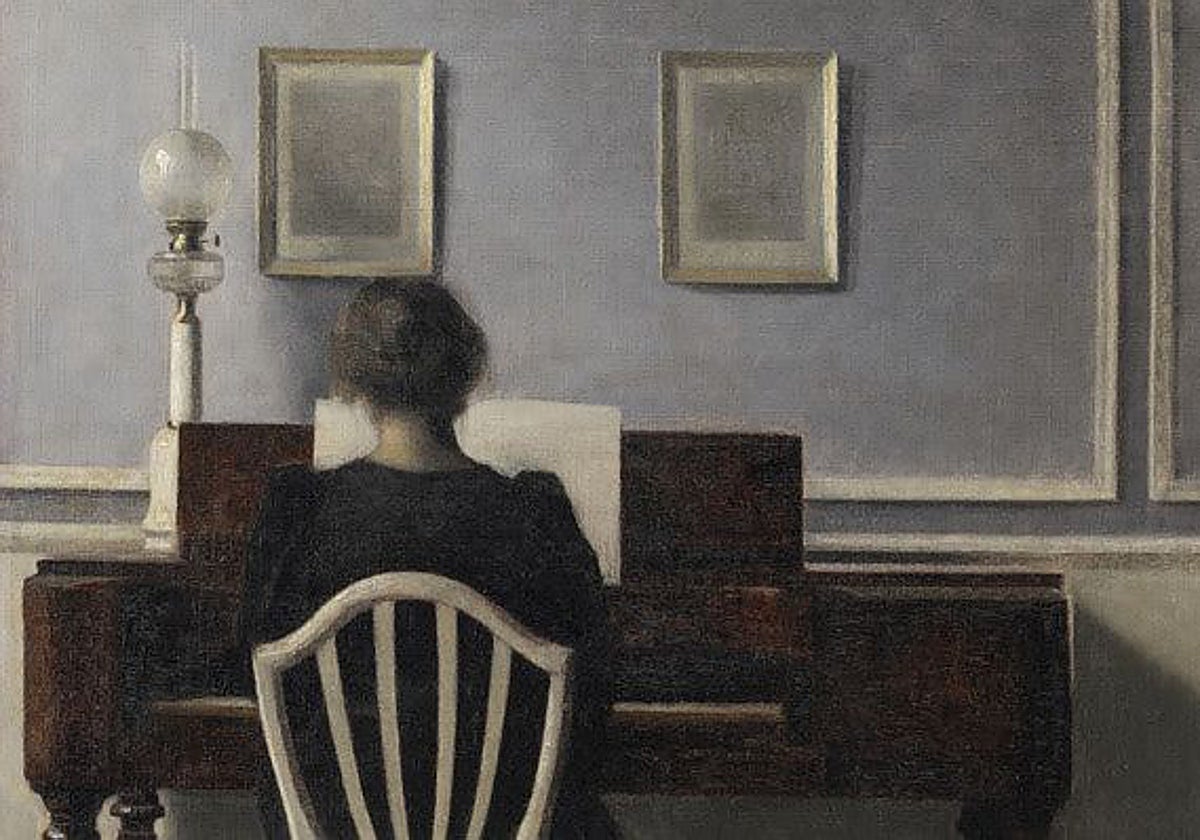

Tagged as the painter of silence and solitude, Vilhelm Hammershøi (1864-1916) is positioned between Vermeer and Hopper. Largely unknown to the Spanish public, the Thyssen-Bornemisza Museum rescues and rediscovers the unique work of the Danish artist. It unveils his enigmatic keys in a surprising exhibition. An invitation to stillness and serenity in noisy times that will be one of the milestones of the season.
Clara Marcellán is the curator of 'Hammershøi. The Listening Eye'. On display until May 31, the exhibition brings together 90 works, 70 by the Danish painter and about twenty by other artists, predecessors and contemporaries, such as Rusiñol or Fantin-Latour, which help to place the Scandinavian's work in the history of art.
Success in Life
Dying at 51, he painted only about 400 works, including canvases and drawings. He enjoyed success during his lifetime and sold his work in Denmark as well as in England and Germany, countries he visited frequently. Later, he was forgotten.
'Interior. The Music Room at Strandgade, 30. 1907', Art Institute of Chicago."A contemporary of Mondrian and Kandinsky, Hammershøi was not an outsider, but he was overwhelmed by the avant-gardes. In 1916, the year of his death, the art world changed radically. With Matisse and Picasso as shining stars, his work fell out of the canon and into an unjust oblivion. It resurfaced in the 1980s as a cult artist, a proto-modern who now seduces large audiences," explains Guillermo Solana, artistic director of the Thyssen Museum.
"He is indeed the painter of silence. He creates disturbing atmospheres with a very limited palette. Playing with white, -which for Kandinsky was 'like a musical pause'-, black, and ochre tones, he paints enigmatic spaces of suspended time. Works with many layers and nuances," says the curator.
"In a silent history of art, he would occupy a place of honor. He is the link in a chain that connects Johannes Vermeer, Caspar David Friedrich, and Edward Hopper," adds Marcellán.
'The Listening Eye' is the first major exhibition in Spain of the unique painter, overwhelmed by the success of Picasso and Matisse
"There is beauty in an empty interior," said Hammershøi, who obsessively painted the interiors where he lived, "muted settings that invite you to listen to the silence and generate intrigue," says the curator justifying the title.
Until 1908, Hammershøi lived on the first floor of Strandgade, 30, in the central neighborhood of Christiania, in Copenhagen, a home he painted tirelessly. Much of his work consists of these interiors: solitary rooms with white windows and doors. Works like 'Interior. An Old Stove' (1888), the first painting he made without people, the spectacular 'Sunbeams' or 'Dust Motes Dancing in the Sunbeams' (1900), 'Ida Reading a Letter' (1899), or 'Interior with a Young Woman Seen from the Back' (1903-1904).
'A Room in the Artist's House on Strandgade, Copenhagen, with His Wife, 1902 National Gallery of Denmark.In his landscapes, there are no figures, and he often paints the backs of women, like the masters of the 17th century and the Romantics. His recurring model was his wife, Ida Ilsted, who had fragile mental health and outlived him until 1949. In his later years, Hammershøi self-portrayed and resumed studying the human figure in large formats, like the very Hopper-like 'Standing Female Nude' (1909-1910).
Highly Valued
After its rediscovery, Hammershøi's work has only gained critical acclaim and attention from collectors and an audience that now accepts and enjoys his enigmatic universe. His works are now in major museums such as the Metropolitan Museum of Art in New York or the Art Institute of Chicago. They are also in major collections and auction rooms, where his valuation has skyrocketed. From initial appraisals of one million euros, the latest works sold fetched between ten and fifteen million.
"By labeling him, we enter a swarm of contradictions: he is an enigma, a realist painter of fascinating unreality, almost metaphysical, ghostly, of spectral realism," lists Guillermo Solana. "Everything about him is subtly disturbing," he adds.
"We hope it will be one of the most literally fascinating successes we have had at the museum and that the public enjoys the discovery," wishes a more than delighted Solana to contribute to the rescue of the Danish painter.
Expand
'Self-Portrait. The Spurveskjul Cottage in Sorgenfri, north of Copenhagen. 1911'. National Gallery of Denmark.This is the first retrospective dedicated to the artist in Spain, where there are no works by Hammershøi in public or private collections. In 2007, the Barcelona Center for Contemporary Culture (CCCB) organized a small exhibition comparing Hammershøi's paintings with the cinema of Dreyer.
Most of the works exhibited at the Thyssen come from the National Gallery of Copenhagen. After its closure in Madrid, the exhibition will travel to the Kunsthaus Zurich, which co-organized the exhibition.

Latest news





Upcoming events
12
Nov
El Desembarco, la traición de Viriato at La Caja Blanca
12
Nov
HOMER El Mero Mero at Sala Trinchera Málaga
13
Nov
Marbella Startup Lab – Innovate & Collaborate
13
Nov
Candlelight: Coldplay & Imagine Dragons at Sala Fundación Unicaja María Cristina
13
Nov
Candlelight: Tribute to Ludovico Einaudi at Anantara Villa Padierna
Similar News

Málaga Airport Makes History with More Than Three Million Passengers in One Month
Málaga

Port of Málaga looks beyond its docks to support future growth
Málaga

Guide to the Virgen del Carmen Processions in Málaga and the Province
Málaga
