


The Afternoon Picasso Survived the Far Right
The Reina Sofía exhibits the engravings by the artist from Málaga that were destroyed by the Guerrilleros de Cristo Rey in 1971.
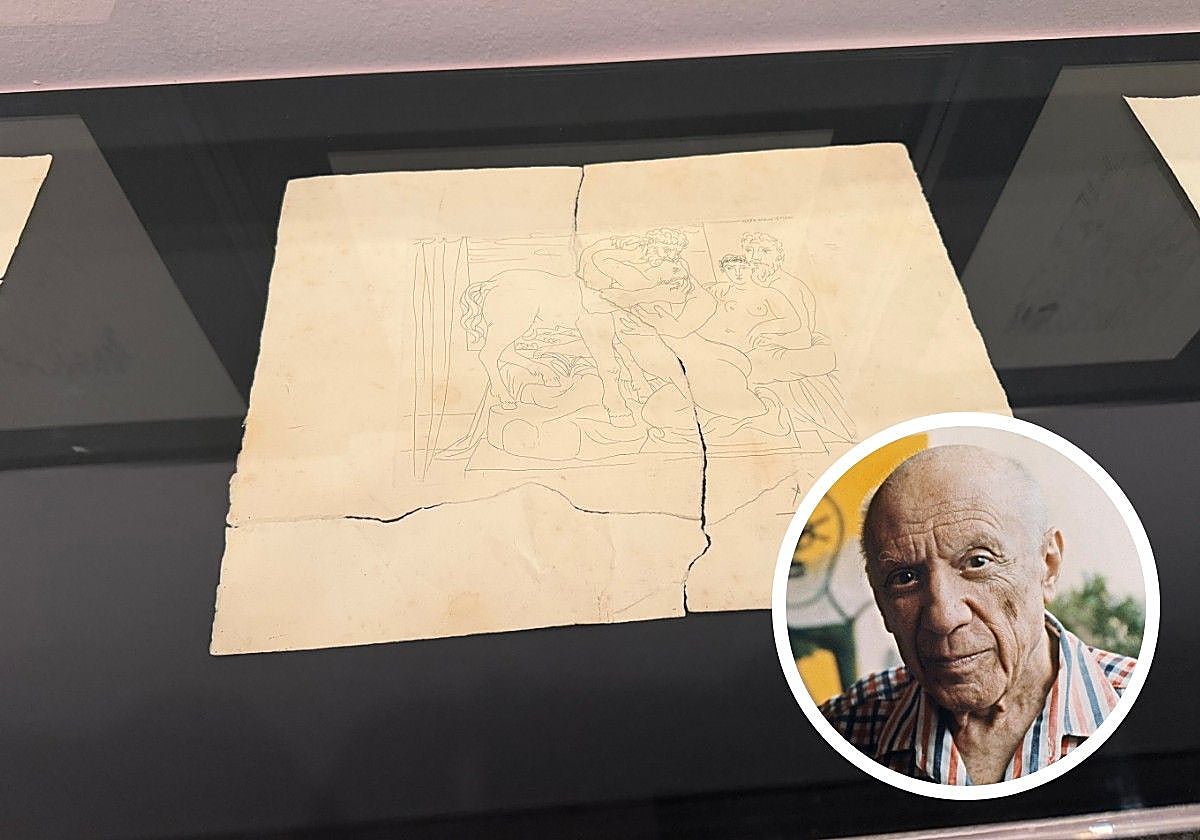

It was the end of 1971. Theo Gallery in Madrid was opening an exhibition of twenty-seven works by Pablo Ruiz-Picasso, which were part of the 'Suite Vollard' collection. Just after five in the afternoon, six men dressed in blue shirts and belonging to the far-right group Guerrilleros de Cristo Rey burst into the room to destroy the engravings of the artist from Malaga. Now, as if in a poetic settling of scores, the Reina Sofía Museum is recovering part of that collection, just steps away from the 'Guernica', as part of the 'Contemporary Art' exhibition.
Sixteen of the twenty-seven works displayed at Theo were destroyed. The attackers threw acid, smashed the pieces with mallets, and slashed them with knives. The gallery kept these devastated engravings as evidence of the unacceptable, something that has allowed the Reina Sofía to exhibit them alongside copies in perfect condition. The collection was inaugurated this Monday by the Minister of Culture, Ernest Urtasun, from the claim of the "ethical exercise of historical repair" that the recovery of these works represents "at a time when it seems necessary to remember the violence that intolerance brings."
Picasso and Franco detested each other. It was a public, undisguised hatred. The Andalusian painter, exiled, always declared himself a republican and even joined the Communist Party. His depiction of the bombing of the Basque town of Gernika became an international symbol against the dictatorship. The regime, in turn, promoted academic and national-Catholic art and associated modern trends with decadence and disorder, a narrow-mindedness that, over time, proved unsustainable.
Because Spain in the seventies, transformed by developmentalism and economic and tourist openness, was not that gray and stale country of the forties. And Picasso was already the most famous living artist in the world. Ignoring him or reducing his figure to that of a "degenerate" was culturally ridiculous, so the dictatorship designed a strategy to appropriate the painter by diluting his political commitment, a narrative in which Picasso never collaborated. In fact, he fought it. But there were even attempts by the Franco regime to have the 'Guernica', then at the MoMA in New York, return to Spain. The founder of Cubism, however, always conditioned that return: his most universal painting would only return home when there were public freedoms.
The initial disdain, in any case, had already led to certain forced recognition by circumstances, a shift that the most radicals considered a betrayal. Because the far-right never forgave Picasso for ridiculing the dictator in 'Dream and Lie of Franco', a series of cartoons where he depicted him as monstrous, clumsy, and subservient to money and the Church. Within that caricature logic, he even drew him copulating with a pig, something that the regime's most loyal followers never forgot. One of those radicals was Blas Piñar, founder of Fuerza Nueva. His role was decisive in the acts of vandalism against Picasso's engravings.
Piñar believed, according to documentation compiled by researcher Nadia Hernández, that the drawings exhibited at the Theo Gallery belonged to the series against Franco, not realizing that they were actually part of 'Suite Vollard'. Hence, that opening took the worst part of the wave of attacks organized at the end of 1971, coinciding with the genius's 90th birthday, against bookstores and galleries displaying his works. But in reality, 'Suite Vollard' was a commission by Ambroise Vollard, considered the great gallerist of modern art in Paris, and most of its production corresponds to the years before the Civil War.
They are etchings and burins of meticulous precision, almost surgical, where the artist from Malaga abandons the stridency of Cubism. There are no slogans or proclamations but mythology, eroticism, and workshop scenes. The minotaur traverses the series as a dark alter ego: sometimes violent, sometimes blind and vulnerable, always ambiguous. Picasso portrays himself as a classical sculptor, surrounded by naked models, in scenes that oscillate between contemplation and sexual tension. When the war broke out, the series was practically concluded, although in the last engravings, dated between 1936 and 1937, his sadness at the catastrophe can already be detected.
The engravings exhibited at the Reina Sofía, loaned by Theo, are part of an ambitious collection that occupies the entire fourth floor of the museum and includes works by other artists such as Dalí, Miró, Juan Genovés, Andy Warhol, Guillermo Pérez Villalta, and Cristina García Rodero. An ending that proves that art, sometimes, wins the battle against violence.

Latest news





Upcoming events
12
Nov
El Desembarco, la traición de Viriato at La Caja Blanca
12
Nov
HOMER El Mero Mero at Sala Trinchera Málaga
13
Nov
Marbella Startup Lab – Innovate & Collaborate
13
Nov
Candlelight: Coldplay & Imagine Dragons at Sala Fundación Unicaja María Cristina
13
Nov
Candlelight: Tribute to Ludovico Einaudi at Anantara Villa Padierna
Similar News

Málaga Airport Makes History with More Than Three Million Passengers in One Month
Málaga

Port of Málaga looks beyond its docks to support future growth
Málaga

Guide to the Virgen del Carmen Processions in Málaga and the Province
Málaga
