


It was the first stupa to be built in all of Spain, it is in this village in Málaga, and this hiking trail is great for discovering it.
The Kalachakra Stupa, located in the hamlet of El Trapiche, is a unique, singular spot in the province of Málaga, a realm of calm and peace. The most impressive route in Málaga when the snow arrives: winter ascent to La Maroma.
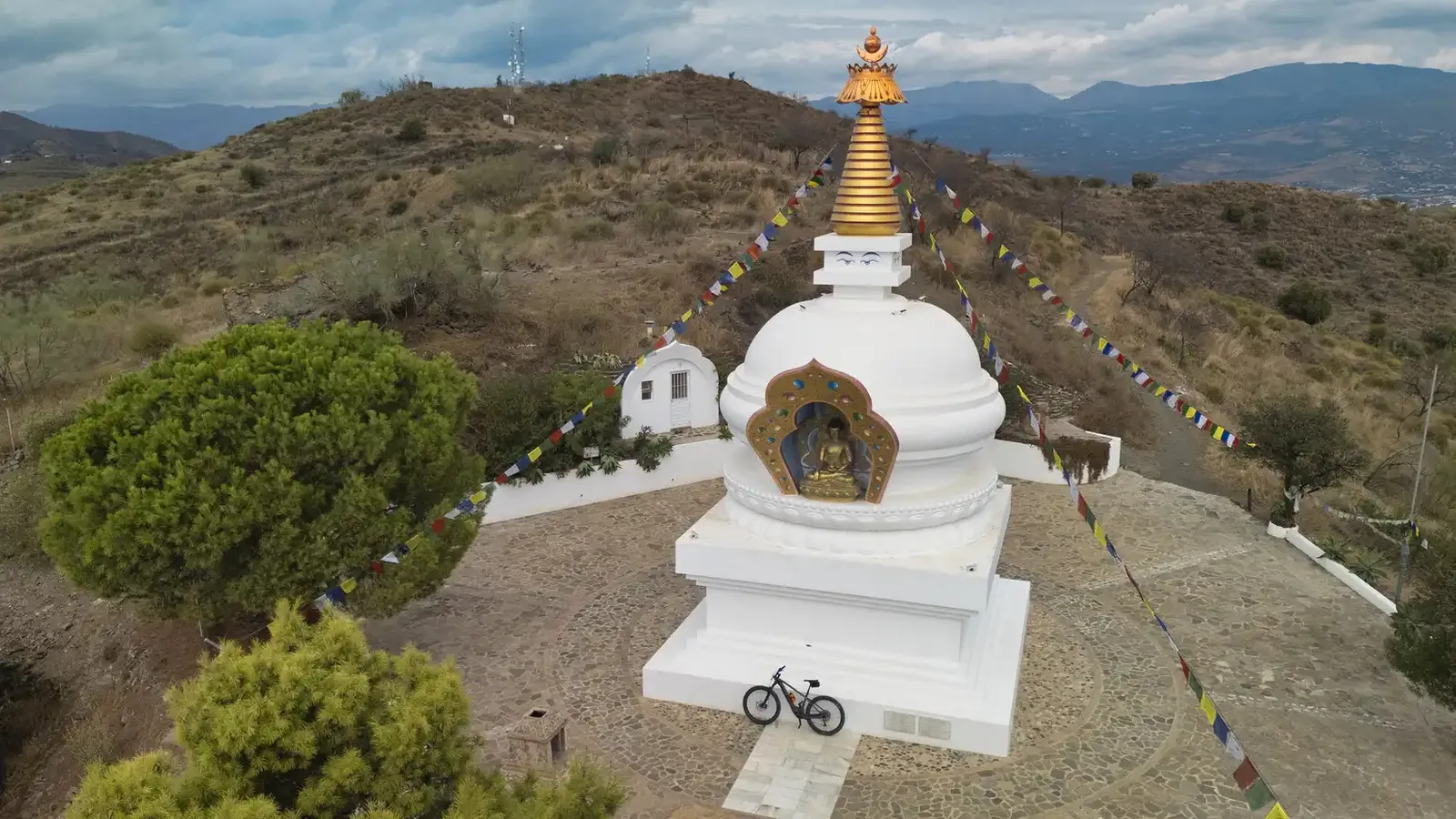

It was in the year 1994, when Lopon Tsechu Rinpoche, a Buddhist master from Bhutan, chose Vélez-Málaga, in the district of El Trapiche, to promote the construction of the first Stupa in Spain. Thus, among hills covered with Mediterranean scrub, accessible trails, and a horizon that blends sea and mountain, this unique enclave in the province was created in the Axarquía. As the path climbs up a winding hiking route, the surroundings become silent and the rocky terrain leads to an open esplanade under the sky where architecture, spirituality, and landscape merge at a single point, and there appears the Kalachakra Stupa, a Buddhist temple turned into one of the most unique spaces for hiking and landscape contemplation in the eastern interior of Málaga.
The stupa is located in the region of Axarquía, an area characterized by its rugged terrain, traditional crops, and an extensive network of rural roads. Specifically, it is situated in the district of El Trapiche, within a small group of buildings known as Aldea Alta, where the Karma Guen Buddhist center is located. In this environment, surrounded by the mountains of the sierra and with wide panoramic views towards the coast and inland, this construction rises, following the spiritual principles of Buddhism.
The hiking trail to the Kalachakra Stupa
Access to the Kalachakra Stupa can be made through various hiking routes of low difficulty, allowing the site to be reached without great physical demands. There are two usual starting points: from Los Romanes or from the district of El Trapiche itself. In both cases, the route runs along comfortable paths, with a gradual incline and no notable technical difficulties.
Powered by WikilocDuring the walk, the landscape opens up over gentle hills and slopes covered with Mediterranean vegetation. The trail progresses between stretches of dirt and paved areas, and the ascent gradually reveals the visual breadth that characterizes this sector of the Axarquía. The arrival at the final esplanade is announced by the arrangement of the trees and by the presence of a wide platform from which direct access to the stupa enclosure is gained.
A natural viewpoint over the region of Axarquía
Beyond its spiritual dimension, the stupa has established itself as one of the most comprehensive viewpoints in this eastern sector of the province. From its esplanade, direct views towards the sierra and the coast are obtained. To the north, the unmistakably high peak of La Maroma, the highest peak in the province of Málaga, integrated into the mountain range of the Sierras de Tejeda, Almijara, and Alhama, stands out.
Views from the Stupa. / sendalitoral.esIn the distance, the white profiles of Canillas de Aceituno and Comares are clearly visible, as well as the water mirror of the Embalse de La Viñuela. To the south, the landscape opens up to the Mediterranean Sea, with wide panoramas over Benamocarra and the core of Vélez-Málaga. From this elevated point, numerous towns in the interior of the Axarquía, such as Iznate, Almáchar, Cútar, Periana, Riogordo, and Alcaucín, among others, are also recognized.
The symbolic meaning of the Buddhist stupa
The Kalachakra Stupa is a monument that symbolizes the body, speech, and mind of Buddha, as well as the Buddhist doctrine as a whole. Each of its parts represents a cosmic and spiritual element.
Its square base symbolizes the earth. The hemispherical dome represents the celestial realm. Above it, the terrace alludes to the residence of the gods. The crescent moon, located at the top, expresses the union between heaven and earth. Finally, the chakras or discs that crown the mast decrease in surface as they gain height and represent the successive heavens.
The stupa is conceived, within the Buddhist tradition, as a space associated with social, economic, and spiritual well-being, the reduction of suffering, and the promotion of values such as peace, compassion, and harmony.
Traditional rituals and use of space
According to tradition, Buddhist practitioners perform three prostration greetings upon arrival and take a minimum of three clockwise turns around the stupa while reciting mantras. It is also common to remain in the vicinity for meditation.
Details of the Kalachakra Stupa. / sendalitoral.esHowever, the site remains open to any visitor, regardless of their beliefs, and presents itself as a space for personal reflection and recollection within a natural environment of great scenic value.

Latest news





Upcoming events
12
Nov
El Desembarco, la traición de Viriato at La Caja Blanca
12
Nov
HOMER El Mero Mero at Sala Trinchera Málaga
13
Nov
Marbella Startup Lab – Innovate & Collaborate
13
Nov
Candlelight: Coldplay & Imagine Dragons at Sala Fundación Unicaja María Cristina
13
Nov
Candlelight: Tribute to Ludovico Einaudi at Anantara Villa Padierna
Similar News

Málaga Airport Makes History with More Than Three Million Passengers in One Month
Málaga

Port of Málaga looks beyond its docks to support future growth
Málaga

Guide to the Virgen del Carmen Processions in Málaga and the Province
Málaga
