


Teenagers Out of Coverage
Malaga families defy social pressure and agree to delay giving a smartphone to their teenage children. "We don't want them to be digital zombies."
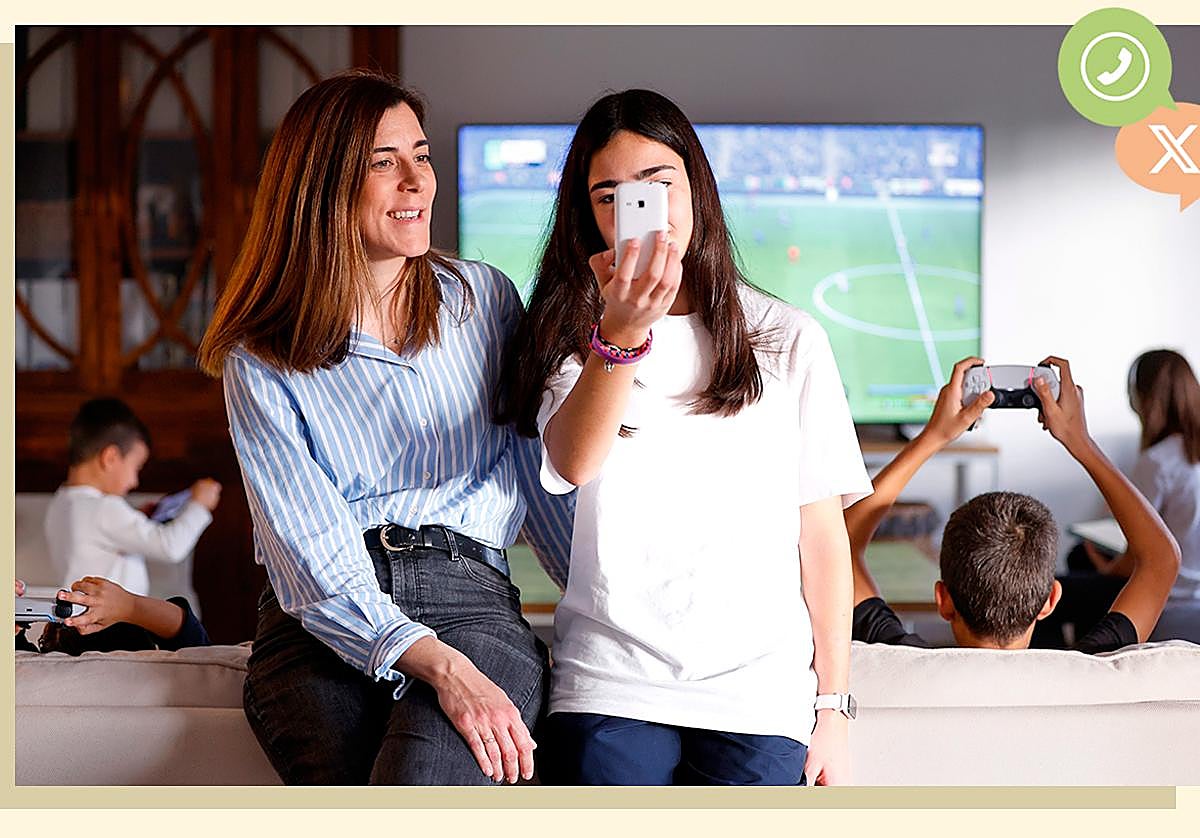

The figures speak for themselves: seven out of ten children in Spain between the ages of 10 and 12 have a social media account, despite the fact that the legal age for creating a profile is 14, revealing widespread non-compliance with the regulations. This has been denounced by the Spanish Society of Neurology, which warns that such early exposure to digital risks has consequences for the neurological development and mental well-being of minors. Other scientific authorities and a social movement (which began in Barcelona under the name Adolescencia Libre de Móviles, or Mobile-Free Adolescence, and was followed by others) have joined in, sounding the alarm three years ago: it was necessary to delay giving smartphones to minors until they were 16 or older and to implement real and effective regulation of digital technology use.
That is why, in Malaga, the Responsible Digital Education Association cannot quite understand the “commotion” caused by the announcement made by the Prime Minister, Pedro Sánchez, to raise the age of access to social networks when in reality there is already a ban on doing so (the limit is 14 years old) that is not being enforced. In any case, they appreciate that the issue is on the table, that this debate has been opened, and they trust that it will not ultimately be a “siren song,” that is, that digital platforms will truly be required to implement effective age verification systems. “We know that the Spanish Data Protection Agency has been working on this for two years,” adds its president, María Vidal.
A neuroradiologist at Malaga Regional Hospital and mother of two daughters aged 13 and 10, she feels in some ways that time has proven them right, although she was always very clear that she was doing the right thing when she argued that giving children free rein online could end in a binge with unpredictable consequences and that the harmful effect on their emotional control would take its toll. Regulation was needed, as it had been for alcohol, tobacco, and gambling, and they got to work.
Vidal now sees that the work they began in 2023, when she was labeled “eccentric” or “crazy,” has not fallen on deaf ears and that the denunciation of this movement, which thousands of families in the country have already joined, and the meetings with all the political parties to convey their concerns have served a purpose: “So now they can't take credit for it.”
Since December 2023, cell phones have been banned in Andalusian schools, but according to Vidal, thanks to greater awareness, teachers are becoming less and less like “policemen.” There are also more institutions that rely on them for guidance, because, as he warns, between everything (smartphones) and nothing (no digital or communication devices), there are many intermediate steps that can be taken, such as mobile phones without Internet access (only for making and receiving calls and SMS), parental controls on devices, or occasional consultations with a WhatsApp group on the parents' mobile phone to prevent the child from feeling left out.
In any case, no one said that this crusade would be easy at a stage, adolescence, that is already complicated in itself. Studies show that for one in two families, managing screen time is the main problem in family life, “because once the child has their own smartphone, it is very difficult to control them and the conflict begins.” Communication and shared responsibility, so that not everything falls on families, are key to ensuring that young people do not end up as “digital zombies,” addicted to scrolling in search of instant gratification. SUR spoke to three families in Malaga who explained why they decided to keep their children off social media.
As the mother of a large family, Blanca López spent some time considering whether giving the eldest of nine siblings a smartphone was the best thing for her when she started high school, which is when the issue usually arises in families. She is now 13 years old and in her second year of secondary school, and like most teenagers around her, she asked for a cell phone when she started high school. And she got one, but it was a simple phone, without Internet or social media. “They call it the ‘mobile grandpa’ in class.” It was a carefully considered decision based, above all, on one key question: does she really need it?
There was no urgency for her to dive into a digital ocean full of risks, and faced with the argument that “everyone else has one,” they opted for analysis. And in that balance, the cons outweighed the pros, including the fear of overexposure that would make the minor vulnerable. “It's not so much the inappropriate content as the fact that it opens the door to anyone.” The internet, she sums up, “is an uncontrolled space for someone who is still developing.”
The family was also aware of the addictive nature of the device. Blanca speaks from her own experience. “I'm the first one who finds it hard to put my phone down,” she admits. Work, family, school, extracurricular activities... “everything happens there.” And if an adult finds it hard to disconnect, “how can we ask a 13-year-old girl to manage it better?” Blanca admits her own guilt, but she is clear that “it is up to us as families to educate” and asks herself: “What good is a government ban if we as parents don't set an example?”
That's why technology is used under supervision in her home: if a tablet with an internet connection is needed for schoolwork, parental control tools (Family Link) are used, and it is always done in common areas of the house. She works on building trust and communication with her children to guide them in digital learning. For example, if an app needs to be downloaded, she consults with them beforehand and works on permissions.
The formula has worked so far. Her daughter socializes normally: she meets up with her friends, plays on a basketball team, and when she needs to, she makes phone calls, sends messages, and uses email for schoolwork. “She's not isolated,” her mother insists. “She communicates, just in a different way.” Her friends and family know that we are more restrictive with her, but they understand. “She is respected, and that respect has not come from a cell phone, but from who she is: a good student, a good classmate, and a good friend.”
Despite everything and although she has accepted the decision, the minor expresses her desire to have a cell phone with Internet access whenever she can. It is the price of social pressure. “As soon as you can, can you buy me one?” she asks her parents, who are open to considering it in the future. The decision, Blanca emphasizes, is not final. “We're not the Taliban.” There is no set age for a smartphone, but they know that this “is a countdown.” “Her siblings are behind her and taking note.” But in the meantime, at home, they prefer to take it slowly. They will act according to need, not according to a schedule. “When he really needs it, we'll talk about it.” For now, the cell phone serves its purpose: location, safety, and basic communication.
Their son is 12 years old and has just started his first year of secondary school. Every morning, he takes the bus to school. He wears a smartwatch with GPS on his wrist. It's not a whim or a precursor to a smartphone: it's the compromise his parents came to after much thought. “His own cell phone? No,” his father clarifies. “He's used mine a few times to check a soccer score or to send a WhatsApp message to a friend's mother to arrange a get-together,” explains Jacob Torres. The debate, as in many other homes, began with the move to secondary school. More independence, more trips alone, more need for communication. They considered a smartphone with parental controls. They ruled it out. “We thought it was too soon.” The alternative was a smartwatch with geolocation and an app that only allows calls and messages from authorized contacts. “Mom, Dad, grandparents, some relatives. No one else.”
Parents manage the device from their own cell phones: they activate or deactivate functions, set schedules (during school hours they keep it locked) and restrict calls. The decision, they insist, has nothing to do with mistrust of their child, who they say is a good kid, sociable and a good student, but rather with the risks of the digital environment. “The main fear is contact with outsiders he doesn't know at all,” she explains. “That through a game or an app, someone could reach him for dubious or illegal purposes.” She is also concerned about content. “An iPhone 16 for a 12-year-old doesn't make sense to me,” she says. "And even if you set up parental controls, there are a thousand apps to bypass them. They know all the tricks.“
For now, that's how it is; the child doesn't have WhatsApp and isn't in any class groups. ”He wanted to give my cell phone number to his friends so they could add me to their groups and he could be indirectly connected, but I refused. I made him understand that a cell phone is personal and that if he needed to make plans, he should do it in person." The child kept asking why his friends could have it and he couldn't. “We explained that he's not old enough, he's not ready, and he's not mature enough to handle the amount and type of information he might receive, and he accepted that.”
At home, digital rules started much earlier. “Since he was little, he's had very little contact with screens.” Video games also have limits: one hour on Friday, one on Saturday, and one on Sunday. No online gaming with strangers. “No playing with some guy in America who we don't know. If he plays soccer, I'll play with him.”
At home, they are not afraid that their child will be left behind technologically. “We want to see how he matures. This has to be done little by little.” If one day he gets a smartphone and doesn't follow the rules, they are clear that they will backtrack.
In the meantime, his free time is divided between soccer practice two days a week, reading, crafts, and computer design. And something that his father claims is almost a rarity: knowing how to wait. "We put up with crying in restaurants and on planes without giving him a cell phone when he was little.
He learned that everything takes time, to develop patience, without frustration or demands.“
For Jacob, the government's proposal to delay access to social media until the age of 16 comes a little late. He believes that cell phones can be useful; the problem is the platforms. ”On many sites, they just ask if you're over 18, you accept, and you're in. There should be real control."
He works in healthcare and is concerned about the increase in mental health problems among young people. “We are not aware of how harmful it can be.” That's why they decided to take it slowly and work together at home. “We have to be on the same page,” he says about the agreement with the mother who, although separated from him, tries to be in sync with him in raising their child.
Belén Vidal will never forget the day she decided to take away her ten-year-old daughter's cell phone. “We've messed up,” she thought when she read the messages. What had started as a measure to gain peace of mind (a simple phone with WhatsApp and calls for when the girl went to the supermarket alone) ended up becoming an early and painful lesson about digital risks.
Belén's eldest daughter had always been “very mature for her age.” So when she started running small errands on her own, her parents decided to give her a basic cell phone. “It was the cheapest one available, just for calling her or making a quick video call,” explains Belén. When she got home, they always took it away from her; she only used it on specific outings. But one day, at a family gathering, a teenage friend of a cousin asked for her number. She gave it to him without anyone knowing.
Soon after, a mother called her, alarmed, warning her that this boy had started writing “very obscene things” to her daughter, with an increasingly uncomfortable tone and explicit and irreverent proposals. He had written phrases such as “you are very pretty” or “we can meet up” to her daughter. “When I saw the other girl's conversation, I was stunned,” says Belén. Although her daughter did not read the most serious messages, the beginning was the same. “I knew it would go further.”
So she made a radical decision: to take away her cell phone. But first she needed her to understand why. “I pushed her to the limit,” she admits. She explained bluntly what could be hidden behind those kinds of messages. "Imagine if instead of this boy it had been an adult. Imagine that he wants to touch you,“ she said. The girl burst into tears: ”I don't want that, it's disgusting." For Belén, it was a very difficult moment, but a necessary one.
The cell phone disappeared from her routine for years. Taking it away was not just a technological measure, but a form of emotional protection. The girl went to a psychologist and developed a certain distrust of her surroundings.
Over time, and after much discussion and support, they decided to give it back to her in her first year of secondary school. Not out of complete conviction, but for balance. “I don't think she's mature enough, but we talk about it a lot,” she explains. The previous experience set the rules: exhaustive parental control, supervision of conversations, cell phones in common areas, prohibited during meals and before bedtime, and no creating profiles on social media. “In my house, we have a ‘cell phone parking lot’ in the entrance. You come home and leave it there.”
Even so, the fear doesn't go away. “What worries me most is that someone she doesn't know will talk to her and she'll strike up a conversation.” The difference now is that she tells me about it. “For now, she tells me everything,” she says.
Belén believes that the key is not just to prohibit, but to educate. But if she could go back, she is clear: she would delay the cell phone. “Children are not ready to manage everything that is in there.” And that early, painful, and controversial withdrawal was the first step for her to understand it.

Latest news





Upcoming events
12
Nov
El Desembarco, la traición de Viriato at La Caja Blanca
12
Nov
HOMER El Mero Mero at Sala Trinchera Málaga
13
Nov
Marbella Startup Lab – Innovate & Collaborate
13
Nov
Candlelight: Coldplay & Imagine Dragons at Sala Fundación Unicaja María Cristina
13
Nov
Candlelight: Tribute to Ludovico Einaudi at Anantara Villa Padierna
Similar News

Málaga Airport Makes History with More Than Three Million Passengers in One Month
Málaga

Port of Málaga looks beyond its docks to support future growth
Málaga

Guide to the Virgen del Carmen Processions in Málaga and the Province
Málaga
