


The Pool, Prehistory Laboratory: technology reveals unpublished images of the cave
Recent research triples the cave art in the grotto by detecting paintings invisible to the human eye and allows viewing the cavity as never before with a 3D reconstruction of its galleries.
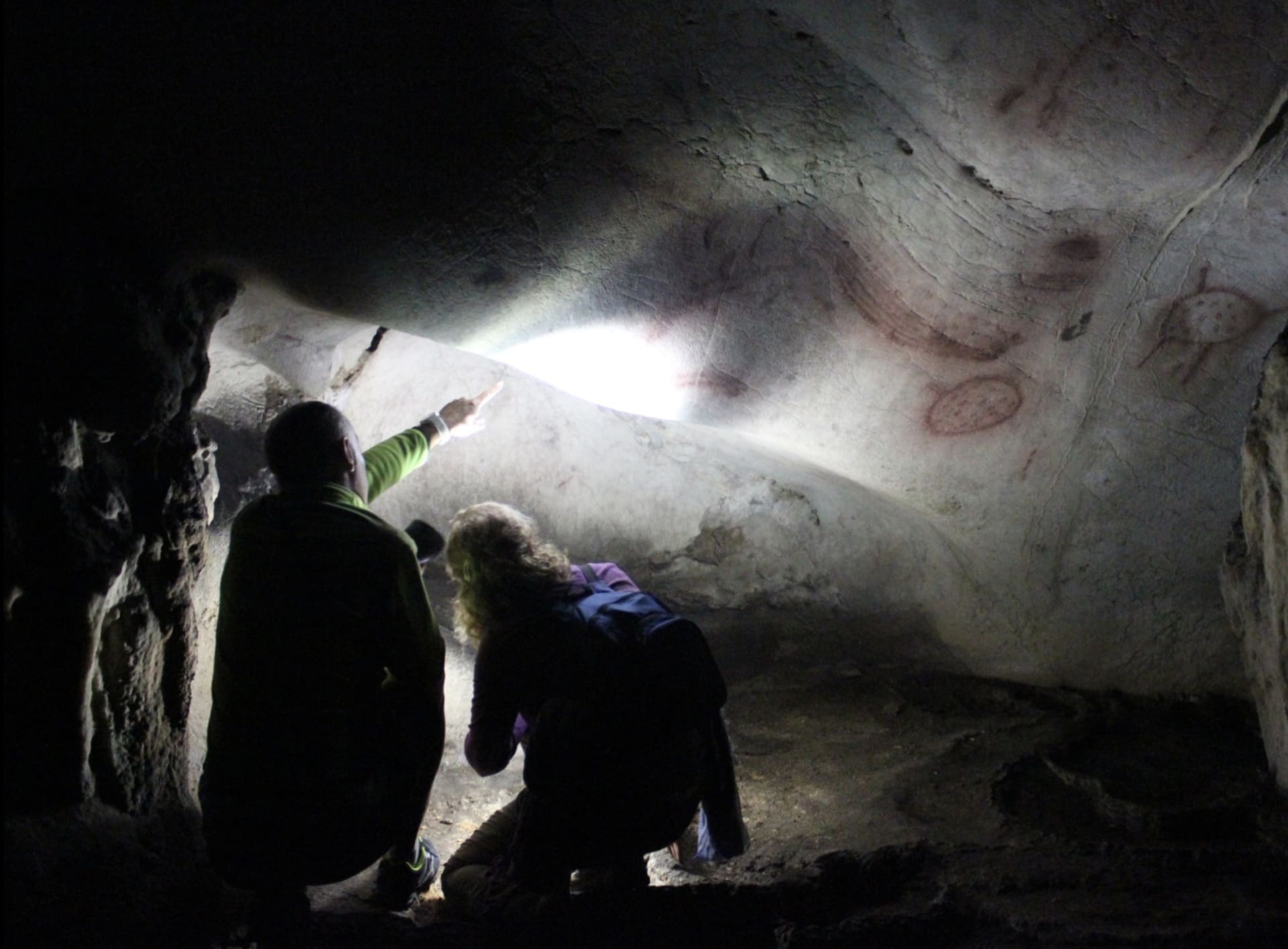

At first glance, only a couple of red strokes can be distinguished and an animal shape can be sensed in one corner. The human eye is unable to see anything else on that wall measuring just twelve square meters, hidden in one of the galleries of the Pileta Cave. But now we know that this small panel was a recurring canvas for prehistoric human groups who returned to this place time and time again. Their markings appear up to 16 times. New technologies allow us to resize the cave art in the Benaoján cave to see it as never before. Some time ago, the first fieldwork carried out by a team from the University of Seville revealed that the more than 800 motifs documented by Henri Breuil at the beginning of the 20th century fell short of everything that the cave had to offer. Today, they can confirm that their research has tripled the number of known cave paintings.
La Cueva de la Pileta is establishing itself as the cave in southern Spain with the most cave art, adding new signs, marks, and animals to the already iconic paintings of the pregnant mare, the fish, the goat, and those known as ‘the turtles’. And it does so with the cave converted into a prehistoric laboratory where cutting-edge processes and technologies are applied to the most primitive human traces to unravel their mysteries. While sophisticated computer programs reveal unprecedented artistic expressions, another project reconstructs the interior of the cave in 3D with a simple iPhone capable of entering inaccessible galleries and infinite wells.
“Technology has revolutionized everything,” confirms María Dolores Simón Vallejo, professor of Prehistory at the University of Seville. From such basic issues as lighting, which is now non-destructive to the paintings, to advanced processes that decode the images on the screen, revealing unknown figures and shapes. The difference compared to just 20 years ago “is enormous,” says the researcher from La Pileta.
A high-powered computer spent three hours processing the thousands of photographs taken of that panel, which surprisingly went from four visible motifs to 16. “When it finished and two caprids and a mountain goat appeared, we couldn't believe it,” recalls the archaeologist. This ‘revelation’ has been repeated on several walls at La Pileta, with analyses pending publication in scientific journals. Behind this progress is the work of researcher Rubén Parrilla, who has developed a computer program capable of grouping the pigments detected in an image. Hundreds of photos are taken per square meter, forming a kind of mosaic with micro-fragments of the wall. “Each photograph detects a part of the pigment and the program groups them together so that the figure appears.” It does not complete anything, Simón clarifies, because that would be recreating what was there. “What we are doing is documenting what is there. The real, not the imaginary,” he points out.
In this way, they have detected hundreds of marks and figures that the human eye could not identify, numbering close to 2,000. The oldest dating goes back to the Gravettian period, some 30,000 years ago, and they know this from the portable lamp they used to paint in the cave. In a fossil shell, which served as a prehistoric candlestick, they found the remains of the pigments that the individual had in his hands. The authors would therefore be some of the first sapiens in the south of the Peninsula. For the moment, there are no Neanderthal remains at Pileta. They know that there is a Middle Paleolithic (Neanderthal) level that they have not yet accessed and that they want to excavate this summer. “But we have not detected any paintings or engravings in the cave,” he says.
Among the new rock art motifs, there is a significant group of positive handprints, one of the recurring signs for Upper Paleolithic human groups, their way of literally leaving a mark in space with their palm impregnated with pigment. “With these new methodologies, we have tripled the number of hands in La Pileta.” But they have also documented goats and aurochs that were not previously catalogued. And above all, new signs, punctuation marks, lines, composite signs, mobility marks...
A huge number of paintings corroborate the theory that La Pileta was a place of aggregation, a “crossroads” of symbolic paths, as the team from the University of Seville has titled the project it is currently working on. The Benaoján cave was occupied for a long period, from 30,000 to 4,000 years ago. That is, from the Upper Paleolithic to the Bronze Age. “It has enormous significance as a symbolic place. Many groups passed through and left their ideas in the cave.” According to some authors, it was probably a meeting point at certain times of the year or from time to time; a place to gather, perform ceremonies, or exchange partners.
Researchers are analyzing the overall significance of this cave in the interior of the province as they scrutinize its galleries. Technology is also a decisive ally in this endeavor. With the help of a simple iPhone, researchers have managed to create a 3D reconstruction of La Pileta, providing a previously unseen view of inaccessible places. Since Breuil discovered the cave in the early 20th century, its topography had been mapped by hand, without much precision, and with successive updates based on information provided by speleologists. However, a complete scan was needed to allow for a rigorous analysis of the cave and to obtain a topography that would be useful for studies in prehistoric archaeology.
In this case, experts have turned to LiDAR technology for 3D digitization using two tools: a professional terrestrial laser scanner and—here's the novelty—an iPhone. The former was used to record the route from the Reina Mora gallery to the Gran Sima area, a deep ravine that stretches as far as the eye can see. The 1.5 billion points recorded make up a map on the screen “with only 7 millimeters of error” in which the stalagmites, the curvature of the walls, and the cave paintings can be seen with complete accuracy.
"But how do we record the ceilings? We can't. We would have to set up scaffolding in the cave. The terrestrial laser scanner is mounted on a tripod. It's impossible to place it in a chimney in the cave or in a shaft where everything is a vertical wall,“ explains Daniel Antón, a researcher at the Higher Technical School of Building Engineering at the University of Seville. And that's where Apple's smartphone comes in. ”The iPhone provides maneuverability." Speleologist Juan Mayoral, co-author of the work with Antón, uses a special iPhone holder with symmetrical lamps that illuminate as he scans, allowing him to reach places that are impossible for a conventional scanner, perfectly capturing the network of galleries and the enormous unevenness of the surface. “Never before has such an extensive 3D digitization of a cave been done. And even less so with a mobile device,” celebrates the engineer.
The advantages are obvious. At the operational level, LiDAR technology combined with an iPhone “greatly” reduces costs. On the other hand, from a scientific point of view, it makes La Pileta accessible to any researcher who can review every nook and cranny of the cave from their computer. Indirectly, it helps to preserve the paintings, which, being recorded in high resolution, makes on-site visits unnecessary, as these are always very restricted due to the fragility of the cave art. And finally, it contributes to the dissemination of heritage. “It allows children, the elderly, and people with disabilities to see a place that they would otherwise not be able to reach. And that democratizes knowledge,” concludes archaeologist María Dolores Simón.
The rock art we see today is only a small part of what prehistoric human groups left on the walls. There are figures, signs, and marks that the passage of time has erased forever, but many others remain there, faint and subtle, sometimes undetectable to the human eye in environments that are already dark and difficult to access. Technology helps to bring them to light by enhancing the colors and contrasts in photographs that suddenly reveal the traces of the past. Caves such as Nerja and Las Suertes in Antequera use digital tools to improve the visibility of cave paintings, in this case applying the D-Stretch plugin for ImageJ.
The result is surprising. In the Nerja Cave, in the Belén room, on a wall where only red marks can be seen, a Gravettian deer and a Solutrean horse have been discovered. In another of its rooms, the Columnas de Hércoles, computer processing has brought out the yellow horse, whose features can now be easily distinguished. In Las Suertes de Antequera, a faint line has been transformed into a clear red bar.

Latest news





Upcoming events
12
Nov
El Desembarco, la traición de Viriato at La Caja Blanca
12
Nov
HOMER El Mero Mero at Sala Trinchera Málaga
13
Nov
Marbella Startup Lab – Innovate & Collaborate
13
Nov
Candlelight: Coldplay & Imagine Dragons at Sala Fundación Unicaja María Cristina
13
Nov
Candlelight: Tribute to Ludovico Einaudi at Anantara Villa Padierna
Similar News

Málaga Airport Makes History with More Than Three Million Passengers in One Month
Málaga

Port of Málaga looks beyond its docks to support future growth
Málaga

Guide to the Virgen del Carmen Processions in Málaga and the Province
Málaga
