


A docuseries uncovers the secrets of the failed Montejaque dam that keeps the inhabitants of the mountain range on edge.
Filmmaker José Luis Matoso spends 15 years on this production which uncovers unprecedented details of a flagship project that became the biggest engineering failure of a century ago.

There are coincidences that not even a script can improve. Just ask director, screenwriter, and producer José Luis Matoso, who has spent fifteen years dedicated to the project of telling the story of the Montejaque Knights' Dam, a flagship project in Europe a century ago that became the biggest engineering failure of its time. The filmmaker premieres his docuseries, 'The Cat and the Knights', next Friday in Ronda (Convento Santo Domingo, from 4:30 PM), just when this ghost infrastructure has returned from the past to become highly topical. Thus, the cover of SUR this Sunday reproduced this dam that has filled to critical levels due to the storm train that has battered Andalusia in recent days and has caused the inhabitants of Estación de Benaoján to have to evacuate the neighborhood to prevent a flood from the overflow of the dammed water.
Expand
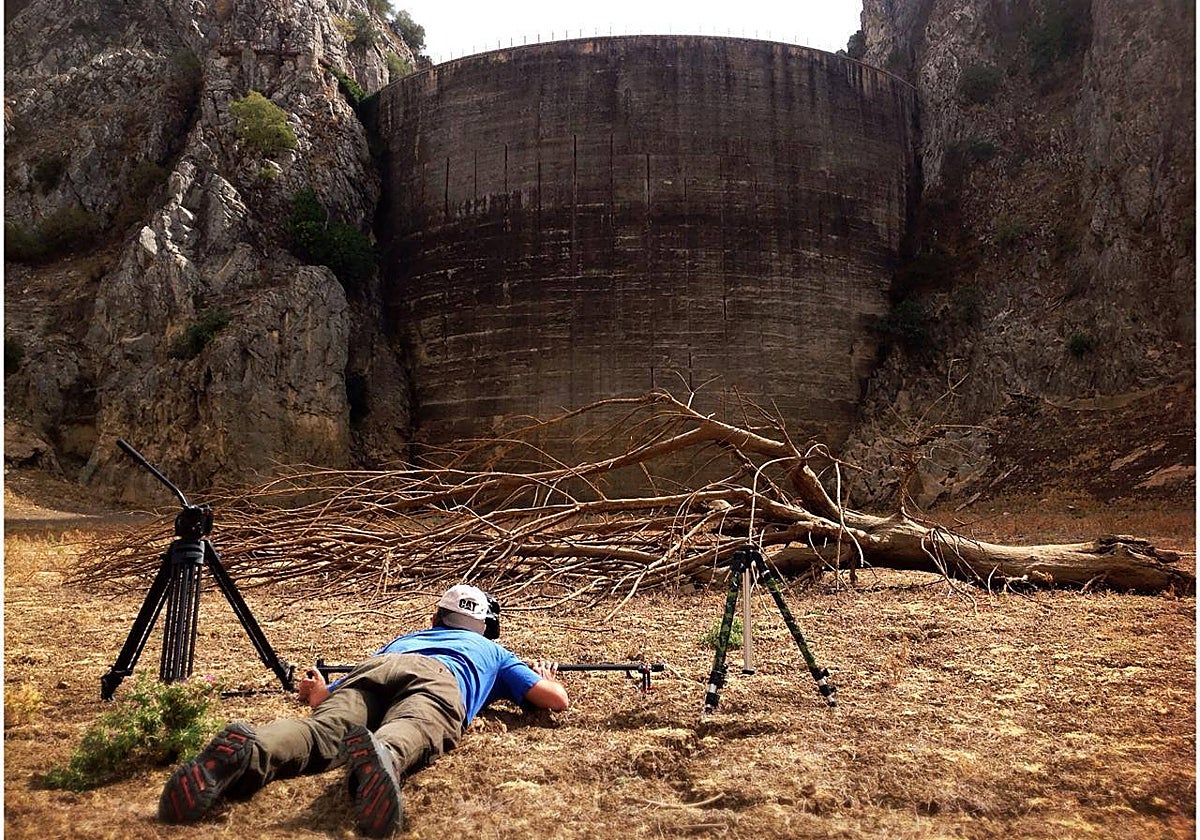
Director José Luis Matoso, filming next to the dam, which can be seen in the background. SURA "tragic topicality," as José Luis Matoso calls it, who is already celebrating that the worst - for now - has passed. Indeed, the director, probably the greatest connoisseur of this infrastructure, has become the expert to consult these days. "I've been bombarded with messages," confesses the filmmaker with a smile, who precisely involved the local residents in the making of his documentary series and now, all of them wanted to know his opinion. So, we asked him too. "The key question is whether the dam will break, and it's hard to know. The technicians are telling us no, and what I can contribute is that the Knights built it with the best Swiss and German companies with an arch structure design that was pioneering at the time and that time has proven to work excellently well," summarizes the director, who uncovers the secrets of this lavish infrastructure that, unexpectedly, turned out to have feet of clay.
In his docuseries, Matoso, who has worked for 'Documentos TV' and is the author of documentaries like 'The Store at the End of the World' and 'Not One Step Back', delves into the origins of this business failure of the Sevillana company, which placed its major electric power generation project in this dam in the 1920s. And he discovers that, despite its Spanish name, the energy company was originally German-owned, but as the end of the Great War approached and to avoid the confiscation of German interests abroad, Sevillana was sold to Swiss investors, who were the ones who finally took over the construction of the Knights' Dam in 1923.
Related News
This is the ghost dam that forced the evacuation of 200 people in Malaga a century after its construction
After the construction, the surprise was that the reservoir began to empty without apparent reason. The answer lay beneath the dam's floor, where two caves, Gato and Hundidero, allowed the water to filter through due to the karstic and porous nature of the soil, with numerous cracks forming the so-called "funnels," which are shown in the documentary.
In fact, the key figure of the project was Heinrich Grumer, the Swiss engineer who designed the concrete arch dam with the latest advances of the time. When it was completed, with its imposing 80-meter wall rising in the middle of the mountain range, the first rains came and it filled up. The surprise was that, without apparent reason, the reservoir began to empty. The answer was beneath the floor of the dam, where two caves, Gato and Hundidero, allowed the water to filter through because the soil was of a karstic and porous nature, with numerous cracks forming the so-called "funnels," which are shown in the documentary.
The Discovery of the Caves
To remedy the failure, the docuseries reveals a fundamental discovery by demonstrating that the Gato cave and the Hundidero cave were actually the same cavity. "There was suspicion, but no scientific certainty," reveals Matoso. Thus, the construction director, also Swiss, sent a group of workers through one entrance and another group through the other. The Swiss manager himself joined one of the expeditions and took his young 13-year-old assistant from Benaoján, Joaquín Guerrero, who accompanied him. "I knew of the boy because the newspaper SUR published his story in 1987," recounts the director of the docuseries about this character who later became a civil guard and traveled across half of Spain with his assignments. "I spent three months looking for him and finally found one of his grandsons who turns out to have studied at my same high school," explains José Luis Matoso. And although the youngest protagonist who lived through that discovery had already passed away, he left a gift for the filming.
Expand
To the left, Joaquín Guerrero, the boy who witnessed the discovery that Hundidero-Gato was the same cave and who left written this episode (right). SUR"Joaquín had written a 30-page account of that expedition which is the only first-person testimony of the discovery. Suddenly, he came to us like a ghost from the past to give us this great moment," says the director, explaining how in those memoirs titled 'My Journey Through the Depths of the Earth,' it was recounted that, when both groups of explorers met and confirmed that it was the same cave, "they started to dance and sing flamenco." After this, the company and the Swiss engineer tried to seal the multiple cracks from inside the caves, but they eventually gave up. Nature cannot always be tamed.
The docuseries reveals the discovery that the Gato cave and the Hundidero cave were the same cavity. "There was suspicion, but no scientific certainty," reveals Matoso
'The Cat and the Knights' includes testimonies of the earthquakes that occurred when the dam was filled, like those that have recently occurred in Grazalema with the aquifers during the storm train
The docuseries also reveals an episode that has become topical these days: the earthquakes caused by the collapse of the aquifers that keep the town of Grazalema evacuated. The same happened in the Malaga mountain range and Benaoján when the Knights' dam began to fill and reached a height of 50 meters. Up to nine induced earthquakes occurred due to the filling, which also alerted the population, as recounted by the descendants of those who experienced those tremors. A series of inconveniences, calamities, and lack of foresight that made the flagship engineering project of early 20th-century Europe a great failure.
Expand
A moment from the filming of 'The Cat and the Knights' with locals who have collaborated on the documentary. SURMatoso tells all this with a certain sense of triumph. Not only for the happy ending of the decade and a half invested in 'The Cat and the Knights', but for the support and involvement of the locals in the production. "I am from there, and without them, it wouldn't have been possible," assures the filmmaker, who even organized a filmmaking course, from which three of the indispensable collaborators of the filming emerged. The film has already been screened in Benaoján and Montajeque and next Friday it will be shown in Ronda, with free admission, while finalizing its premiere in Ubrique, Granada, and Malaga. Not a fan of platforms like Netflix, Matoso says that the production system of these operators is the antithesis of this "story with a capital 'S'" filmed in an "artisanal" way. When he finishes with the screenings, he is thinking about how to make it available to all viewers. "If necessary, I'll set up my own platform," he asserts defiantly. Seeing that he has managed to shoot his docuseries without any help, it's not out of the question that he might end up inventing 'Matoflix'.

Latest news





Upcoming events
12
Nov
El Desembarco, la traición de Viriato at La Caja Blanca
12
Nov
HOMER El Mero Mero at Sala Trinchera Málaga
13
Nov
Marbella Startup Lab – Innovate & Collaborate
13
Nov
Candlelight: Coldplay & Imagine Dragons at Sala Fundación Unicaja María Cristina
13
Nov
Candlelight: Tribute to Ludovico Einaudi at Anantara Villa Padierna
Similar News

Málaga Airport Makes History with More Than Three Million Passengers in One Month
Málaga

Port of Málaga looks beyond its docks to support future growth
Málaga

Guide to the Virgen del Carmen Processions in Málaga and the Province
Málaga
