


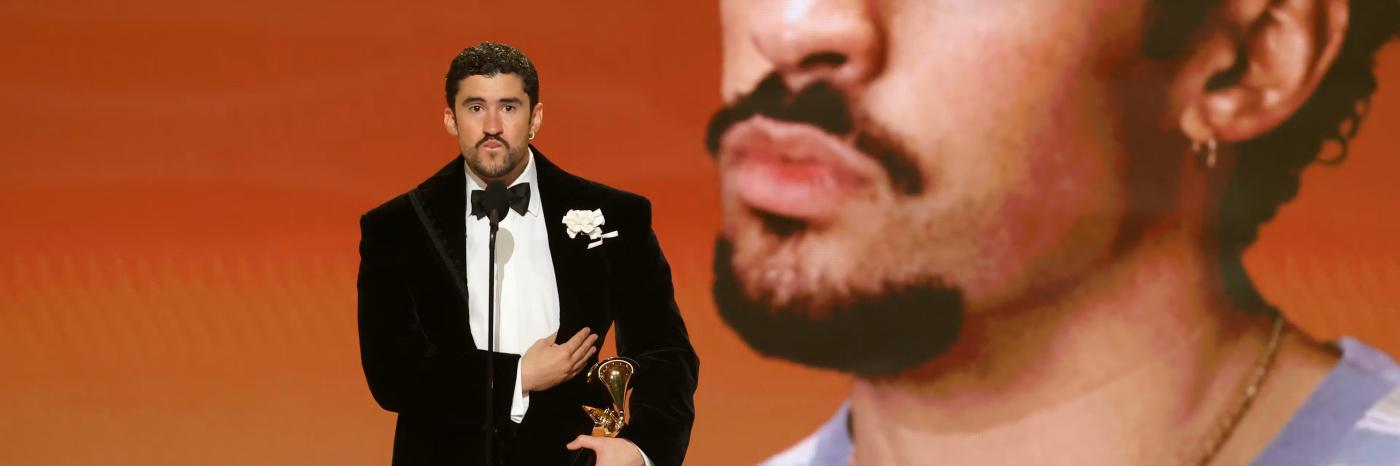

With these words, Bad Bunny confirmed in September 2025 that he would be the artist in charge of the Super Bowl halftime show. The reference to “those who came before” does not point to an individual career, but rather to a shared history—to accumulated trajectories, to prior presences that made that moment possible.
And, above all, to a language such as Spanish, which for decades has occupied a paradoxical place in the United States.
The United States is the fifth country in the world with the largest number of Spanish speakers. However, it is the only one among those five where Spanish is a minority language in the face of the dominance of English. In other words, although Spanish has been omnipresent in many U.S. contexts—such as work, music, or the everyday lives of millions of people (more than 43 million, according to the 2023 census)—it has also been a language carefully depoliticized in spaces of national representation.
In the United States, one in five people is of Hispanic origin, yet, for example, only 6 out of its 100 senators share that background. Spanish is audible, but it is contained.
A hidden language
Bad Bunny, Puerto Rican and therefore an American citizen, has already announced that his concert will be performed entirely in Spanish. That this year’s Super Bowl will sound in that language is not just any cultural event. This is one of the most significant national rituals in the United States, a stage where a particular idea of the country is represented and normalized. In this context, the emergence of a language other than English cannot be read as a neutral gesture.
What does this mean, then?
Our mission is to share knowledge and enrich debate.
Who are we?
The answer is not simple, but the fact itself is powerful and symbolic. According to an analysis conducted by the U.S. Census Bureau’s 2023 American Community Survey (ACS) Data Center, 78% of Americans aged five or older speak only English at home. The remaining percentage is divided between those who speak English very well but do not use it at home (14%) and those who do not speak English well.
Moreover, Spanish in the U.S. is considered a “heritage language,” spoken primarily within households and subordinated to the dominant language. Thus, in Spanish-speaking homes, as more generations are born, the heritage language gradually fades in favor of English.
In this context, it is also important to note that since March 2025, following an executive order by Trump, English has been declared the official language of the United States—something that had not been established in nearly 250 years of the country’s existence.
This “officialization” has been accompanied by a deliberate reduction in public services, progressively eliminating most non-English information and seeking to reinvest that funding in programs aimed at learning English. The effects are already visible, such as the closure of the Spanish-language version of the White House website or the LEP.gov portal.
Would you like to receive more articles like this? Subscribe to Suplemento Cultural and receive cultural news along with a selection of the best articles on history, literature, film, art, and music, curated by our Culture Editor, Claudia Lorenzo.
Spanish in the world
While official state channels are restricting the use of Spanish, sports and music are now granting it a visibility that extends beyond U.S. borders.
Super Bowl halftime performances have become cultural events with enormous international reach. This has been the case for superstars such as Michael Jackson, Madonna, Lady Gaga, Katy Perry, and Usher. The format has established itself as a space for the celebration of diverse identities, characterized by high technical production standards and strategic collaborations among musical artists beyond pop.
In the 2025 edition, Kendrick Lamar reached a record audience of 131.2 million viewers, surpassing even the viewership of the game itself.
For Bad Bunny, this will not be an individual conquest nor an unprecedented experience, as he already participated as a guest artist in 2020 during Jennifer Lopez and Shakira’s performance in Miami. That show was, in fact, the most-watched in history prior to Kendrick Lamar’s, and according to YouTube data, its official video is the most-viewed halftime show on the platform.
What impact could Bad Bunny have?
Bad Bunny has acquired a leadership position within the global music industry that cannot be considered circumstantial.
He has just won the Grammy for Album of the Year with DeBÍ TiRAR MáS FOToS, and on Spotify he has achieved the title of Top Global Artist on four occasions, with more than 27 million recurring listeners. These figures have made him the artist who has received this recognition the most times, ahead of figures such as Drake or Taylor Swift.
His entire catalog has already surpassed 19.8 billion global streams, averaging more than 60 million streams per day. Translated into temporal scale, listening consecutively to all the streams generated by the Puerto Rican artist in a single year would require more than 124,000 years—a magnitude that illustrates the distance between this type of phenomenon and conventional cycles of musical success.
Image of Bad Bunny’s album on Spotify displayed on a mobile screen.
The world loves Bad Bunny on Spotify. McSleepy/Shutterstock
The National Football League (NFL) is not unaware of these numbers and, despite the rejection the singer provokes within the U.S. government, it seeks to appeal to Latino audiences through his participation in this year’s Super Bowl. But the question is not what Bad Bunny can do for the NFL, but rather what the artist’s exposure at this global event can do for the Spanish language.
According to data from the online language-learning platform Preply, in the 24 hours following the announcement that he would headline the Super Bowl halftime show, searches for “Spanish classes” from the United States increased by 178%. Searches for “Bad Bunny lyrics in English” also rose by 366%.
These figures serve as indicators of a phenomenon that is reshaping Latino culture and the Spanish language—one that does not seek to satisfy political or institutional desires. And here, the Super Bowl acts as an intermediary, functioning as a mirror.
Music
Spanish
Spanish language
Bad Bunny
Author
Lourdes Moreno Cazalla
PhD in Communication. Author of the study for the Nebrija Observatory of Spanish, “The boom of Latin urban music and the global expansion of Spanish”, Universidad Nebrija.