


Flocks of red flamingos can be seen these days on the beach of Estepona.
The successive storms are altering their migration patterns to the breeding areas.
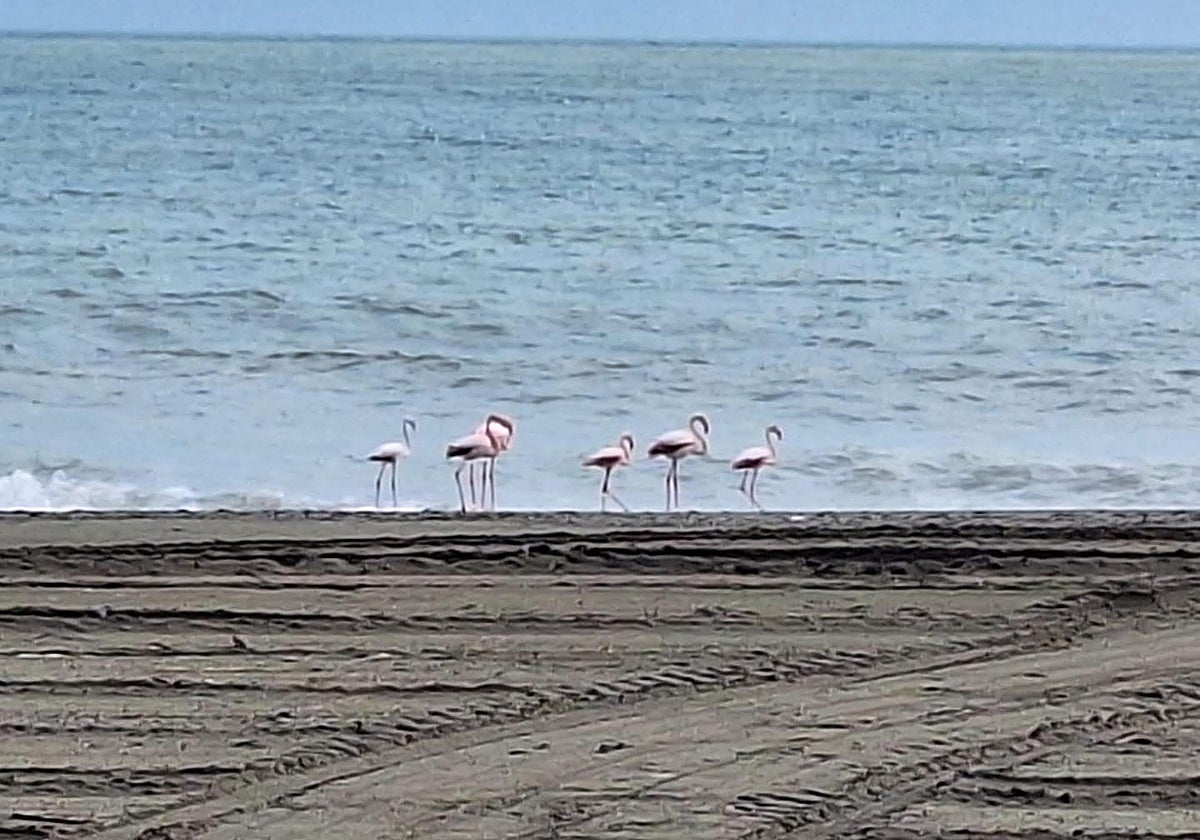

The residents of Estepona these days are witnessing something unusual, as it is not a common stopover area. Dozens of red flamingos are on the beaches of Estepona, having been spotted on the beaches of El Cristo and La Rada, a presence framed by their usual movements between wetlands, searching for food and heading to their breeding sites.
This is explained by Andrés Rojas, ornithologist from the Ornithological Group of the Strait, member of the Sierra Bermeja Naturalist Group and the SEO/BirdLife Rarity Committee. "Flamingos do not undertake a strict and time-bound migration, but rather continuous movements among different wetlands, estuaries, marshes, and lagoons, depending on the water level and the food resources available at any given time," he says.
"During these movements, flamingos tend to opt for coastal routes, following the shoreline rather than crossing large expanses of solid land. In this sense, the Costa del Sol, and particularly Estepona, are situated right in the natural corridor between some of the main Andalusian enclaves used by the species, such as the salinas of Cabo de Gata, the Fuente de Piedra lagoon, the mouth of the Guadalhorce, the marshes of Palmones and Barbate, the Bay of Cádiz, or the surroundings of Doñana," adds Rojas.
However, intense rains like those of these days can cause disruptions in the movement rhythms, altering the routes, which forces the birds to interrupt their journey.
"Strong gusts of wind and the rough sea hinder their progress, which leads them to seek calm areas where they can rest and wait for conditions to improve. It is in this context that the stopover recorded on the beaches of Estepona is explained, becoming temporarily a resting place before resuming their route once the weather allows," explains Andrés Rojas.
At this time of year, many flamingos are in transit to their breeding areas or already settling in them if conditions are favorable. In the case of Andalusia, according to information from SEO Birdlife, Fuente de Piedra is the main breeding reference, but only if the water level is adequate. Thus, the beaches of Estepona have temporarily become stopovers for resting before resuming their route, once the weather permits.

Latest news





Upcoming events
12
Nov
El Desembarco, la traición de Viriato at La Caja Blanca
12
Nov
HOMER El Mero Mero at Sala Trinchera Málaga
13
Nov
Marbella Startup Lab – Innovate & Collaborate
13
Nov
Candlelight: Coldplay & Imagine Dragons at Sala Fundación Unicaja María Cristina
13
Nov
Candlelight: Tribute to Ludovico Einaudi at Anantara Villa Padierna
Similar News

Málaga Airport Makes History with More Than Three Million Passengers in One Month
Málaga

Port of Málaga looks beyond its docks to support future growth
Málaga

Guide to the Virgen del Carmen Processions in Málaga and the Province
Málaga
