


This is how the Virgin of the Apple was discovered in Málaga: perseverance and a stroke of luck from Google Lens
The discoverer at the Customs Museum of this sculpture, stolen and missing since the 1960s, recounts the investigation solved thanks to his personal dedication and technology.
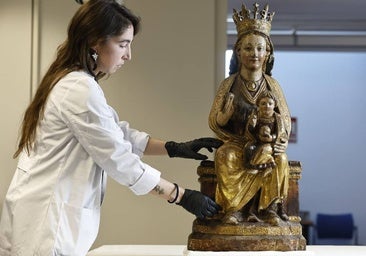

This story could very well be the script for an episode of 'Cold Case,' a series where old murders are solved using the latest technologies. Here, there is no corpse, but there is a crime: a robbery to be exact. And there are no homicide detectives, but rather an art historian who truly deserves the title of sleuth. The investigator himself, Germán Chicote, contacted Diario SUR when he saw the news of the recovery of the Riojan Virgin of the Apple in the Malaga Museum more than 60 years after its theft from the Monastery of San Millán de Suso. His testimony as the main detective of the event helps complete the story of this bizarre heist, return, and subsequent disappearance of the Romanesque-Gothic sculpture (13th-15th centuries), thanks to the persistence of the tireless expert and the invaluable help of the Internet. Specifically, the Google Lens app that we all have available on our phones.
"I am from San Millán de la Cogolla, but I never got to see the Virgin of the Apple, because when it was stolen I was very young," begins the recently retired art history professor and historian, Germán Chicote, who has led this entire investigation from Madrid, where he resides. But as Rilke said, the homeland is childhood, and this event marked the teacher since "every year, on the day of Saint Lucia, we would go up to the monastery and visit the caves where they took out the Virgin," says the Riojan who, despite the distance, never lost sight of the sculpture. "I was convinced that the problem was that it had been re-cataloged and was lost in some warehouse of the Ministry of Culture," maintains the investigator whose theory was not far off.
Rewinding to the beginning of this story, the entry of the Virgin of the Apple into the crime pages occurred on the night of August 4 to 5, 1963, when it was stolen from the Monastery of San Millán de Suso. At the end of the following year, the French Gendarmerie located the sculpture in the residence of a photographer in the Romanesque city of Poitiers (France), being returned to Spain in 1965. Its first destination was the Central Institute for Conservation and Restoration (ICCR) of the Ministry of Culture for cleaning and restoration. Once the intervention was completed, this institution, which is currently called the Institute of Cultural Heritage of Spain (IPCE), delivered the image on June 3, 1966, to the congregation of the Augustinian Recollects, according to an official act in possession of Chicote.
But here would begin the ceremony of confusion with the Virgin of the Apple, since 20 days later, on June 23, the work is returned to the ICCR. And to understand this rapid coming and going, a pause is necessary, explains the professor of Art History. It turns out that in San Millán de la Cogolla there are two monasteries, that of San Millán de Suso, which belongs to the State after the disentailment of the 19th century and which is currently under restoration, and that of San Millán de Yuso, managed by the Augustinian Recollects. Believing that the latter were the owners of Suso and, therefore, of the sculpture, they were given the same, but when it was verified that, in reality, the legal owner was the State, it was returned to the Ministry of Culture. And there it was lost track of.
"The academic world considered it disappeared," says art historian Germán Chicote who cites experts such as G. Moya Valgañón, Minerva Sáenz, and F. Gutiérrez Baños, among others. "My opinion was that the Virgin of the Apple would be in the declassified warehouses, without knowing the origin from the Monastery of Suso," argues the professor who, in the 90s, intensified his search by incorporating the Internet into his inquiries. "Since Google started working, I have been doing periodic searches without any results. When AI started working, I did the same but without success," regrets the investigator who, last year, learned of the guided tours to the IPCE - successor to the old ICCR - and entered the premises of this institution, where they provided him with the documentation with the certificates of delivery to the Augustinians and subsequent return.
With the new data, Chicote returned to the Internet and, last spring, found an unpublished image of the Virgin of the Apple from the EFE agency dated 1965, after its theft and return, and before its whereabouts were lost. "Until then I only had a couple of photos from the 20s and it occurred to me to put the new portrait in Google Lens," says the retired professor who did not know then that this simple gesture would lead him to the resolution of the case in a stroke of luck. This app allows you to upload a photo and the search engine compares it with images from around the world to find similarities. "Several came out and one seemed very similar. I even put it on the TV to see it enlarged and compare it. It was identical to the one from EFE," says the sleuth, whose accompanying information revealed that the original sculpture was located in the Malaga Museum.
Not content with this, he sought a second confirmation and found a video of the museum from the television program 'Thesis'. And there, in a tracking shot, the long-awaited Virgin reappeared in the visitable warehouse of the Customs. He communicated his finding to the Ministry of Culture of La Rioja and bought an AVE ticket to Malaga to verify his discovery. After so much time even the high speed seemed slow to him. "I entered the Malaga Museum, went directly to the warehouse, and was there for two hours in front of the image," says the art historian who, to record the moment, asked a girl to take the photo that accompanies this story.
After seeing it on-site, the art historian agrees with the recataloging of the work that was done in 1966, considering it closer to the 13th century than to the 15th, as previously thought. "It has Romanesque features, such as the iconography of the Virgin as the throne of God, but the child is on her left leg which breaks the symmetry and her face is already sweeter, which are Gothic traits," explains Germán Chicote who, however, does not agree that the Virgin's name was changed to 'Seated Virgin with Child', which helped to lose track of it.
Thus, he says that the head of the Department of Conservation and Research at the Malaga Museum, José Ángel Palomares, confirmed that, according to the museum's archives, the sculpture was registered that same summer of 1966, coming from the ICCR. And there it has remained since then waiting for someone to rediscover it. The paradox of this whole story is that Germán Chicote has family in Malaga and knows the city well. In fact, he points out common ties and remembers that Manuel Agustín Heredia, Félix Sáenz, and the father of the first Marquis of Larios were notable figures from La Rioja in Malaga. The investigator was close to the Virgin he was looking for, although he did not have the opportunity to solve the problem because he visited the capital a lot before 2016, when the Malaga Museum was still stored and pending its inauguration in the Customs.
Happy with the resolution of the enigma of the disappearance, he confesses that the return to San Millán de la Cogolla for an exhibition is a magnificent ending that could be completed with the complete and definitive return to its original place. He assures that "if it hadn't been for the Internet, I would never have found it," but the real key to this happy ending is his perseverance and dedication for more than 30 years to its location. Despite this, the resolution has a downside for the discoverer: "The pity is that people who knew it in the Church, like my parents and grandparents, can no longer see it."

Latest news





Upcoming events
12
Nov
El Desembarco, la traición de Viriato at La Caja Blanca
12
Nov
HOMER El Mero Mero at Sala Trinchera Málaga
13
Nov
Marbella Startup Lab – Innovate & Collaborate
13
Nov
Candlelight: Coldplay & Imagine Dragons at Sala Fundación Unicaja María Cristina
13
Nov
Candlelight: Tribute to Ludovico Einaudi at Anantara Villa Padierna
Similar News

Málaga Airport Makes History with More Than Three Million Passengers in One Month
Málaga

Port of Málaga looks beyond its docks to support future growth
Málaga

Guide to the Virgen del Carmen Processions in Málaga and the Province
Málaga
