


Welcome Mr. Mosher, the architect from the most exclusive and endangered Costa del Sol
The outstanding disciple of Frank Lloyd Wright arrived with the Marshall Plan, fell in love with Marbella, and left an architectural legacy as unknown as it is unprotected.
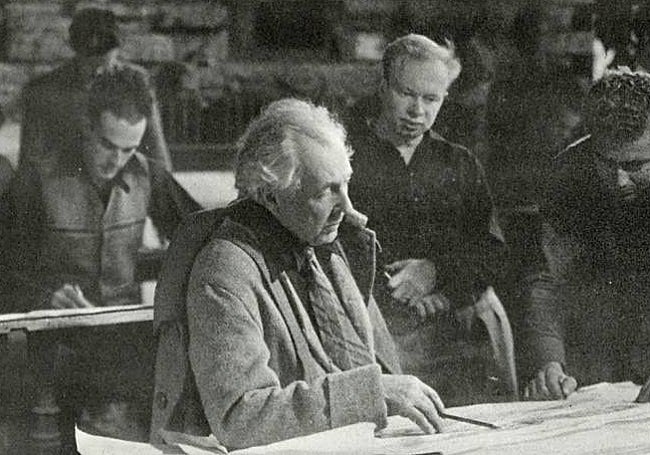

Photographer Pepe Marpy, an essential figure of Marbella by night, introduced her. "I'm going to take you to a place you'll really like," the photographer told the architect Elisa Cepedano Beteta, and she followed him with her eyes closed. She knew he wouldn't disappoint her. What she never imagined was that it would mark her both professionally and personally. The destination was a villa in Nagüeles with a welcoming name: 'El Remanso'. But before meeting the owner who lived up to that name, she recognized on the stairs the design of the legendary Fallingwater house by Frank L. Wright. "But it wasn't a reproduction, it was the original sketch," recounts the then visitor who subsequently met Robert Mosher, a smiling, approachable, large man framed by large vertical windows that amplified the staging of that introduction. Then she knew she was in the presence of Lloyd Wright's right-hand man and the true author of the sketch of the most famous residence in the history of architecture. A man who, upon his first arrival on the Costa del Sol, knew he had found his waterfall house. Here he lived from the 1950s until his death in 1992 and left his most important work, an architectural encounter between organic style and Andalusian spirit. A heritage that, unfortunately, is unprotected and is being lost.
"He would design a house for the baroness Von Pantz—the main shareholder of the multinational Avon—as easily as he would enter a small contest because he was passionate about designing. He didn't need to, but he entered. His lack of ego always caught my attention," recalls Cepedano, who, along with her partner Roberto Barrios, ended up becoming a regular visitor to the American and the main expert on his work. Thus, she recounts that he arrived in Spain with the arrival of the American bases in the 1950s and the Marshall Plan, which, although it briefly passed through our country as parodied by Berlanga, also unlocked the dictatorship to the world. A Spanish-American collaboration that, in the Trump era, seems from a very distant time.
However, Robert Mosher did not arrive directly in Spain. As researcher and journalist Carlos Zamarriego recalls, after spending the 1930s in Frank Lloyd Wright's studio as one of his closest collaborators, he followed his own path in the 1940s and headed to Europe. He traveled through Germany, stopped in Italy, and finally arrived in Madrid to the rhythm of 'Welcome Mr. Mosher': "We receive you Americans with joy," as the movie sang. "He had a very good relationship with the diplomats and his first commission was the Casa Lange, in El Limonar," recalls Elisa Cepedano, who in her study 'Robert Mosher, open gaze and dream of traveling' dates this cult project of Malaga architecture to 1957. The promoter was American Colonel Roy Allert Lange, who gave him carte blanche. The urban planner here laid the foundations of his style by mixing organic concepts with the Mediterranean spirit and local materials, also taking care of the environment and the incorporation of nature into the living space.
"Coming to Malaga, he fell in love," reveals the architect, who adds that Mosher made the Costa del Sol his natural area of influence and, particularly, Marbella where he built his home. He never married nor is known to have descendants, but he left a recognizable legacy in the form of residences and villas. Like that of John David Lodge, the first U.S. ambassador to Madrid since the UN lifted the veto on Spain in 1955, who called on Mosher to build his vacation home in Marbella on the Santa Petronila estate.
A commission that was any architect's dream: cost was not an issue and he had 8,000 square meters extending to the beach at his disposal, bordering the properties of the Duke of Alba, of Petronila Escandón and Salamanca, and of the Marquis of Villalobar. A villa "facing south on a small promontory like a smile to the Mediterranean," wrote the owner. "The clients themselves are the ones who best define Mosher's architecture," states Cepedano.
Marbella was the heart of Mosher, but his most emblematic and extensive work is in Benalmádena. "His meeting with the brothers Simon and Maurice Beriro was crucial, as they commissioned him to build Rancho Domingo," explains Carlos Zamarriego, who is preparing a book on this emblematic urbanization of the Costa del Sol. It is not known how the promoters and owners of the Hotel Tropicana and the architect met, although the researcher notes that the businessmen were of Sephardic origin from Casablanca of the protectorate, while the American was also Jewish. There is no doubt that the understanding was total.
Robert Mosher transformed a field of olive trees and cattle into a luxury residential complex. The urbanization consists of 27 single-family homes, most of them signed by the American, like the emblematic villa La Rotonda, where Simon Beriro himself lived—today it can be rented for 2,300 euros a day in high season—; San Ysidro, which belonged to producer George Ornstein who brought the first Hollywood productions to Spain, or Arcadia, where Alain Delon stayed during the filming of 'Lost Command'. A colony that, like Pueblo Rancho Domingo (consisting of 12 apartments) or the residence La Roca, showcases the "prodigious" architecture of Lloyd Wright's advantaged disciple, as Cepedano Beteta assures.
"Instead of transforming the sloping terrain, his designs adapt to the terrain," explains the architect who also highlights the large windows and the adoption of the Andalusian style of white villages. However, his pronounced overhangs were often transformed by construction managers. "Sometimes they would cap his houses," explains Cepedano, whose urban study of Rancho Domingo was used by the Benalmádena City Council as a basis for protecting this complex. The expert raises one of the problems encountered by the American, as, despite building villas for over three decades, he never signed a plan. "He was not licensed, so his projects were legalized through some Spanish colleague and he could not lead the construction management," the architect points out.
Probably, that "lack of ego" that Cepedano Beteta speaks of made the architect not claim his prominence in official papers. "He was a caring person who needed nothing," insists the researcher on his humanity, while explaining that Mosher had the complicity of his clients who were also friends. However, today, his work is falling into oblivion and, more seriously, many of them are not cataloged or yet to be discovered. Like the residence in Marbella of the baroness Terry Von Pantz for which he built a 'bungalow' next to the beach with twelve guest rooms, rooms for nine servants, and a dining room for a hundred guests.
However, the most serious threat to this unique legacy of the province of Malaga is its lack of protection. Except for the aforementioned Rancho Domingo which has municipal conservation, the Casa Lange in Malaga capital is the only one listed in the General Catalog of Historical Heritage of the Junta de Andalucía. "There is no census of his work, but he made more than 60 houses," counts the architect and leading expert on the work of her American colleague, who does not mince words to warn about the future of this urban heritage that, in some cases, has already been destroyed by the wrecking ball. "If it is not protected, it will continue to disappear."

Latest news





Upcoming events
12
Nov
El Desembarco, la traición de Viriato at La Caja Blanca
12
Nov
HOMER El Mero Mero at Sala Trinchera Málaga
13
Nov
Marbella Startup Lab – Innovate & Collaborate
13
Nov
Candlelight: Coldplay & Imagine Dragons at Sala Fundación Unicaja María Cristina
13
Nov
Candlelight: Tribute to Ludovico Einaudi at Anantara Villa Padierna
Similar News

Málaga Airport Makes History with More Than Three Million Passengers in One Month
Málaga

Port of Málaga looks beyond its docks to support future growth
Málaga

Guide to the Virgen del Carmen Processions in Málaga and the Province
Málaga
