


Images of Málaga | Three Málaga churches that can only be seen in photographic archives

Three photos for a triangular view of the history of Málaga. The term "triangular" refers to the topographic operation that enables the mapping of a place. In 'Estampas de Málaga. Memoria SUR', historian Javier Ramírez adopts this concept to position some pieces of a potential photographic, and almost sentimental, map of Málaga. He does this within the three parameters of mechanical cameras: focus, depth of field, and time. The result: a personal focus that selects and comments on the layers that time sketches. Welcome to this visual story.
-
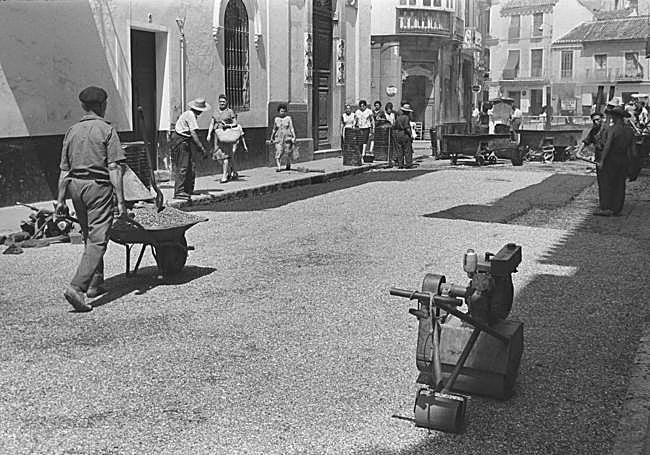
June, 1961
Málaga
Calle Álamos, corner of Puerta de Buenaventura; in the background, buildings on Carreterías Street
Enlarge
Fondo Bienvenido-Arenas. Historical Photographic Archive, University of MálagaThe entrances to the convent of Recoletas Bernardas de la Stma. Encarnación and to the church of Aurora del Espíritu Santo are to the left of the image. They are two distinct buildings, although they shared a common history since the Cistercian nuns moved in 1878 to the house adjoining the church, which also served as a conventual chapel. The original temple predates this. Belonging to the Brotherhood of Aurora del Espíritu Santo, it was built, according to Guillén Robles, in 1727, next to the wall and at the boundary of Puerta de Buenaventura. In 1879, with the new layout of Plaza del Teatro and Calle Álamos, the Gate disappeared, but not the church, which remained standing until the earthquake that shook Málaga in 1884, leading to its ruin. The religious complex was rebuilt in 1890. The photograph marks the beginning of the transformation of this urban space. Tram rails and cobblestones are being covered with a tar layer to optimize vehicle traffic. The church and convent would fall in the summer of 1968. The phrase that sentenced "Málaga, fierce city, of a thousand taverns and not a single bookstore" seems about to reverse its meaning.
-
May, 1966
Málaga
Calle Granada, San José Church
Enlarge
Fondo Bienvenido-Arenas. Historical Photographic Archive, University of MálagaIn the spirit of the guilds of 17th-century Málaga, the carpenters' brotherhood built a church on Calle Granada in the middle of that century, dedicated to their patron saint, and next to it, a shelter for foundling children. A faint historical thread links the church of San José with the also vanished church of Aurora del Espíritu Santo, since the brotherhood of that name initially had its interim headquarters in the temple of the carpenters' fraternity. Both churches were assaulted and looted during the unfortunate days of May 11, 12, and 13, 1931, a lamentable episode in our local history that, as Professor José Jiménez Guerrero recalls, is popularly known as the "burning of convents."
These events marked the beginning of the end: the churches were restored and reopened for worship, but with a significant loss of their religious heritage. Both fell to the demolition hammer on dates very close together, San José two years before the one on Calle Álamos. The photographic report from May 1966, in which this image is located (UMA Archive), shows the church and the adjoining building in a ruinous state.
-
First decade of the 20th century
Málaga
Partial view from the northern slope of Mount Gibralfaro
Enlarge
Fondo Thomas. Historical Photographic Archive, Institute of Photographic Studies of Catalonia (IEFC)I have held the original of this image, a 13X18cm glass plate negative, in my hands. Belonging to the Thomas Collection of the IEFC, there was no data to establish authorship or to know the exact date of production of this image. It could well have come from the photographic studio of the Málaga native Miguel Osuna, who took photographs for Editorial J. Thomas, or from the graphic reporter Juan Barrera Gómez from Seville, who also produced a good number of plates for the same publisher. The date can be approximated around 1910. The extraordinary quality of the original image and careful digital recovery make it possible to delve into the details of this specific photographic atlas. Thus, the notable presence that the church of La Merced, another of the disappeared, had in its immediate surroundings is evident. Like the previous two I have discussed, it was attacked during those dire days of May 1931. It burned from all sides and the roof. It was never restored, and its ruins were noticeable for thirty-two years. The photograph brings us closer to the Plaza de la Merced and the church that gives it its name in early 20th-century Málaga.

Latest news





Upcoming events
12
Nov
El Desembarco, la traición de Viriato at La Caja Blanca
12
Nov
HOMER El Mero Mero at Sala Trinchera Málaga
13
Nov
Marbella Startup Lab – Innovate & Collaborate
13
Nov
Candlelight: Coldplay & Imagine Dragons at Sala Fundación Unicaja María Cristina
13
Nov
Candlelight: Tribute to Ludovico Einaudi at Anantara Villa Padierna
Similar News

Málaga Airport Makes History with More Than Three Million Passengers in One Month
Málaga

Port of Málaga looks beyond its docks to support future growth
Málaga

Guide to the Virgen del Carmen Processions in Málaga and the Province
Málaga
