


What not to miss in the Montes de Málaga Natural Park
Beyond sales, this protected area, which now also holds the status of Special Protection Area (for its Site of Community Importance), features hiking trails, viewpoints, recreational areas, and even old water mines.

Few provincial capitals can boast having a protected area of such ecological value within their municipal boundaries. Although it is one of the smallest natural parks in Andalusia, the city of Málaga, together with Casabermeja and Colmenar, has the Montes Natural Park, a true green lung thanks to reforestation efforts made less than a century ago.
This March, the Andalusian Regional Government has taken a further step in promoting its value by declaring it a Special Conservation Area (ZEC) of the Site of Community Importance (SCI). With this, the enclave is fully integrated into the European Natura 2000 Ecological Network, recognizing its high environmental value and the need to ensure its long-term preservation.
Today, this area has many attractions. Beyond the roadside inns along the old road to Colmenar, its nearly five thousand hectares of land offer many interesting enclaves and routes for exploring on excursions. Here are some of the most important:
Thanks to its altitude above sea level and its proximity to the sea, this protected area boasts numerous spots for enjoying wide panoramic views, both of the coast to the south and the inland to the north, east, or west. Among these enclaves, such as lookout points accessible by hiking trails, are El Cochino, Pocopán, and those named after Martínez Falero and Vázquez Sell, two forestry engineers who were fundamental to the forest repopulation done less than a century ago. But, there are many more. In fact, one of the most well-known in recent years is the Unity Lookout, located on the Matanza hill. It is relatively easy to reach via a path starting near the El Detalle inn. After passing by the Umbría bridge, you arrive at a lookout built by volunteers with curious elements like a wind rose and a tetrahedron-shaped construction with mosaics that allude to peace, cooperation, and love. Other lookouts in the area or within the natural park itself include El Palomar or the 360-degree Cerro Mallén, from which Casabermeja can be perfectly seen below.
The altitude of the Montes is not excessive, as the highest points barely exceed one thousand meters. Despite this, it features several significant peaks. Today, not all of them have marked trails, but they usually have intuitive paths. Among these summits, the highest, above one thousand meters, are Cresta de la Reina, Santo Pítar, Cerro Cuéllar, or Pico del Viento, among others.
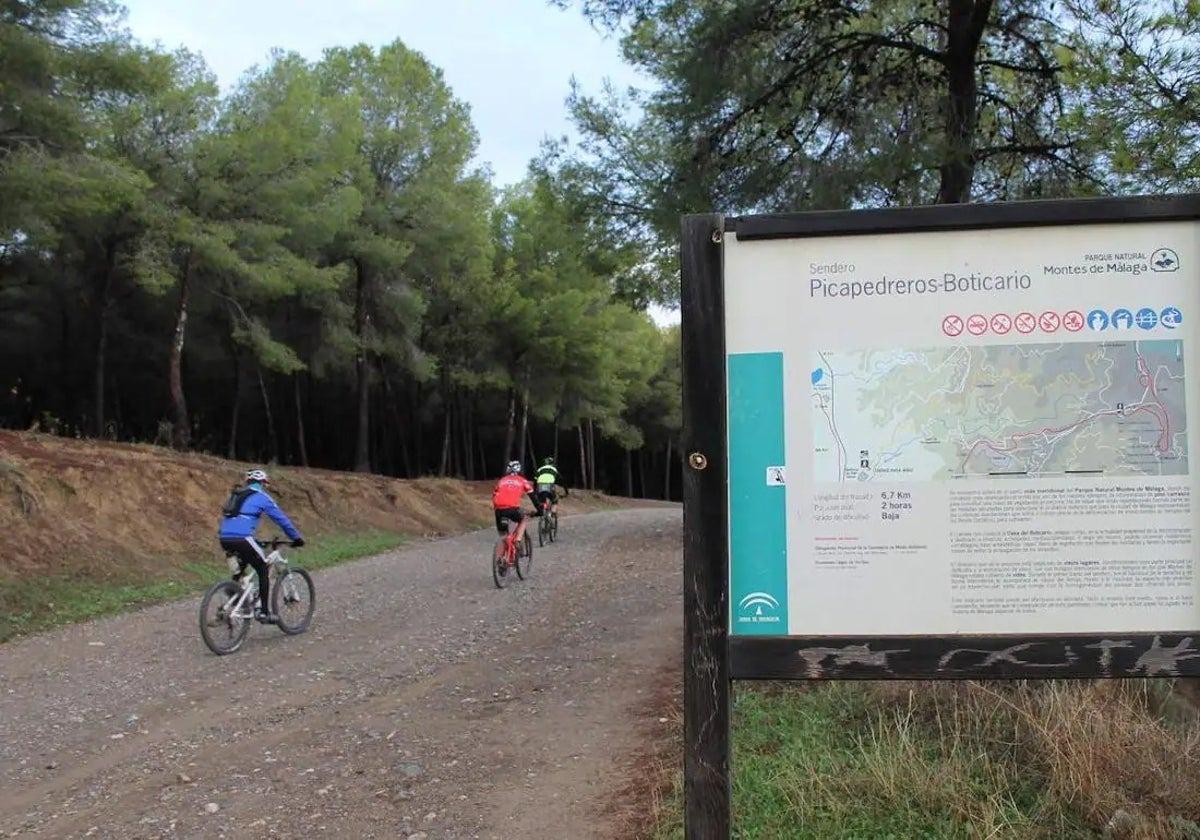
Although there are many paths throughout this protected space, not all are marked and approved trails, which are those that offer safety and orientation to make a journey without risks. Among these official routes are the Pocopán lookout trail, the one connecting El Cerrado to the Cochino lookout, the Torrijos trail, and the Umbría de Contadoras trail. To these, some lesser-known itineraries must be added, such as the one connecting Casabermeja with the natural park through Cerro Mallén. There are also paths specifically designed for mountain biking. One of them is between Picapedreros and El Boticario, and another reaches the Contreras winery.
Currently, there are two recreational areas in the Montes de Málaga Natural Park. In the heart of this protected space, opposite the Humaina hotel, is El Cerrado, equipped with barbecues, tables, and other elements for a day out in the countryside. Further north, the Torrijos recreational area can be accessed, which has more space than the former. In both cases, fire can be used for cooking during the period stipulated by the authorities (usually between mid-October and May).
Among the most emblematic spots of this protected space is the Torrijos winery ecomuseum, built in the mid-19th century, located next to a large recreational area and one of the aforementioned hiking trails. This ethnographic space is ideal for learning about the history of this natural park, linked throughout its history to traditional agriculture. Indeed, there you can see beams and presses that were necessary for the production of wine and olive oil or even ovens for baking bread. It is not by any means the only winery or farmhouse that can be found within this green lung of the city, which holds so much natural, historical, and ethnographic heritage in its core. Next to the old winery, there is a recreational area with the same name, as well as a small approved trail.
In the heart of the Montes de Málaga, this nature classroom, oriented towards environmental education, can be visited. In a restored 18th-century building, various activities related to the environment can be undertaken. It has very well-equipped facilities, including a multi-sport court, a swimming pool, a nocturnal observatory of native fauna, and a botanical garden. To get there, take the detour at Fuente de la Reina and then take a lane that leads directly to the nature classroom. To enjoy the activities there, it is necessary to reserve the facilities or spots in some of the workshops in advance.
Although there was also mineral extraction in the past in what is now known as the Montes de Málaga, in this case, the term refers to the traditional water extraction system that has been used in the area. The agricultural past of this protected space led to the engineering of very unique water supplies. Thus, today there are hundreds of landmarks between underground springs and the mines where the water element was extracted. Today many of them can be easily seen on some of the hiking trails or near known enclaves. Among them are those of the Contadoras, the Don Ventura stream, the Camino de la Encina, the Zara winery, or the Corcel. These mines should not be confused with those that did exist for mineral extraction in the area in past centuries. On the other hand, in the chapter on pillars, springs, and fountains, there is a long list. However, of all of them, the most emblematic is the Reina spring. Its name, which has been documented for centuries, has given rise to the legend that says Queen Isabel the Catholic drank water from it before taking Málaga. However, today it is more credible that the term 'Reina' comes from Arabic, from words like Rayyana or Rayya.
The Montes de Málaga Natural Park is not so well known for its rivers and streams, but it must be taken into account that many of those born there pour their waters into the Guadalmedina. They are very seasonal and depend especially on rainfall, but they can be spectacular after recent rains. Thus, in the area of Picapedreros, many people from Málaga come to see the waterfall of the Don Ventura stream after heavy precipitation. Among the most important rivers and streams are Chaperas, Humaina, de las Vacas, Hondo (also called Don Ventura), de los Frailes, or de las Vizcaínas. In addition, the importance of the Guadalmedina for the area's fauna must not be forgotten.
Thanks to its agricultural past, today numerous remains of farmhouses and wineries are preserved in this protected space. Before the current forest mass with which these mountains were repopulated to avoid mainly their erosion and flooding of the Guadalmedina, the area was dedicated to agriculture. Its most well-known facet was that of a large vineyard, which, like other areas in Spain, was devastated by the phylloxera plague. In fact, wineries were especially abundant and can still be located in many points of the natural park. After the abandonment of the vineyards, some were converted for other agricultural or even livestock uses. Besides being a historic area for the wines of Málaga, it also had other crops, such as cereal.
Today this protected space has high ecological values. The large predominant forest, which is a green lung for Málaga and its surroundings, is also a rich ecosystem. Thus, although the pine with which much of this territory was repopulated is omnipresent, other trees and shrubs such as juniper, strawberry tree, carob, wild olive, cork oak, holm oak, or eucalyptus can also be seen. Along with them, there are no shortage of aromatic plants like rosemary or other exceptional ones like the palmetto, the only native palm species that grows in Europe. In terms of animal species, the largest mammal is the wild boar, whose population has increased so much in recent years that it is seen in the urban environment of the Montes. Squirrels, which were repopulated a few decades ago in the most wooded areas, can also be occasionally seen. Other mammals in this natural space include foxes, badgers, genets, and rabbits. As for birds, the repertoire is very broad and includes numerous birds of prey, both diurnal and nocturnal. The short-toed snake eagle, booted eagle, goshawk, sparrowhawk, common buzzard, barn owl, or tawny owl are some of them. In the chapter on reptiles, the best known is the chameleon.
What is now known as the Montes de Málaga is an area of mountains and basins that has been inhabited since the earliest settlers. In fact, today the dolmens of Chaperas are preserved on a hill away from the usual trails. It should also be noted that within the perimeter of the protected space is the valuable archaeological site of Peñas de Cabrera, natural shelters where important cave paintings have been found. Also, in what is now the natural park are the remains of the depopulated Mozarabic village of Jotrón, declared today as a Site of Cultural Interest. This enclave, located in the western area, even had a castle. In addition, there are also indications of another depopulated site, that of Reyna, where vestiges of a necropolis are found. Among the historical enclaves, the importance of the San Telmo aqueduct, which preserves several sections in the Guadalmedina valley, should not be forgotten. This important 18th-century engineering work preserves important sections such as the bridges over the Quintana and Humaina streams.
In recent decades, gastronomy has been one of the pillars on which the tourist offer of the Montes de Málaga is based. From Fuente Olletas to Colmenar, by the roadside, more than a dozen inns can currently be counted that offer the most traditional preparations of this area. Not in vain, there the famous 'plato de los Montes' has been coined, which receives other names when it is prepared in other parts of the province. Although almost all these establishments now have modern facilities, there is no doubt that they still retain the charm of the traditional. This is especially true in some of the more remote from the city, such as the Galwey inn, the one with the most tradition. Others characterized by their typicality are those closer to the Fuente Olletas area, such as the Ventorrillo de Santa Clara, El Boticario, or El Mijeño.
Today there are several options for staying in the natural park or its perimeter. There are many rural houses scattered around the protected space. Some of them are even old wineries converted for tourist use. But, there is also an option to stay in the heart of the natural park, the Humaina hotel, located opposite the El Cerrado recreational area. With a three-star rating, it is located in the middle of the forest. In addition, there are also two possible accommodations for sleeping in the Montes de Málaga. On one hand, there is the controlled camping area of Torrijos. For this, those who want to stay overnight must bring their own tent. Previously, with a minimum of 15 days in advance, they must request permission from the Territorial Delegation in Málaga of the Ministry of Sustainability, Environment, and Blue Economy (the maximum camping time is two nights). On the other hand, in the nature classroom of the Counters, there is a hostel with capacity for seventy people. It is specially designed for groups and children's camps.

Latest news





Upcoming events
12
Nov
El Desembarco, la traición de Viriato at La Caja Blanca
12
Nov
HOMER El Mero Mero at Sala Trinchera Málaga
13
Nov
Marbella Startup Lab – Innovate & Collaborate
13
Nov
Candlelight: Coldplay & Imagine Dragons at Sala Fundación Unicaja María Cristina
13
Nov
Candlelight: Tribute to Ludovico Einaudi at Anantara Villa Padierna
Similar News

Málaga Airport Makes History with More Than Three Million Passengers in One Month
Málaga

Port of Málaga looks beyond its docks to support future growth
Málaga

Guide to the Virgen del Carmen Processions in Málaga and the Province
Málaga
