


Ferran Adrià: "If you first get the premises and then think about what you're going to serve, that's bad."
The promoter of the elBulli Foundation reveals some secrets of the next volume of Bullipedia, a guide to prevent more restaurants doomed to bankruptcy from opening.
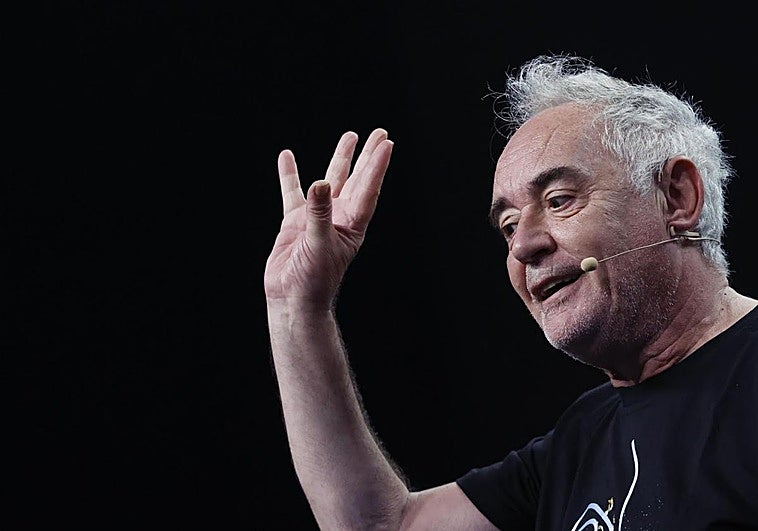

Chef Ferrán Adrià sparked a debate about what traditional cuisine really is. "I could be trolled before, because I hadn't done much research," ... he began his anticipated intervention at Dreams Madrid Fusión. Dressed in a black t-shirt and pants, he removed his blazer after a few minutes and held a water bottle in his hand, asking for a blackboard to write down the audience's answers to his questions. "I'm going to be provocative," he warned.
With him came chefs Joan Roca and Nacho Manzano, surprise guests of Adrià, to whom he said: "Relax, I'm not going to mess with you." A "gin and tonic buddy" of Roca and an admirer of Manzano, whom he says makes "some of the best creative meals of the last ten years," he also questioned them. "Who are we talking about when we talk about customers?" "Gastronomy is quality and pleasure," he later declared, in a talk that progressed through rhetorical questions. "And what is a dining house?" Someone ventured an answer and he said no, that "it's a fancy trend they're talking about now."
Most restaurants do not make a business plan and close within three years in a sector that contributes between 4,000 and 6,000 million euros to the Spanish economy, cites the volume from the Bullipedia titled 'Plan Genesis. Business Plan for Gastronomic Restoration,' which he will present in the coming days. He questioned again. "What is a business model?" Someone started an idea: "It's the strategy...". "Out, let another come, with all due respect," Adrià continued: "It's how you're going to make money," and without pause, "what is a financial plan?" He asserted: "How much money I'm going to make. Can I cover the investments with what I earn?"
Few Customers
Agile, standing, microphone in hand, moving among the three tiers of the audience, Adrià continued: "How much does one need to earn to go to a gastronomic restaurant, from the pizzeria to a higher range? €60,000? If four go, at a three-star they pay no less than €600 per person. You better bring a big wallet, better yet, don't go. And if it's abroad... my goodness! In Spain, only 0.73% earn more than €150,000 gross. You can go every so often," he clarified the real scenario.
He paused. "I could buy a Porsche, but I spend that money on restaurants. I don't own a car," and returned to the topic: "Who knows restaurants? Very few, for economic reasons. If you go once a year, you can't judge. Only 7.6% can afford a €15 menu restaurant. Why? Because you can't even afford that. You can't pay €400 a month every day. If you earn €1,200, tell me what you do. (To open a restaurant business) you have to see this first. It's the economy. If I have a restaurant over €30, only 1.2% of Spaniards can go. If it's over €150, you're extremely limited in the number of customers, if they are only Spaniards. The average annual spending is €1,040 per person."
And with these data on the table, "the question is: how many people can go to a gastronomic restaurant weekly and how many to one of high creative cuisine? You can debate me all you want on this." In contrast, he said. "I also like shabby restaurants, but there's a limit." More data: There are about 8 million restaurants worldwide and Michelin stars are the benchmark present in all countries, "like it or not," with just over 18,000 recommended. There are 3,100 with one star, 525 with two, and 157 that are three stars. In Spain, there are 3,000 gastronomic restaurants. With these figures, Adrià does live calculations: I need 240,000 covers daily (for the business to be profitable), about 54 million annually. "With less than 70% occupancy, it's hardly going to be profitable."
On the Tightrope
"When I started working in the kitchen in the 80s, there were no hours. The product, you could buy shrimp without problems," he recalled his time as chef and owner of elBulli. "But now, inflation: the product has increased by 40% since the pandemic. The cost at a seafood restaurant is at 60% product cost. The last day I bought for my home it cost €400 per person to eat seafood. You have to calculate the rent, energy. Many restaurants have survived on (undeclared) money B. "This is unviable for small restaurants."
He handed the floor to his chef friends. "We shouldn't be pessimistic, but, as Ferrán says, you have to know where you're stepping before opening," Manzano pointed out. "You sell on Saturday and Sunday but drag a deficit the other days and you're dead, you'll never recover. If you don't cover your fixed expenses every day, you're doomed. If you open the blinds in the red, especially in these months, it's been the final blow. We can't cheat at solitaire."
Regarding houses that offer a tasting menu of seven and eight dishes, Roca shared his view, which coincided with his colleagues. "The model you choose has to be very thought out and measured, and know which audience you are targeting. They say that what you pay in rent you have to make every day. If you pay two thousand, you have to make that money every day. It's a fact to know if you can face it."
"Who wants to set up a restaurant in the future?" Adriá asked his audience. Only one raised his hand, a guy who is now working as a waiter. Adrià recommended that he keep all this in mind, that he look at the profitable places, and gave an example of a successful case where someone set up a bar with an investment of €30,000. "It was shabby and he made it shabbier. Here lies the crux. A very cool, designer place? No, later. At the beginning, minimal investment. When you're the owner, there are no hours, no Saturdays or Sundays. Not for a chef, nor a dining room manager, who disconnect and go home." And a piece of advice: "Business model, the first thing you need to have clear is the menu. If you first take the premises and then think about what you're going to serve, bad."

Latest news





Upcoming events
12
Nov
El Desembarco, la traición de Viriato at La Caja Blanca
12
Nov
HOMER El Mero Mero at Sala Trinchera Málaga
13
Nov
Marbella Startup Lab – Innovate & Collaborate
13
Nov
Candlelight: Coldplay & Imagine Dragons at Sala Fundación Unicaja María Cristina
13
Nov
Candlelight: Tribute to Ludovico Einaudi at Anantara Villa Padierna
Similar News

Málaga Airport Makes History with More Than Three Million Passengers in One Month
Málaga

Port of Málaga looks beyond its docks to support future growth
Málaga

Guide to the Virgen del Carmen Processions in Málaga and the Province
Málaga
