


The Chef or the Client: Who Rules in Haute Cuisine?
The Adrià brothers, Dabiz Muñoz, or Quique Dacosta reflect on the balance between creativity, business, and experience at the opening day of Madrid Fusión.
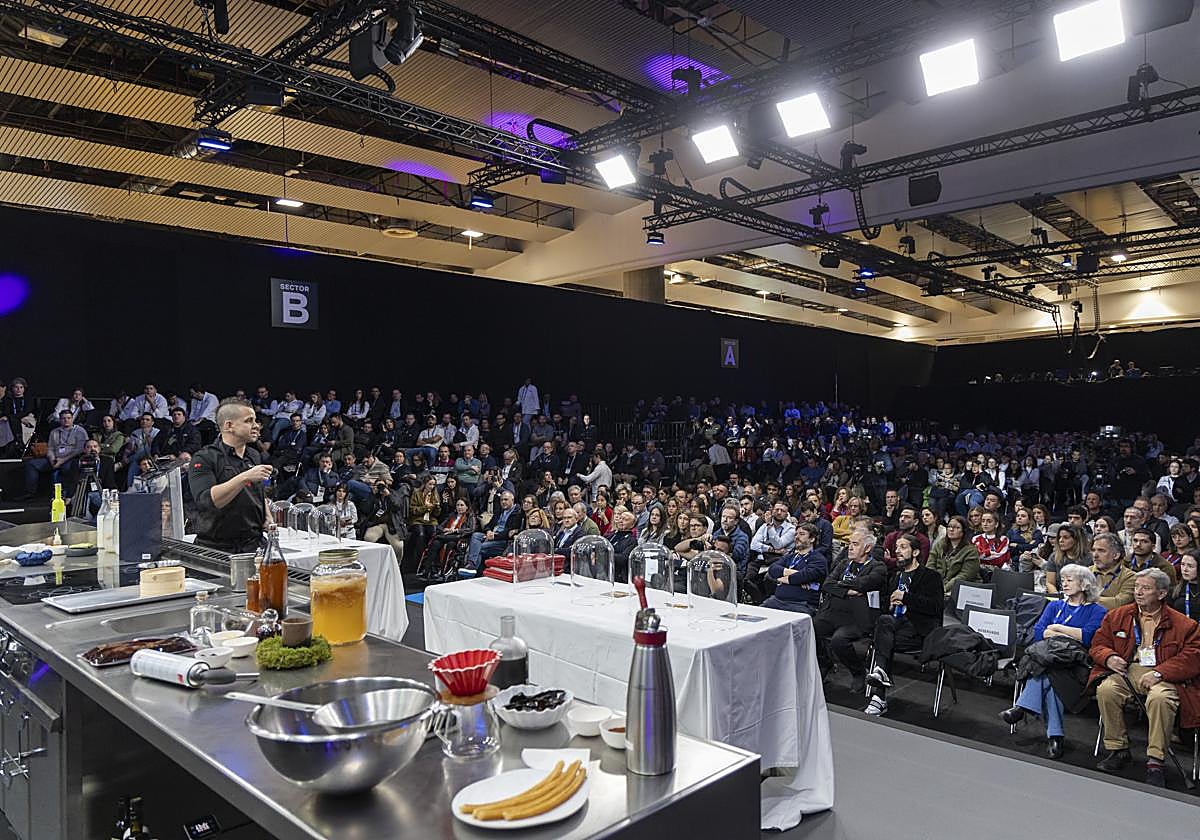

When a customer sits at the table at Enigma, Albert Adrià's team asks two questions: whether they want explanations before or after each dish, and whether they want the long or short version. Thus, they try to adapt the pace and language of their offering to a diner who has little choice in what they eat, but can at least control what they hear.
This delicate balance of power in high-end dining is the focus of the latest edition of Madrid Fusión Alimentos de España, which sports the motto 'The customer takes control'. However, it is not entirely clear that chefs are willing to relinquish the prominence they have gained over the past three decades. "One thing is to be flexible to adapt to the diner and another is to let them run your business," Paulo Airaudo pointed out on the main stage of this sort of Davos summit of gastronomy, held until Wednesday in pavilion 14 of Ifema.
The Argentine chef based in San Sebastián does not even accommodate requests to adapt the menu for allergies or intolerances. No alternative menus, no last-minute changes. "At most, I can prepare a dish, but I will charge for the full menu." In his restaurant Amelia—two Michelin stars in the bay of La Concha and soon in the María Cristina hotel—the price is paid not so much for what is eaten, "but for sitting in the chair."
Because, fundamentally, the tasting menu is not so much a creative option as a business model. "If I have five tables and they fill up with people who order a couple of dishes to share, the numbers don't add up," Airaudo said. He is not alone. Tasting menus continue to be fully valid at leading tables—Enigma, Diverxo, Disfrutar, Quique Dacosta, or Hermanos Torres paraded through the auditorium showing their latest dish collections—simply because they are necessary for profitability.
But the debate, as was evident throughout the dense schedule of presentations, is much deeper than a mere discussion about the format. It may be that once seated at a table of haute cuisine, the customer has little power of decision, but "their experience begins much earlier, with desire," warned Lluis García, who during the triumphant years of El Bulli was responsible for managing the reservation book. More than two million requests annually for a mere 7,000 spots. "I felt I was generating a lot of disappointments; the way to compensate was to make those who made the cut feel very special." His intervention on the Dreams stage—where he spoke of "the humility and honesty necessary to honor the trust the customer has placed in us"—served as a counterpoint to Ferran Adrià's volcanic presentation in the main auditorium.
Clearly, not all restaurants can boast a waiting list like El Bulli had in its day or like those that can be boasted today by El Celler de Can Roca, Diverxo, and a few others. The pie of haute cuisine is small—just 1.2% of the total turnover of the hospitality industry in Spain—and the supply shows signs of being oversized. Many of the 3,000 gastronomic restaurants estimated to exist in the country have to conquer the attention of a scarce, volatile, and predominantly foreign clientele every day. Hence Ferran Adrià's insistence on addressing basic aspects like a business plan before taking the plunge.
Up to 900 euros per cover
Assessing what their customer is willing to pay and what it will cost to offer those creative dishes they imagine is vital. And there are very few in the world who, like Dabiz Muñoz, can afford to charge 900 euros per diner for the complete experience. The chef of DiverXo presented exclusively before an auditorium packed to the rafters his new liquid menu: alcohol-free, sugar-free, and with the same identity—and the same price—as his solid proposal. A hare wine, a butter champagne, or a chufa sake are the kind of entertainments with which the chef proposes to continue blazing trails in haute cuisine. And he does so aware that his projection allows him to tempt a global customer who will pay whatever he asks.
It was not the only exclusive news of this opening day. Quique Dacosta surprised early in the morning by announcing that El Poblet, his two-star restaurant in Valencia, will undergo an ambitious 'rebranding' starting tomorrow: new name—Flores Raras—and new head chef. Carolina Álvarez takes over from Lluis Valls and becomes, along with Fina Puigdevall, one of the only two women to lead a two-star in Spain. A striking move to boost a project that opened in 2012, in a scene—both Valencian and global—that is increasingly competitive.
The debate is far from closed. Although gastronomy today is full of set menus and open discourses, its dynamics refer to that maxim that earned Clinton the presidency: "It's the economy, stupid." It may be that the customer does not govern the kitchen or choose what falls on the plate, but they still decide something essential: whether they want to sit at the table.

Latest news





Upcoming events
12
Nov
El Desembarco, la traición de Viriato at La Caja Blanca
12
Nov
HOMER El Mero Mero at Sala Trinchera Málaga
13
Nov
Marbella Startup Lab – Innovate & Collaborate
13
Nov
Candlelight: Coldplay & Imagine Dragons at Sala Fundación Unicaja María Cristina
13
Nov
Candlelight: Tribute to Ludovico Einaudi at Anantara Villa Padierna
Similar News

Málaga Airport Makes History with More Than Three Million Passengers in One Month
Málaga

Port of Málaga looks beyond its docks to support future growth
Málaga

Guide to the Virgen del Carmen Processions in Málaga and the Province
Málaga
