


'The Music': Not for all audiences
Starring Ana Duato and Darío Grandinetti, it closes the third week of the Malaga Theater Festival with performances on Saturday and Sunday.
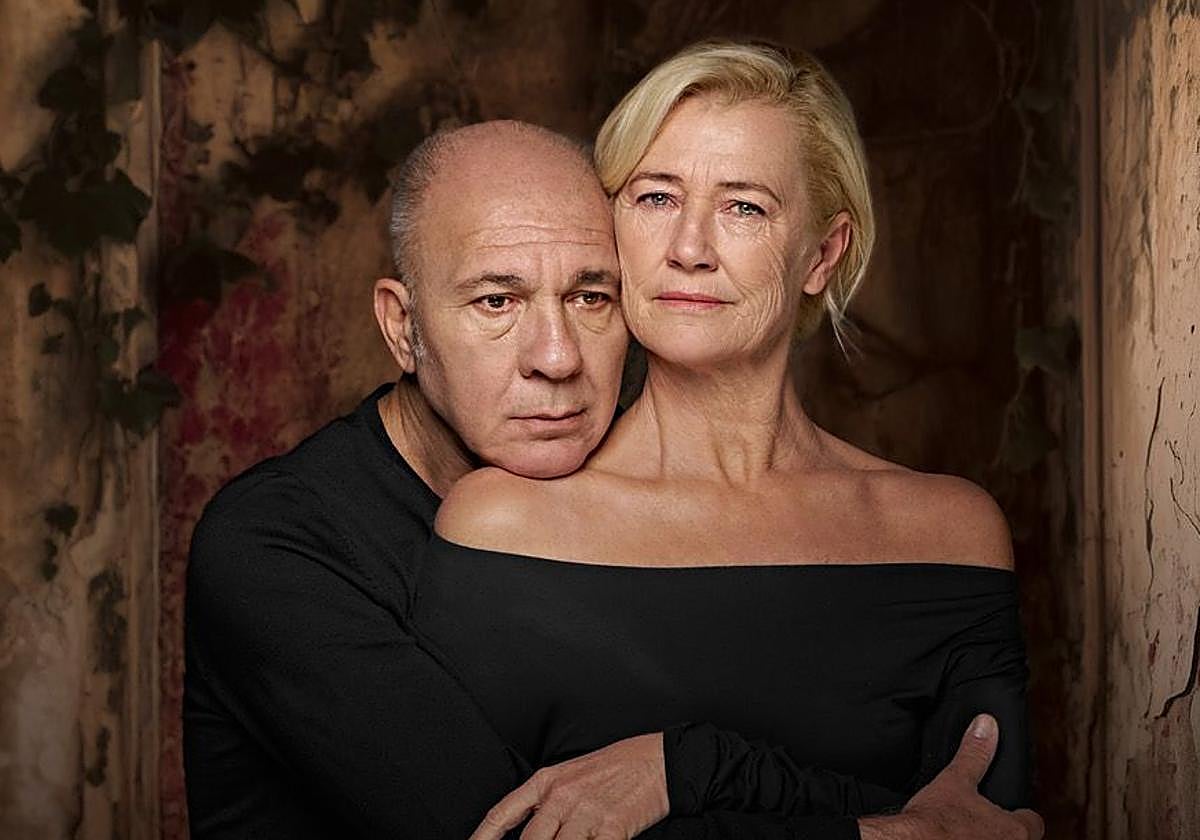

The first thing to appreciate about 'La música', one of the two productions that Magüi Mira brings to the Malaga Theater Festival, is ... that it lasts barely an hour. There's an obsession in the theater world with watching the clock, and I argue that, in a post-Netflix world, if there's no problem watching series with 50-minute episodes, we shouldn't be bothered by shorter theatrical productions if they are sufficient to tell what needs to be told. This is the case. The text by Marguerite Duras is what we would now call a liquid or multi-format content, since it was conceived for British television, hence its duration, and the author herself first brought it to theater and then to cinema (the 1967 movie was co-directed by Paul Seban).
This Sunday, they will return to the Cervantes Theater to tell a story that seems simple: a married couple meets in a hotel to sign their final divorce papers, and from there everything arises: passion, guilt, jealousy, hatred... The background is not so much, because Duras touches on a topic that is not for everyone. I sincerely believe that many of the people who packed the theater yesterday will have gone home without believing in the complex relationship of the two protagonists. Certain feelings must be experienced. In that sense, the best thing about rescuing this text is the moment and the depth in which Duras chooses to talk to us about love: when it no longer belongs to the other, when there is nothing left to hide, when it mixes with a painful past, when it is forever, when it will never be again. "From now on we will love others less," is said at one point, and it is so. Those who have lived it know. And there is no possible way out, it is an eternal circle as the work subtly suggests at its end. Very good ending, by the way.
The worst, however, is that it describes as love a completely toxic relationship, perhaps more typical of the impulses of the 60s (though not extinct), but unacceptable in today's eyes. The man is a sexist who follows his wife, is unfaithful but does not allow her to be, and continually threatens her with death. However, each comment of this type provoked laughter in the audience, so this work achieves something very interesting: it portrays us as a society. From that perspective, intentional or not, many conclusions can be drawn.
Magüi Mira maintains in the play that air of intellectuality of the nouvelle vague, with Handel's 'Sarabande' playing at the beginning and end, a tiny space around an old table, a large window, and, of course, wilted leaves on the ground. It also provokes, why not say it, boredom at times. Boredom that I tried to alleviate by trying to decipher the code that guided the lighting by José Manuel Guerra, beautiful yet incomprehensible in that dance between the light that crossed the window and the emotions that sprang up among the characters.
Ana Duato and Darío Grandinetti perform well, very well. Restrained, suggestive, natural even in the most artificial phrases, and with chemistry. A broken chemistry, as befits what is happening to them. Yesterday they had to endure the interruption of several mobile phones from distracted spectators. One of them rang for a long time while Grandinetti was holding his character in a very fragile, key moment of the performance, and I really felt bad for him. I don't know how he was able to continue, honestly. This is another painful reality of the post-Netflix era, going to the theater as if sitting on the couch at home watching 'Cuéntame'. Perhaps it happens that theater is no longer for all audiences.

Latest news





Upcoming events
12
Nov
El Desembarco, la traición de Viriato at La Caja Blanca
12
Nov
HOMER El Mero Mero at Sala Trinchera Málaga
13
Nov
Marbella Startup Lab – Innovate & Collaborate
13
Nov
Candlelight: Coldplay & Imagine Dragons at Sala Fundación Unicaja María Cristina
13
Nov
Candlelight: Tribute to Ludovico Einaudi at Anantara Villa Padierna
Similar News

Málaga Airport Makes History with More Than Three Million Passengers in One Month
Málaga

Port of Málaga looks beyond its docks to support future growth
Málaga

Guide to the Virgen del Carmen Processions in Málaga and the Province
Málaga
