The man in the red car who brought Hollywood to Spain and retired on the Costa del Sol
American George Herbert Ornstein, who turned Spain into a film set before Samuel Bronston, mingled with the legends of the seventh art and for his retirement swapped the spotlight for the light of the Costa del Sol.

1970s. A sumptuous burgundy Mercedes Benz 250 CE climbs the road connecting Arroyo de la Miel with the village of Benalmádena. In the passenger seat sits Gwynne Pickford, niece of silent film star Mary Pickford, 'America's Sweetheart', and daughter of Lottie Pickford, also an actress until her early death from alcoholism in 1939 at the age of 43. Long before, young Gwynne was first adopted by her grandmother Charlotte and then by her famous aunt. Around the same period, Mary Pickford founded, along with Douglas Fairbanks, Charlie Chaplin, and director D.W Griffith, the film production company United Artist (UA). Gwynne's childhood unfolded between film sets and Pickfair, a fabulous four-story, 25-room mansion located at 1143 Summit Drive in San Ysidro Canyon, Beverly Hills, very close to the imposing villas of Chaplin, Harold Lloyd, and Buster Keaton.
Mary Pickford retired from cinema after an Oscar and more than 200 movies in 1933. She remained a legend but the movies had become too small for her. She dedicated herself to the business of UA until in 1965 she secluded herself in her mansion, from which she would emerge only a few times until her death. One of her last trips, in 1964, was precisely to the Costa del Sol along with her third husband Charles 'Buddy' Rogers.
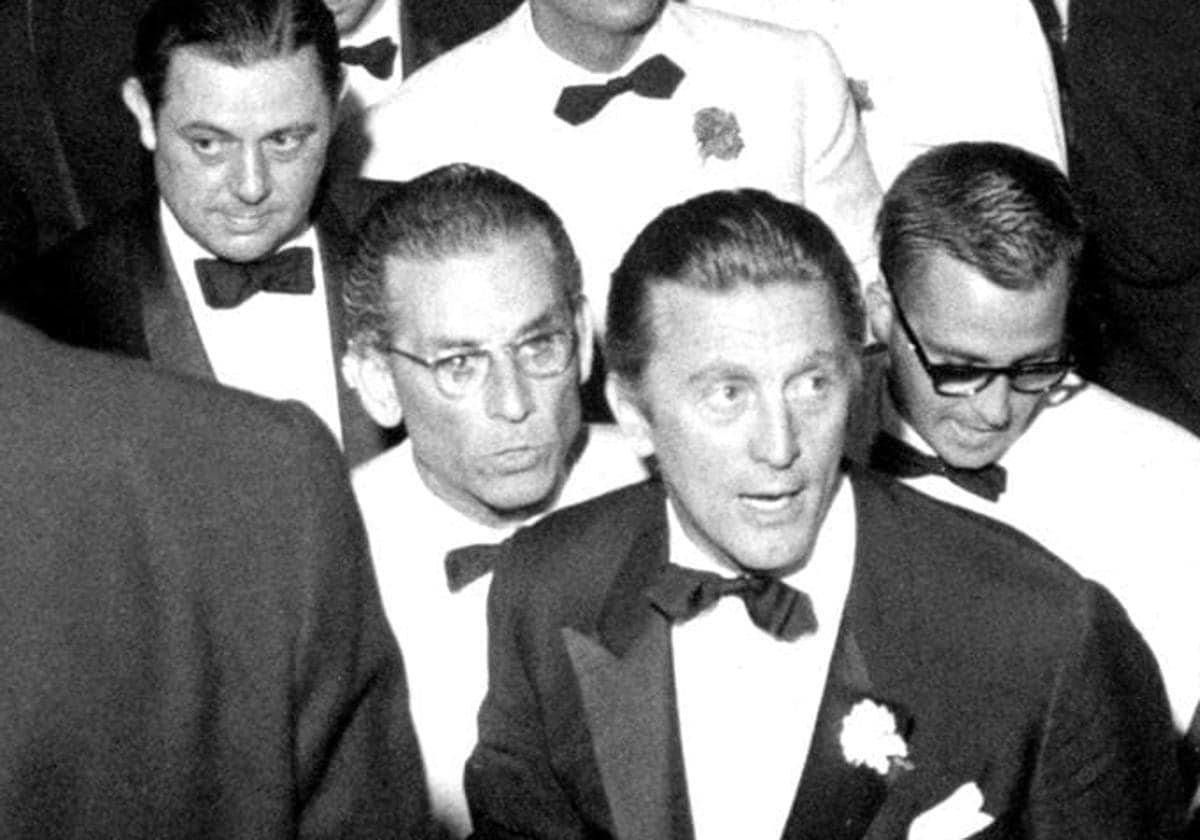
It is on this same Costa del Sol that now hears the roar of the red Mercedes engine. For a local neighbor, the scene might recall a 007 movie. The power of its six inline cylinders propels this sporty coupe through the mountainous curves of a Benalmádena that was beginning its love affair with tourism. Behind the wheel, George Herbert Ornstein, better known as Bud. Like his wife Gwynne, his life can only be understood through the seventh art. In 1961, as head of UA in Europe, he was in London with producers Albert R. Broccoli and Harry Saltzman looking for the protagonist of a new spy movie. "As they watched from the first-floor window how Connery crossed the street with swagger, the producers and Ornstein were convinced they had found their James Bond," recounts Andre Yule, Connery's biographer. 'Dr. No' was an unexpected blockbuster and the beginning of an inexhaustible franchise.
The Mercedes Benz reaches the Arroyo Hondo bridge and, instead of continuing up to the village, it turns into a hidden development called Rancho Domingo. "Previously, at the gate, there were the names of all the residents, in ceramic," says Jesús Peinado. He and his nine siblings lived with their parents in 'Viñas viejas', a farmhouse bordering this development built by Simón and Maurice Beriro (also responsible for the Tropicana hotel in Torremolinos). It was 1959. "It was called Rancho Domingo because Simón appeared one Sunday afternoon, visiting, on a tourist drive with his wife, in a white sports car. I was about 10 or 11 years old, I was coincidentally herding animals, he asked me, I introduced him to my father and he took him to the owners. He bought the land for five million pesetas." What was previously a field "forever, with olive trees and cattle" turned into a luxury residential complex of 22 hectares with 27 single-family homes designed by architect Robert Mosher, a disciple of Frank L. Wright. "Simón helped us, he brought us light in the farmhouse, water, telephone… it was like a miracle," says Peinado.
It has not been easy to speak with someone from the Ornstein Pickford family to confirm how they ended up in Rancho Domingo. The youngest, Mary and John, aged 78 and 76 respectively, live in the United States. "My father's favorite song was 'Viva España'," states the eldest, Suzy Ornstein, at 80 years old in a telephone conversation. She confirms her parents' friendship with the Beriro family. But the relationship with our country begins in 1953, when Bud, until then stationed in Italy, is appointed UA delegate in Spain and the family moves to Barcelona, where they settle in a luxurious apartment on Diagonal. "I remember there were always scripts on the floor," says Suzy. "My mother was the sweetest woman in the world and the most beautiful. My father was very proper and very strict," although professionally she describes him as an innovator, "he did many things that people said could not be done."
In the early 1950s, Franco's regime had blocked the profits in Spain from major Hollywood studios, just like from other American companies. Why? "Spain lacks dollars," explains CSIC researcher Pablo León Aguinaga, a reality "very similar to that of much of Western Europe after World War II." Despite several approaches, the 'majors', grouped in the Motion Picture Export Association of America Inc. (MPEA), decide on a blockade in 1955. "The film channel is closed. For two and a half years they do not export a single movie to Spain," assures Aguinaga, who turned his doctoral thesis into the book 'Usual Suspects: American cinema, the United States, and Francoist Spain, 1939-1960'. It is in this context that Ornstein seizes the opportunity. "United Artists starts producing cinema in Spain despite the boycott," explains Aguinaga, using "those blocked funds" in a way similar to what was being done in countries like the United Kingdom or Italy. "Basically what they are doing is using the profits in pesetas to produce here," something that, according to Aguinaga, not only served to "make much cheaper movies with high-quality professionals and different settings" but also led to a large number of Hollywood stars landing in Spain in the 1950s: "They come because the companies give them facilities to have access to blocked pesetas, and that allows them to take great tours of Spain practically at laughable prices." Years later, producer Samuel Broston would repeat Ornstein's formula but using the blocked funds of the petrochemical giant DuPont.
But it is Ornstein who first carries out a major production on Spanish soil. It is 'Alexander the Great', directed by Robert Rossen, with Richard Burton in the leading role. The movie was filmed in 1955 in the Madrid towns of El Vellón, El Molar, Rascafría, and Manzanares el Real, but also in the province of Málaga. The Spanish government, aware that it is "exploiting an internal division within Hollywood," in Aguinaga's words, allowed units of the National Police and the Army to participate as extras in the most epic scenes. Total collaboration, as shown by a photo from EFE, dated February 19, 1955, at the Sevilla Film Studios in Madrid: next to Ornstein appears the dictator's daughter, Carmen Franco, enjoying a cocktail during filming.
In that little paradise called Rancho Domingo, the red sports car stops, right at the gates of a villa called, and still called, San Ysidro, just like the natural gorge where the Pickfair mansion stood. The only vestige of its past in a place where Gwynne and Bud had decided to retire, in their early fifties, definitively distancing themselves from the glimmer of celluloid. "I was their electrician," recounts Peinado, who remembers that "they were super educated and super kind people. The lady was a charm. She would say, 'come, come,' and give you a 500 peseta note, she was all day giving away money. And she spoke perfect Spanish, had children who had studied in Spain, but he never spoke a word."
When Jesús Peinado got married at the Church of San José Obrero, in the Carranque neighborhood, the Ornstein Pickfords were not only at his wedding. "He lent me his Mercedes with his son as chauffeur," he gratefully recounts. Several years earlier, in February 1956, Bud had parked at Barajas airport ready to pick up, and protect from the 'flashes', Sophia Loren, whom he brought to film 'Pride and Passion', directed by Stanley Kramer, in Madrid, Galicia, Segovia, and Ávila. Another co-production between UA and the Spanish CB Films with Cary Grant and Frank Sinatra in the cast. Bud prepared a reception for the Italian actress in his Barcelona mansion. "She came to our apartment and she was tired," recalls Suzy, "so my father told her 'you can lie down on my son Johnny's bed'. And Johnny came home from school and opened the door to his room and found Sophia sleeping. He was very upset."
Ornstein was also a great host for Kirk Douglas. In July 1958 he accompanied him to present 'The Vikings', a movie again distributed by UA and in Spain by C.B. Films, at the San Sebastián Film Festival. That year, Bud began production in Spain of 'Solomon and Sheba', directed by King Vidor. During the filming, he had to face the sudden death, from a myocardial infarction, of the protagonist Tyrone Power. Finally, Yul Brynner would play Solomon.
In 1960 Bud is promoted to direct all of UA's production in England and on the European continent. Before leaving Spain, Franco awarded him the commendation of the Order of Civil Merit. There, while his father supervised the production of the first two Beatles movies, 'A Hard Day's Night' (1964) and 'Help!' (1965), directed by Richard Lester, Suzy fell in love with Neil Aspinall, a childhood friend of Paul McCartney and George Harrison and road manager of the band. They would marry in 1968. By then Ornstein had already left UA to become vice president of Paramount in charge of European production.
Once the Mercedes was parked at the entrance of his villa, Bud might spend a few hours tending to his garden with Román Peinado, Jesús's brother. "Román was his delight, they were always together. He liked having conversations with my brother, speaking a bit of Spanish." And Gwynne might write a letter to Mary Pickford, now carefully guarded in the archive of the Academy of Motion Picture Arts and Sciences in Hollywood. "My father was very involved in the garden," admits Suzy, "there wasn't much else to do." And indeed, the Benalmádena of then was nothing like it is now. "It was a really sweet little village, with a church, a park, and just one restaurant. There was no one, no one, no one," explains Suzy, "I would arrive with my children and the first thing was to go to Fuengirola to do a bit of shopping. And I cooked for everyone."
In 1972, the Benalmádena Author's Film Week, directed by Julio Diamante, paid tribute to Mary Pickford by screening seven of her movies. The event was attended by 'Buddy' Rogers. The documentation from that edition reveals that Bud Ornstein's mediation was fundamental, if not indispensable. In a memorandum dated October 19 of that year, it is established that the producer would be one of the representatives of the actress at the tribute.
The connection of the Ornstein Pickfords with this city on the Costa del Sol continues with Gwenndy, daughter of John Ornstein and the Spanish María Reyes Nieto. "We have an apartment in Benalmádena, it's my favorite place in the world," she assures. Her parents met on the movie 'Villa Rides'. "She was an extra, they were 16 or 17 years old, my father was with my grandfather." Filmed between Colmenar Viejo (Madrid) and El Casar de Talamanca (Guadalajara) in 1967, and released a year later, it was a Paramount co-production directed by Buzz Kulik, screenplay by Sam Peckinpah, and a spectacular cast: Robert Mitchum, Yul Brynner, and Charles Bronson. Like everyone in the family, Gwenndy was always aware of the weight of the Pickford surname. "I have held Mary Pickford's Oscar in my hand. When I was 17 years old, they took me to the Pickfair mansion. It was quite a house, huh? It even had an anti-bombing basement and everything." Gwenndy proudly states that Mary Pickford had paid for the private education of all the grandchildren and great-grandchildren.
Suzy says that, despite his retirement, Bud still had the itch for cinema: "He used to go back to England to see if he could join EON Productions [known for producing the official James Bond franchise], to film again. But that didn't happen." In 1976 the Ornsteins decided to return to the United States. Although Bud liked life in Europe, Suzy says, "it was good for my mother to return to Los Angeles, where she had her friends, Mary Pickford, she had all her family there." But not everything went with them. Dr. Lorenzo Valderrama has been a doctor in Arroyo de la Miel for over 50 years. "I visited them at their home several times, both him and his wife, never for any really serious problem." Valderrama bought the red Mercedes, which still had time to take a few more spins around Benalmádena for another seven years.
Shortly after returning, in 1978, 'Bud' Ornstein died in Los Angeles at the age of 60 after complications from a relatively minor surgery. A year later, the matriarch, Mary Pickford, would pass away, secluded in Pickfair, while Gwynne would die in 1984 at the age of 68. With them, an irreplaceable era of cinema and the Costa del Sol came to an end. As Gloria Desmond would say in Billy Wilder's classic 'Sunset Boulevard': "You see, this is my life. It always has been. There's nothing else. Just us, and the cameras, and those wonderful people out there in the dark."
Latest news
Upcoming events
17
Sep
La Pequeña Cuba Gastro-Cultural Festival in San Pedro Alcántara 2026
18
Sep
World Wellness Weekend Marbella 2026
18
Sep
Candlelight: Queen vs. ABBA in Málaga
18
Sep
Candlelight: Coldplay and Imagine Dragons in Málaga
18
Sep
3 de Corazones – Pancho Céspedes, Enrique Ramil and José Luis Jaén in Málaga
Similar News
Marbella Launches ‘Summer Youth’ Programme with 2,500 Free Places
Marbella
Premium Tourism Drives Marbella’s Hotel Profitability to Record Levels as Overnight Stays Exceed 291,000
Marbella
‘Machos Alfa’ seeks extras in Marbella for filming of its sixth and final season
Marbella