


Tomás Olivo takes the first step to build a large shopping center in Málaga
The owner of La Cañada and the sixth wealthiest entrepreneur nationally begins the process to transform the Azucarera plot.
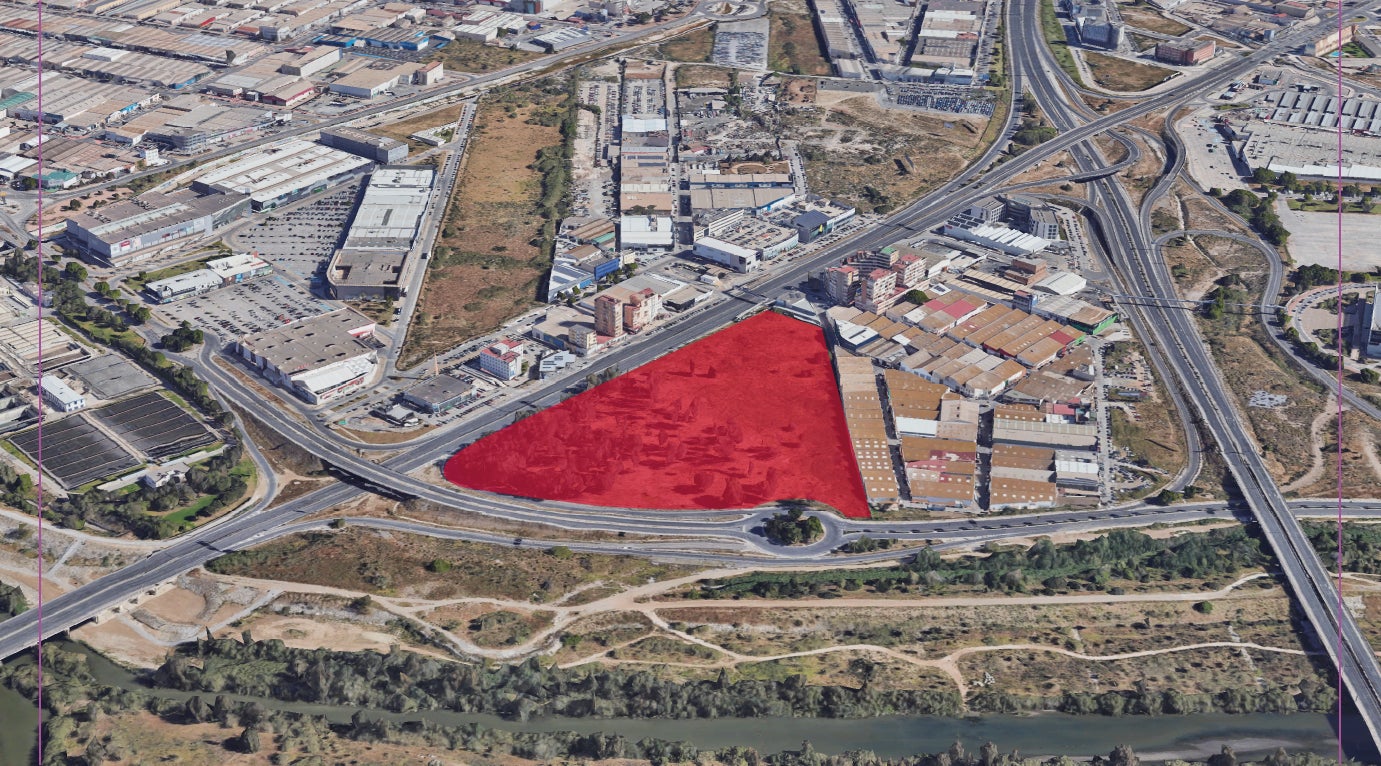

Although it has been anticipated for years, it was not until now that businessman Tomás Olivo, owner of La Cañada de Marbella and many other shopping centers throughout Spain, has taken the first step to build a large shopping center in Málaga on the plot of the Azucarera, between Velázquez Avenue and the MA-22 road that extends the Azucarera-Intelhorce axis towards the area of Martín Carpena and the western seafront promenade. According to SUR, Olivo's company, General de Galerías Comerciales, has submitted a document to the Municipal Urban Planning Office to initiate the procedure for changing the land use, which he acquired years ago, to accommodate a shopping center.
The current General Urban Planning Plan (PGOU) of the capital, approved in 2011, maintains the classification granted by the previous plan of 1997, with the aim of accommodating businesses, as well as a green area closest to the confluence of Velázquez Avenue with the MA-22. Thus, for Tomás Olivo to realize his project, a modification of the planning must be processed to convert that business use, which has been definitively approved since 2009, into commercial.
This modification could still take several years of procedures, as it must first undergo an environmental assessment by the Junta, which usually takes one or two years. However, the first step has already been taken for a project that, as this newspaper has learned, bears the signature of the local architect Ángel Asenjo, along with the British firm Chapman Taylor, one of the most prestigious international companies in the design of shopping centers, founded in 1959, with notable projects in the United Kingdom and Qatar.
Olivo has surrounded himself with top-level architects for his venture in the Málaga capital, for which he has chosen a plot of land he owns that has been vacant for years and is located in one of the city's clearly expanding areas, next to the Málaga Nostrum center, which is undergoing renovation with the arrival of the Costco supermarket, and the Carpena area, where a campus of the Alfonso X El Sabio University has started operating, and the renovation of the racquet center with a club promoted by the Marbella-based developer Sierra Blanca that will carry the Rafa Nadal brand. Additionally, new high-priced homes continue to be built at this end of the western coast in the La Térmica and El Pato area.
Málaga
Industrial estate
Haza de la Cruz
Planned shopping center
MA-22
Guadalhorce River
Source: Málaga City Council
According to the data collected, the project of Tomás Olivo's group covers a land area of about 65,000 square meters where a large commercial complex of ground floor plus two (although it could reach a height of three floors at some points), with a footprint of about 45,000 square meters, and approximately 115,000 square meters built inside. Additionally, in the sector's planning maps, two green areas totaling almost 20,000 square meters have been drawn.
It will be a shopping center with numerous commercial premises, a supermarket, and cinemas, whose construction could involve an investment of over 150 million euros. It will also have two large basement floors that could accommodate about three thousand parking spaces.
The promoters of this future commercial space are relying on the administrations to expedite the necessary procedures for its approval, so that it can become a reality within about three or four years. However, the urban planning procedure required for the change of land use (from industrial to commercial) is complex because it requires an environmental assessment procedure by the delegation of the Ministry of Sustainability and Environment.
One of the main challenges of the project is the traffic congestion in the area
Moreover, it is clear that one of the main challenges of this project is related to traffic, as it is located next to one of the road axes where major congestion often occurs during peak hours. The promoters of the project have conducted a traffic study and proposed the construction of roads to channel the circulation that this large area could generate. However, the reports issued by both the Mobility Department of the City Council and the General Directorate of Highways of the Ministry of Transport will be crucial.
It is worth remembering that the reservations of both departments have so far stalled the approval process of a new commercial expansion of the Plaza Mayor center, although its owners hope to unlock it by undertaking new road infrastructures, such as the doubling of the south lane of the Guadalmar highway, a new access from the north from the Airport road, and a deterrent parking lot for more than a thousand spaces.
The PGOU also indicates that, having carried out a "potentially polluting" activity on these soils that housed an industrial activity, its owners "will be required to present a situation report, when applying for a building license for the new authorized uses in the sector." "If based on this information, the autonomous community declared the soil as contaminated for such uses, the owners will be required to carry out the necessary actions to proceed with its environmental recovery," adds the General Plan, which emphasizes that the soil "will cease to be considered contaminated when the administrative resolution declaring it so is firm."
Expand
Olivo, the 'king' of shopping centers
For years, businessman Tomás Olivo has aimed to open a shopping center in Málaga capital, a city that has eluded him until now after deploying a dozen complexes along the Mediterranean and Canary Islands. Since the construction of the La Cañada shopping center in Marbella in 1997, Olivo's company has built nine other large surfaces. In 1998, he launched the Mediterráneo shopping center in Almería; and in 2000, he opened one in the town of Mataró, Barcelona. In 2002, he moved to Almería, with the Gran Plaza de Roquetas de Mar, and a year later, he launched Dos Mares in Murcia, where he also owns La Rambla in Cartagena.
In 2008, he opened Las Dunas in the town of Sanlúcar de Barrameda, and that same year expanded his businesses to Las Palmas de Gran Canaria, where he owns Las Terrazas Outlet and El Mirador Shopping. Also, in 2016, he opened the Nevada center in the municipality of Armilla, which in recent years has become one of the main commercial references in Granada.
The latest update of the 'Forbes' list placed Tomás Olivo as the best-positioned businessman from Málaga (although by adoption) in sixth place. His estimated fortune has increased by 1.9 billion euros in the last year, reaching 4.6 billion. Olivo was born in Murcia and has his company's headquarters in Madrid, but his life and business have been linked to the Costa del Sol for decades. He is also a prominent shareholder and advisor of Unicaja Banco.
There are only two Andalusian fortunes among the fifty largest in Spain, and both are in Málaga. The first is that of Olivo and the second, that of the family that owns Mayoral, headed by Manuel Domínguez de la Maza, which remains in the 41st position on the list.

Latest news





Upcoming events
12
Nov
El Desembarco, la traición de Viriato at La Caja Blanca
12
Nov
HOMER El Mero Mero at Sala Trinchera Málaga
13
Nov
Marbella Startup Lab – Innovate & Collaborate
13
Nov
Candlelight: Coldplay & Imagine Dragons at Sala Fundación Unicaja María Cristina
13
Nov
Candlelight: Tribute to Ludovico Einaudi at Anantara Villa Padierna
Similar News

Málaga Airport Makes History with More Than Three Million Passengers in One Month
Málaga

Port of Málaga looks beyond its docks to support future growth
Málaga

Guide to the Virgen del Carmen Processions in Málaga and the Province
Málaga
