


José Antonio Trujillo: "Artificial intelligence will replace the doctor and the teacher who do not use it"
The doctor and popularizer from Malaga presents at the Unicaja Foundation 'Smart Natives', a book that advocates for humanism against the educational, social, and ethical impact of AI.
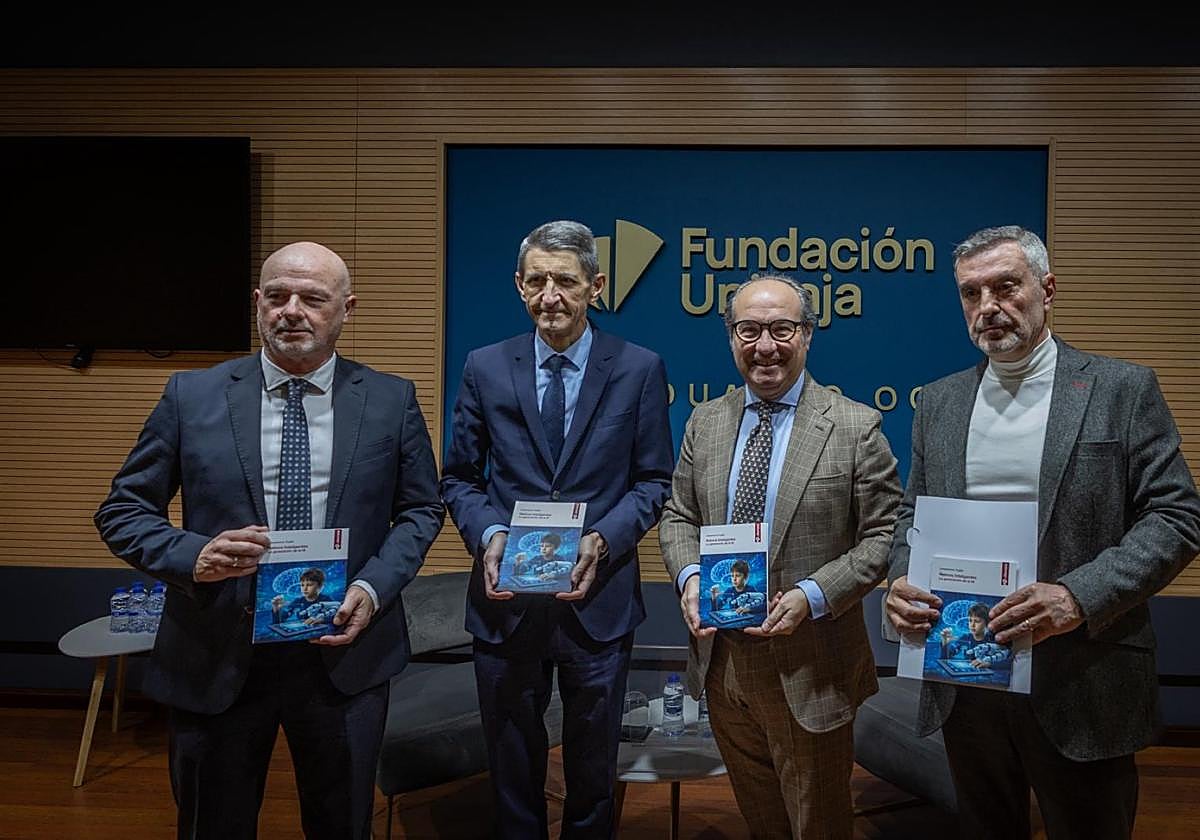

What we considered human is no longer obvious. Technology has advanced at a dizzying pace to the point where ... a newly installed CT scan program can read images with such precision that many specialists are no longer needed. Where there were six workers, one would suffice. Their role would be to monitor, not to act. The rest, dispensable. This scene, more clinical than futuristic, serves Dr. José Antonio Trujillo to make an uncomfortable diagnosis: "Artificial intelligence will replace the doctor and the teacher who do not use it." Not as a sectoral warning, but as a symptom extending to any profession that confuses resistance with survival.
Trujillo avoids abstraction and technological enthusiasm, giving voice to humanism from a career that spans medicine, scientific dissemination, and ethical reflection. As the first vice president of the Official College of Physicians of Málaga and author of several essays on AI and patient rights, he presented his new book, 'Intelligent Natives', published by the Publishing Service of the institution, at the Unicaja Foundation. The event, held in the Eduardo Ocón Hall of the Unicaja María Cristina Foundation, featured the participation of the Foundation's Literature Officer, Francisco Cañadas, and journalist Adolfo Arjona, who served as a thoughtful interlocutor in a dialogue more reflective than promotional.
Before delving into technological analysis, Trujillo paused to remember Jesús Aldaña, a doctor from Málaga who died in the train accident at Adamuz. "He was brilliant, the best of his class. He wanted to return to Málaga and get married in August," he said. The subsequent silence set the tone for the evening. "Talking about algorithms without talking about people is a form of contemporary estrangement," he suggested.
"The important thing about artificial intelligence is not the answers, but the questions"
One of the central concepts of the book is the distinction between digital natives and intelligent natives. The former use tools; the latter dialogue with them. "My son no longer searches the Internet, he converses with the machine," Trujillo explained, referring to a relationship that is no longer instrumental but cognitive. The question, slipped in without drama, is what happens when that dialogue begins to mediate vital decisions and maturation processes.
The essay is structured around three axes: education, employment, and ethics; and it denounces an educational system anchored in 20th-century schemes while students compete on a global board. "Either we are protagonists of change or we are those holding the cocktail," he warned. Either solutions are offered, or others are consumed.
Time as a moral frontier
Special attention was given to time. AI promises efficiency, but also a delimitation that frees up hours of persistence. What to do in that space? Trujillo even proposed a "time bank" that allows deciding what to delegate to machines and what to reserve for the human. "Artificial intelligence is intelligent, but it is not wise," he insisted.
From there his defense of a new humanism. People capable of formulating good questions, detecting algorithmic biases, protecting the most vulnerable, and understanding that dignity is not quantifiable. "Our generation was that of the Moon, the intelligent natives might reach Mars." The unknown, he concluded, is not the destination, but the human baggage they decide to carry.

Latest news





Upcoming events
12
Nov
El Desembarco, la traición de Viriato at La Caja Blanca
12
Nov
HOMER El Mero Mero at Sala Trinchera Málaga
13
Nov
Marbella Startup Lab – Innovate & Collaborate
13
Nov
Candlelight: Coldplay & Imagine Dragons at Sala Fundación Unicaja María Cristina
13
Nov
Candlelight: Tribute to Ludovico Einaudi at Anantara Villa Padierna
Similar News

Málaga Airport Makes History with More Than Three Million Passengers in One Month
Málaga

Port of Málaga looks beyond its docks to support future growth
Málaga

Guide to the Virgen del Carmen Processions in Málaga and the Province
Málaga
