


Francisco Jarauta, writer:
He just directed a series at the Student Residence in Madrid on Thomas Mann for the centenary of 'The Magic Mountain', after presenting his new book there, 'Poetics of the Fragment', in which he advocates for the essay over academic discourse.
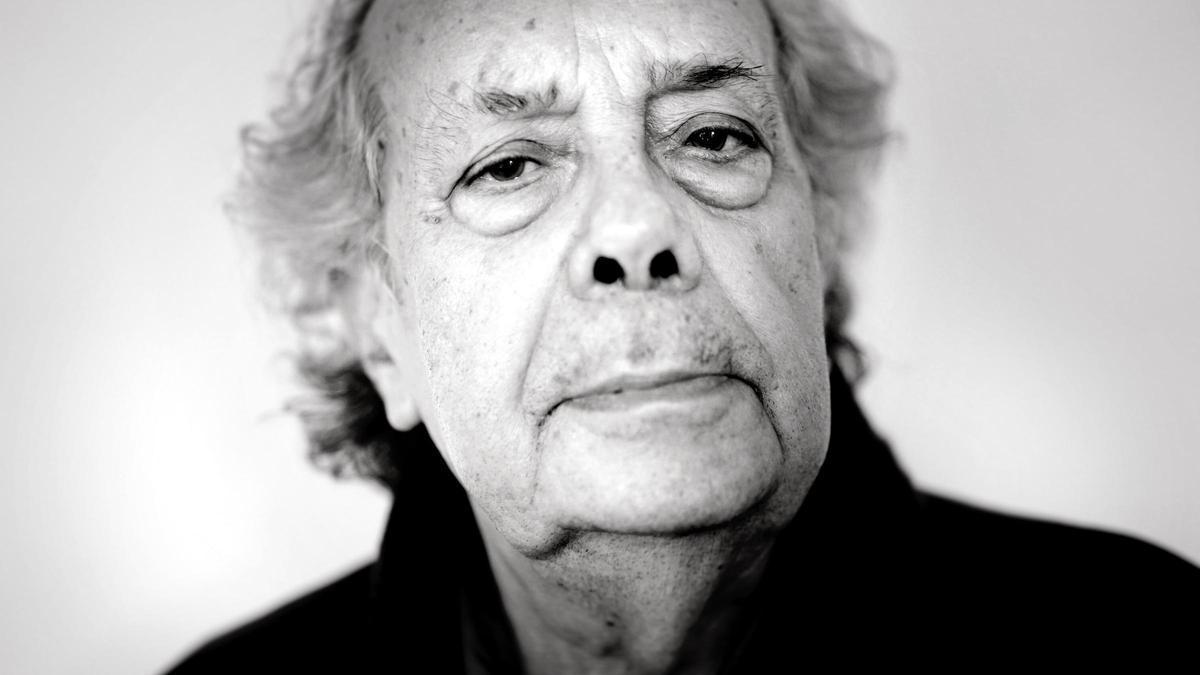

In "the most accelerated and fragmented era in the history of humanity," asserts Francisco Jarauta (Zaragoza, 1941), who describes himself as "a passionate skeptic" and counters that "thought is a form of resistance." During the over three-hour conversation, on a November morning with a spring-like memory, the famous hill of the Residencia de Estudiantes de Madrid turns into a valley, behind the window of the cozy upper room they have provided him, with the treetops at eye level.
He is their intermittent guest, as a tutor for the fellows, a role extinct since the Republic, now revived with him. This afternoon he will deliver - another 3 hours - a seminar on Surrealism for the 100th anniversary of the 'Manifesto', and the next day, he will discuss music and silence in Cuenca, and soon, about the insular imaginary at a film festival in Lanzarote…
Also at the Residencia, he has just directed a cycle on Thomas Mann, for the centennial of The Magic Mountain, after presenting his new book, 'Poetics of the Fragment' (Lancelot), where he advocates for the essay over academic discourse, and in 2025, will publish 'Nietzsche: The Aura of Nihilism'. At 83 years old, even retired as a Professor of Philosophy at the University of Murcia, he continues to teach postgraduate seminars at Humboldt University in Berlin, and at the Collège de France in Paris.
Those who know him closely, among the thirty philosophers and writers who pay tribute to him in 'Francisco Jarauta at the Borders of Babel' (2018), published by the European Institute of Design, highlight his enveloping oratory skill, filled with historiography, where anecdotes are as substantial as the content. In his lectures - always a cappella, without looking at any notes - he summons characters and authors from the past as if they were his friends, and to whom, in turn, he seems to be introducing, one by one, to each member of his audience.
Up close, his hospitable generosity and symmetrical empathy are more apparent, no matter who his interlocutor is. Also, his proverbial ability to live the text ("it is our second flesh") and to read each experience. As an advanced student, he seems to follow Nietzsche's main mandate, which poor Nietzsche himself could not undertake: to populate the present moment, to be, each time, where one is.
Q. In 'Poetics…', and I imagine even more so in your upcoming monograph, you defend the special relevance of Nietzsche, even though postmodernisms, weak thoughts, and other fin de siècle hedonistic currents, which invoked him so much, have gone down the drain.
A. His teaching, which continued to grow throughout the 20th century, is now more solid and urgent. His notion about the metaphorical nature of language, and consequently, the lack of correspondence between language and world, is much clearer. Postmodernism, which certainly invoked him, had something of a collective therapy: a shared comfort space and even glamour, while now we talk about limited comfort zones. Back then, heroes were no longer necessary, and circular subjectivities were enhanced. But, with the fall of the Berlin Wall, there was a drastic cultural shift. We begin to identify the negativity of the social, in increasingly complex societies. Differentiating elements accumulate, the culture of violence, of wars intensifies. It was no longer possible to maintain a generalized happy theory, as was attempted then. Nietzsche's gaze becomes more severe today, when the provisionality of languages and fleeing structures multiply. Of course, Zaratustra's laughter saves us from the melancholy for the nostalgia of the lost totality. But today the Nietzsche who reminds us that “our future is the mineral kingdom” prevails. Or the one who, as a family doctor, announces: “I have come to cure you of the nightmare of eternity.”
Never before has the present been so disconnected from the future. In the past, the future offered more guarantees of continuity, but today the question of the future is distressing.
Q. Could it be that the simulacrum of the past has decomposed into almost irrefutable liquid simulations? You echo, by the way, Zygmunt Baumann's turn in his last essays, where he detects our current condition of "global spectators," subjected to a new "anxiety"; that terrible simile of being prostrate on a platform watching high-speed trains pass by without being able to board any of them…
A. Notice that, in that lucid image, Baumann incorporates "high speed." I refer to Paul Virilio's warning: that the paradigm shift of our time is having "domesticated speed." Previously, for example, parallel to that culture of the simulacrum, coined by Jean Baudrillard, the ephemeral was highlighted. But now that concept falls short for us, as the ephemeral becomes something permanent, and its tempo is ever shorter and shorter. Thus, we are condemned to be observers of a world that changes at a permanent speed. And the distance from our gaze keeps growing, because while everything continues to change at breakneck speed, we must remain clinging to a certain identity. Obviously, this generates "anxiety", and, unable to digest it, we fall into perplexity. I believe that is the most notable syndrome today: We live in a loop between anxiety and perplexity.
Q. Wow! It sounds like not even being able to bathe once in Heraclitus' river; or, at least, not being able to cross to the other shore on the first swim. Even worse than the "immemorial present," by J-F. Lyotard, how can we articulate any future from such a cyclothymic and fast-paced present?
A. It's that never before has the present been so disconnected from the future. In the past, the future offered more guarantees of continuity: it was more peaceful and predictable; but today the question of the future is distressing. If we surveyed 50 people from any background on how we perceive the future, each would say something different, and surely, no answer would match reality. The future is a spectral enigma, even for Donald Trump himself [smiles of perplexity]. If we were to imagine it, our eye would be pierced by the razor in the famous frame from Buñuel [smiles of anxiety]…
Q. And how does it affect any will for transcendence in literature and art? Art critic Estrella de Diego claims that no one wants to be immortal anymore, but we are content with being 'undying' …
A. Art continues to fulfill its function of illumination and protection against chaos. More radically than Walter Benjamin had noticed, it is obvious that it has lost any aura of transcendence, and no one can ask of a work, more than its immediate profitability. Beauty is no longer associated with a model of universal beauty. Today, beauty is much more fragmented, more subjective, and can be found anywhere... in a gust of wind that has tousled your hair, or, who knows, a crumb of bread lost on an abandoned table... Each one has their episodes of instant beauty. I am still moved by Hans Castorp, in 'The Magic Mountain', humming towards the end of the novel, entering the battle, Schubert's 'Der Lindenbaum', the Lied that accompanied his childhood... No one can frame the world in a single text anymore, as naturalists and romantics wanted. The unitary is a mirage; but, knowing this, it is not idle to try to reassemble the fragments over and over again. In that lies creation, which has little to do with eternity, so associated with the idea of posterity. It is too long to offer us guarantees of anything...
Freedom has always been part of my way of living and thinking; I have always felt it, from a certain silent anarchism, as something non-negotiable.
Q. So, is any artistic proposal or literary delivery, as it is significantly said, destined to be increasingly ephemeral, marginal, and invisible to society as a whole?
A. In a society so atomized into individuals and very heterogeneous groups, it would be quixotic to seek the generalized visibility that was sought in the past. The more rigorous and ambitious an artistic or literary work is, the more marginal it will be, but it will compel much more to think, and thinking is a form of resistance. It is not useless to write or paint on the borders, or in the sands of the desert, as Edmond Jabès [Jarauta has introduced the author of The Book of Questions in Spain] teaches us. These are not bad times to understand that there is a silence born from inner experience, very fertile for creation or for contemplating life.
Q. In your book, you exalt the fragment as the most appropriate expression. Isn't it dictated by the space granted by social networks? Don't we run the risk of perpetuating the culture of snacking; and of violating Wittgenstein's warning: "the cherry might be the best part of a cake, but a bag of cherries is not better than a cake"?
A. I defend the thoughtful fragment, as an antidote to its banalization; the fragment as the center of the essay, which should permeate any other literary genre. Against the theses of classicism on the unity of culture, and civilization, what remains for us is the fragment, which multiplies. The fragmentary essay, against the fallacy of systematic dreams, as the academic discourse pretends. We can no longer find out anything, but by approximation, in a wandering manner; not by explanations, but in infinite allusions, as envisioned from Nietzsche to Robert Musil. It is a revulsive against all positivization of artistic languages, when the most important thing is that they show their tension, their version of the shipwreck of any totalizing discourse.
Q. You also talk about old age, and even illness, as a certain space of redemption, when "the ghosts calm down" and "a sovereign freedom" appears, much more internalized...
A. Freedom has always been part of my way of living and thinking; I have always felt it, from a certain silent anarchism, as something non-negotiable. And indeed, old age reaffirms that attitude abundantly. Of course, it grants nothing if one has not had that predisposition. The last Gilles Deleuze, already very ill, left written on a sheet, which I accessed through my friend Lyotard, something that marked me: "Only death gives us the right to think and say certain things." I feel that freedom.
Q. I was going to ask you from the beginning, but knowing that we are fragmentary castaways, anxious and perplexed, and most of us, to forget it, with headphones on, it is more pertinent to ask now, What is the use of philosophy today?
A. To be able to recompose the questions. Today there is an excess of exclamations and a defensive fear of asking too many questions. Augustine of Hippo said it, and María Zambrano adopts it: "Who are we?: We are those who ask questions." We thirst for answers, and, knowing that we will not finish quenching it, each new time demands that we reformulate the questions, and that is the tutelary task of Philosophy. In the Asian steppes, a radical etymological term was born, the term 'eth', which means, at the same time, "human" and "thirsty." We are human because we thirst for answers and have an insatiable curiosity. It is one of the most radical warnings given to us by Robert Musil in 'The Man Without Qualities': "When we no longer have questions, we become posthumous in life."
'Poetics of the Fragment'
Francisco Jarauta
Artsolut Publishers
174 pages. 15 euros

Latest news





Upcoming events
12
Nov
El Desembarco, la traición de Viriato at La Caja Blanca
12
Nov
HOMER El Mero Mero at Sala Trinchera Málaga
13
Nov
Marbella Startup Lab – Innovate & Collaborate
13
Nov
Candlelight: Coldplay & Imagine Dragons at Sala Fundación Unicaja María Cristina
13
Nov
Candlelight: Tribute to Ludovico Einaudi at Anantara Villa Padierna
Similar News

The Cat Guardian: Nearly 14 Years of Rescues and 16,500 Neutered Cats
Málaga

María Barranco resurfaces after hitting rock bottom: "No one can sink me"
Málaga
Ana Duato: "Merche taught me to be a woman, a person, and an actress"
Málaga
