


This town in Málaga is one of the great unknowns of the province: it is Mudejar and white.
Salares is a very unique enclave in the Axarquía region of Malaga due to its structure and history. It is one of the towns in Spain that
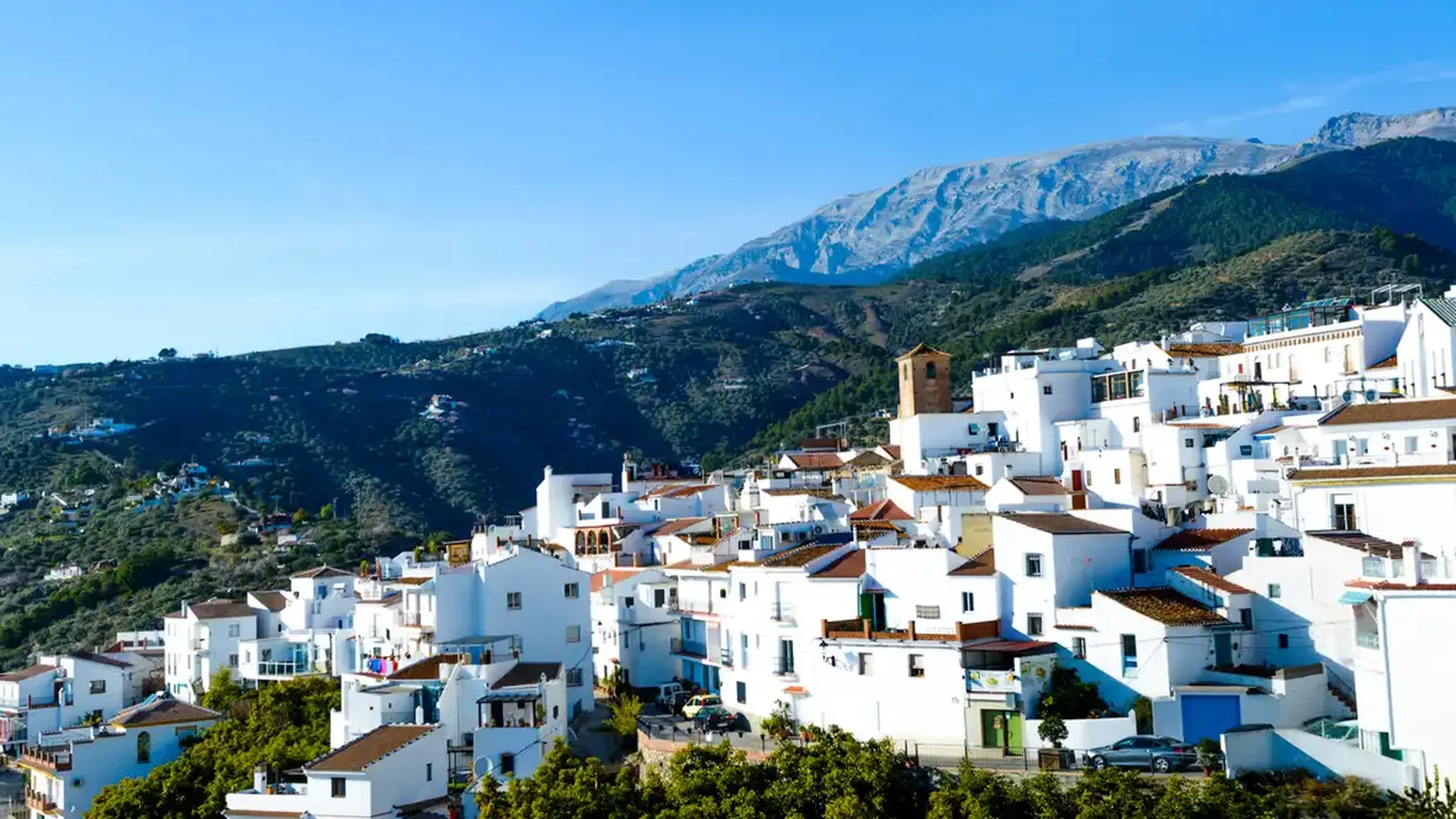

Sometimes, the smallest towns hold the most eloquent stories. In the heart of the Axarquía, among mountains that filter the light and streets where white is not just a color, but a heritage, Salares appears as one of those towns where time seems to have stopped. Nestled at the foot of the Natural Park of the Sierras de Tejeda, Almijara, and Alhama, it sketches a landscape where architecture and environment converse without stridency, allowing the Mudejar past to continue setting the pace of the present.
Located in the heart of the Axarquía, Salares is one of the smallest towns in the province of Málaga and, at the same time, one of those that best preserves its historical legacy. Its location, in a mountainous area of great scenic value, has helped preserve an urbanism inherited directly from its Andalusian past.
Steep streets, irregular steps, and narrow passages form a layout that follows the logic of the ancient Moorish towns. In many places, the houses still show the original structures beneath layers of lime, revealing the stone and traditional materials with which they were built. The result is a coherent urban ensemble, sober and deeply authentic.
Ancient Origins of Salares: From Rome to Al-Ándalus
The origins of Salares date back to Roman times. After the passage of Phoenicians, Phocaeans, and Carthaginians, it was the Romans who consolidated the settlement, attracted by the exploitation of salt in the area. According to historical studies, the site was then named Salaria Bastitanorum, a name that directly refers to that activity.
With the arrival of Al-Ándalus, the town acquired an identity that is still clearly perceived today. The Muslim footprint not only defined the urbanism but also the main architectural elements that have survived to this day and make Salares a reference within the Mudejar Route of the Axarquía.
The Church of Santa Ana and the Almohad Minaret
The most representative building of the town is the parish of Santa Ana. Built in the 16th century on the remains of an old mosque, this Mudejar-style church preserves one of the great heritage treasures of the town: its bell tower, which was originally an Almohad minaret.
Built between the 13th and 14th centuries with red brick, the minaret is considered one of the best examples of Almohad art preserved in Spain. Its historical and artistic value was recognized in 1979, when it was declared a National Historical-Artistic Monument. Its facade still displays decorative details and remnants of tiles that refer to its original function as a call to prayer tower.
The Torreón House and the Defensive Legacy
Another of the most prominent vestiges of Salares' past is the Casa del Torreón. This building, linked to the old fortress and the mosque's wall, is part of the small but significant historical heritage of the municipality. Although its exact function in Islamic times is not completely defined, its presence reinforces the strategic importance that the enclave had in other times.
From its vicinity, some of the most recognizable perspectives of the urban area are obtained, with the church and the minaret dominating the ensemble of white houses.
The Roman Bridge over the River Salares
At the entrance of the town, one of the oldest elements of its heritage is found: the Roman bridge that crosses the River Salares. This structure, restored at different times over almost two millennia, is a testimony to the passage of different civilizations through the area.
During the Andalusian period, the bridge was reinforced with a red brick arch, characteristic of the Mudejar style, which explains why it is sometimes also called the Arab bridge. From this point, a privileged view of the natural environment and the village, integrated into the landscape, is obtained.
Nature, Tradition, and Everyday Life
The natural environment of Salares is marked by its proximity to the Natural Park of the Sierras de Tejeda, Almijara, and Alhama. The mountains, watercourses, and trails that start from the town configure a landscape of great ecological richness. Inside the town, small details like the citrus planted in the streets, the flowered alleys, or the century-old olive tree in the main square reinforce the feeling of continuity between nature and everyday life.
Salares is part of the Mudejar Route of the Axarquía, along with other municipalities such as Árchez, Sedella, Canillas de Aceituno or Arenas, an itinerary that highlights the Andalusian heritage of this eastern region of Málaga.

Latest news





Upcoming events
12
Nov
El Desembarco, la traición de Viriato at La Caja Blanca
12
Nov
HOMER El Mero Mero at Sala Trinchera Málaga
13
Nov
Marbella Startup Lab – Innovate & Collaborate
13
Nov
Candlelight: Coldplay & Imagine Dragons at Sala Fundación Unicaja María Cristina
13
Nov
Candlelight: Tribute to Ludovico Einaudi at Anantara Villa Padierna
Similar News

Málaga Airport Makes History with More Than Three Million Passengers in One Month
Málaga

Port of Málaga looks beyond its docks to support future growth
Málaga

Guide to the Virgen del Carmen Processions in Málaga and the Province
Málaga
