


The Case of the Virgin of the Apple: Stolen 63 Years Ago in La Rioja and Unexpectedly Found... in the Malaga Museum
The sculpture, dated between the 13th and 15th centuries, is removed from the collection for an exhibition in San Millán de la Cogolla, from where it was stolen in the 1960s.
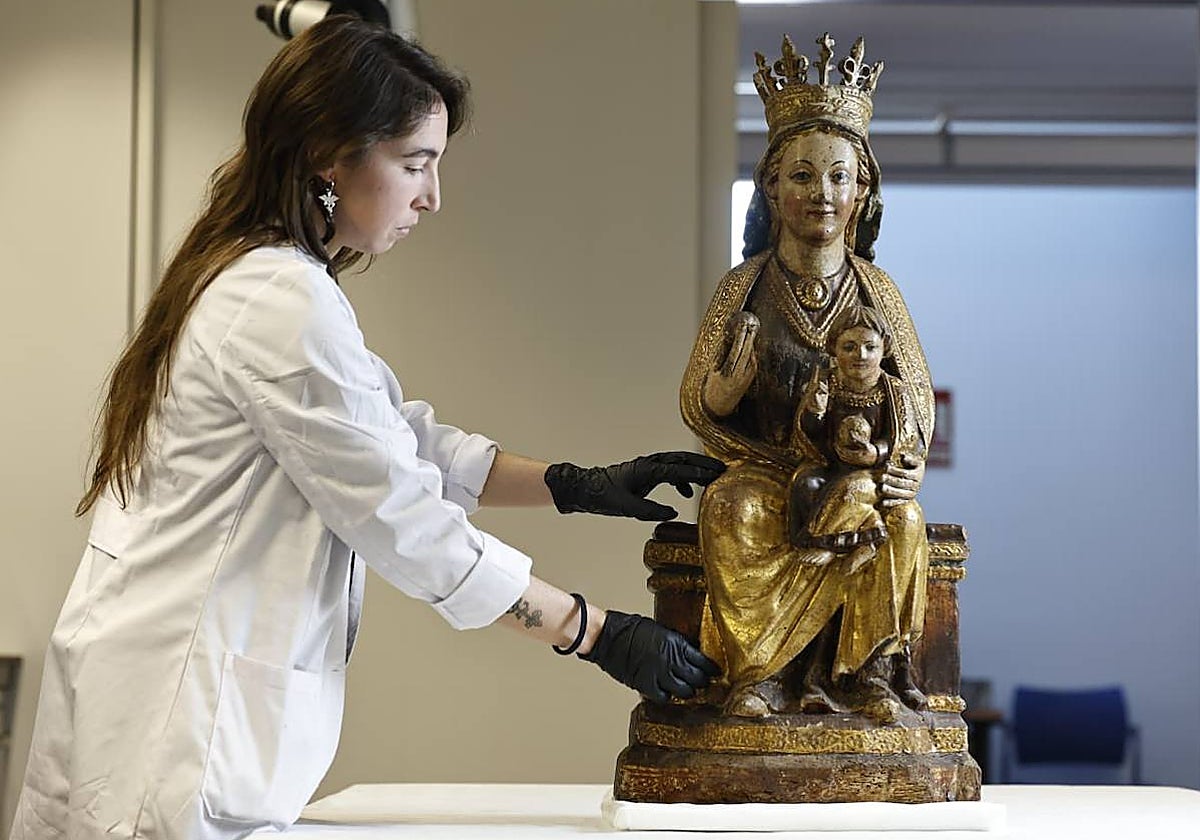

This story begins with a theft in La Rioja in 1963 and ends with its definitive resolution six decades later at the Museum of Málaga, where the stolen item was found. A journey worthy of a movie script: a heist executed with premeditation and at night, illegal export of cultural goods, police investigation, recovery in France, and repatriation of the piece, and, in an unexpected twist, the loss of the whereabouts of the work after its return to Spain. The protagonist of this story is the Virgin of the Apple, a sculpture dated between the 13th and 15th centuries, which adorned the altarpiece of the Monastery of San Millán de Suso, from where it was stolen in the early 60s of the last century. Although the sculpture was rescued, it never returned to its original place and was lost from sight. Until some visitors recognized it at Customs.
After this story was reported by the newspaper 'La Rioja' and the intervention of the Government of this autonomous community, the Museum of Málaga has moved the 'Virgin of the Apple' from the storage area to its restoration workshops, where it has undergone preventive treatment for its temporary loan and upcoming transfer for the 'AuthorÍA' exhibition, scheduled in San Millán de la Cogolla in the second half of that year. The Customs gallery has opened its doors to SUR to show the emblematic and forgotten work which, after solving the mystery of its whereabouts, has seen a revival in its popularity and devotion from when it occupied the central space of the church's altarpiece.
Related news
The lion found in the lost city of Roman Málaga reveals its secret: it has a twin
Guerrero Strachan, the architect who invented modern Málaga with just 'a grain of sand'
The museums of Málaga spend four million euros on security to prevent thefts like that of the Louvre
The Virgin holds a sphere representing the world, but popular belief thought it looked more like an apple, hence the name by which it is known.
In a room resembling an operating theater, the 'Virgin of the Apple' stands out in the center of the space, with its back to everyone who enters. What first surprises is its size, with its almost 90 centimeters in height, and the remains of polychromy and gilding that still withstand time and the woodworm that, up close, left its marks on the wood. As you circle around and look at it from the front, the serene expression of the sculpture captivates the viewer, although it is also discovered that the figure of the Virgin is not alone as in her left hand -and on her knee- she holds her son. The key to the sculpture is in the other palm, which holds a sphere. This sphere -the child holds another similar one- represents the world, but popular belief considered that it looked more like an apple, hence the title by which it is known.
Follow Diario SUR on Google DiscoverRobbery, gendarmes, and return
The quality of the piece, together with its 15th-century antiquity and the scant surveillance of this heritage at that time, led to the sculpture being stolen from the altar of Suso on the night of August 4 to 5, 1963. According to the chronicles of the time, it was the monastery's guard, Ignacio Echeverría Casamayor, who noticed the disappearance and reported it to the authorities and the Civil Guard. Nothing was known until, sixteen months later, in December 1964, the sculpture was recovered by the French Gendarmerie in Poitiers, "at the home of a photographer", along with other "thirty or forty art objects or small Spanish pieces", the press reported then. The work was returned by the French authorities and initially deposited in the Directorate General of Fine Arts in Madrid for "cleaning and restoration" with the aim of "being duly reintegrated into the place it occupied in the National Monument from which it was stolen", according to the press.
Indeed, in the workshop of the Museum of Málaga, it can be seen how the sculpture retains on its hollow and uncarved back the document from the Central Institute for the Restoration of Works of Arts that identifies the work as 'Virgin of the Apple'. The record also confirms that it underwent a conservation treatment after its recovery and specifies that the intervention was carried out by the Cruz Solís Brothers in September 1965. Up to that point, the journalistic story was fulfilled, but the second part, its reintegration into the altarpiece of the monastery, never arrived. And everything points to an administrative error.
After the theft, the sculpture was cataloged again and renamed by the Ministry of Culture, thus losing its link with La Rioja and being sent randomly to Málaga
The unexpected twist in the story occurred when the piece was re-cataloged in Madrid and its description was modified by changing its dating from the 15th century to the 13th, and being renamed 'Seated Virgin with Child', losing its original 'ID': 'Virgin of the Apple'. Once misplaced, it seems that the Ministry of Culture sent it on deposit to the Museum of Málaga randomly. "At that time, the prevailing idea was that all provincial museums of Fine Arts should have a complete journey through the history of art, but of course here this piece is decontextualized and does not contribute much to our exhibition discourse because there was never Romanesque or Gothic art here," María Morente, director of the Customs gallery, told SUR.
"This theft is the story of what happened with part of the artistic heritage for decades in the 20th century in many of our towns," José Luis Pérez Pastor, the Minister of Culture, explained to 'La Rioja', noting that the location of the 'Virgin of the Apple' is due to Francisco Burgos and Germán Chicote, who "by different paths arrived at the same discovery". Two people with an expert eye who have given the final resolution to "a nearly detective story of a loss and a recovery", says the minister who highlights the collaboration of Ángeles Albert, director general of Fine Arts, and María Morente, director of the Museum of Málaga.
For the moment, the loan of the work and its return to San Millán for an exhibition has been authorized. A loan that, beyond this temporary exhibition, is intended to be definitive, for which there seems to be understanding and willingness among the parties. "Its transfer to La Rioja, where the sculpture is explained in its context, is going to be studied," they advance from Málaga.

Latest news





Upcoming events
12
Nov
El Desembarco, la traición de Viriato at La Caja Blanca
12
Nov
HOMER El Mero Mero at Sala Trinchera Málaga
13
Nov
Marbella Startup Lab – Innovate & Collaborate
13
Nov
Candlelight: Coldplay & Imagine Dragons at Sala Fundación Unicaja María Cristina
13
Nov
Candlelight: Tribute to Ludovico Einaudi at Anantara Villa Padierna
Similar News

Málaga Airport Makes History with More Than Three Million Passengers in One Month
Málaga

Port of Málaga looks beyond its docks to support future growth
Málaga

Guide to the Virgen del Carmen Processions in Málaga and the Province
Málaga
