


The Government sees the feasibility of the coastal train segment between Fuengirola and Marbella as viable.
The deputy opens up to the possibility of the Executive collaborating on the Cerro Blanco dam, although he recalls that the competencies in water matters belong to the Regional Government.
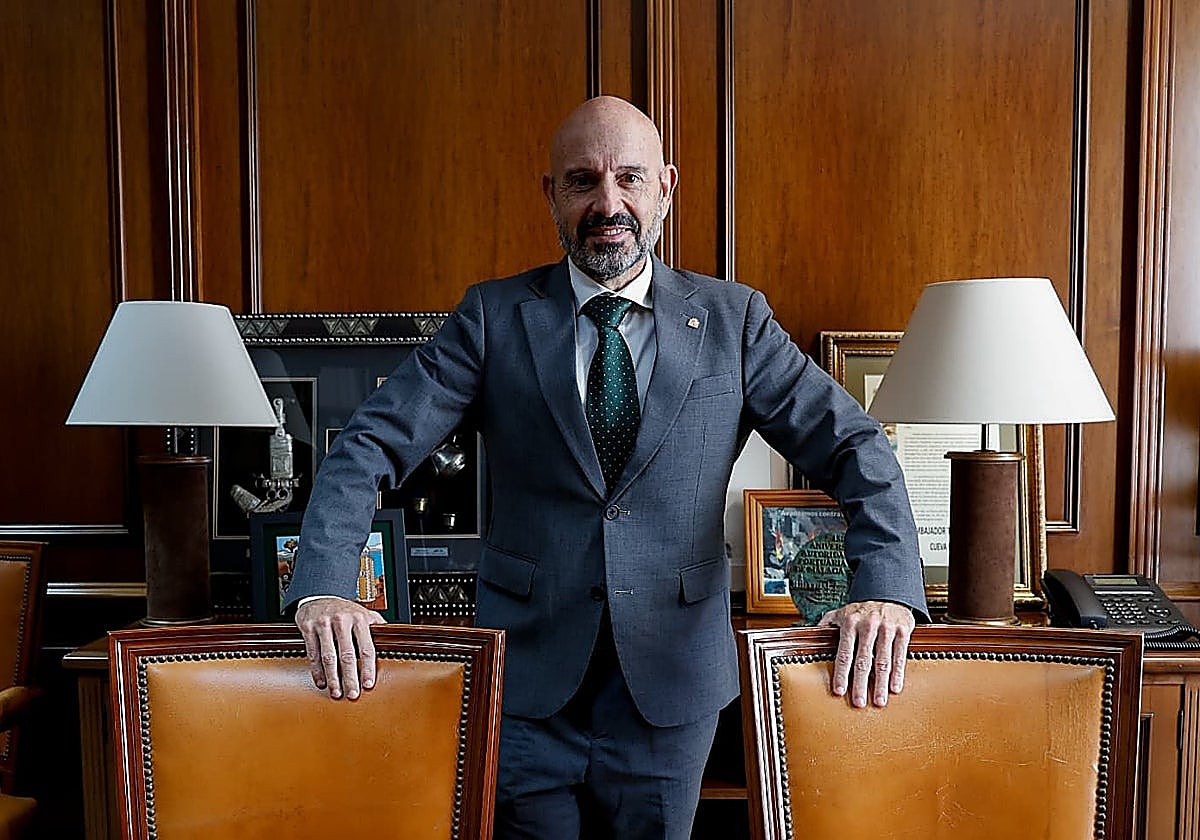

The Government of Spain sees the feasibility of the coastal train section between Fuengirola and Marbella as viable. This was confirmed this Wednesday morning by the Government's subdelegate in Málaga, Javier Salas, during a press breakfast marking the start of the year where he outlined the priorities and commitments of Pedro Sánchez's Government to the province.
Salas confirmed that the feasibility study commissioned last year by the Ministry of Transport, which will lay the technical groundwork for the future railway corridor, will be known after the summer. He added that from the data known so far, there is "some viability" in one of the "priority" sections, which is the one extending between Fuengirola and Marbella.
"From the mobility data we have, the section with the highest people mobility is between Fuengirola and Marbella," added the subdelegate, who noted that different routes are being considered, with one option being to follow the current route of the A-7 highway, although "until the feasibility study is seen, we will not know which one it will be."
Timelines for the studies
Javier Salas also confirmed that this year the studies on improving the viability of the A-7, both in its eastern part, where it will be determined whether the solution is a third lane, a new highway, or both options, according to the subdelegate, and in the western part, where options to improve the interconnection between the highway and the AP-7 toll road will be diagnosed.
Reviewing the outstanding issues of the Executive in the province and after the claim made by the Junta and the PP following the last rains to resume the Cerro Blanco dam project to prevent flooding of the Grande River, Salas has shown the Government's willingness to collaborate on this project but reminded that water matters are under the Junta's jurisdiction, and it should be the regional administration that conducts the study.
"The Government has always offered absolute collaboration with the Junta on anything they propose. There is no problem in discussing how we could help and collaborate, but it is within the Junta's competence," he emphasized.
The subdelegate recalled that the project included in the national hydrological plan was the construction of a small weir to collect water to be sent to the Atabal plant for treatment and not to prevent river surges, and that the initiative was discarded due to opposition from municipalities and environmental groups. "Water matters are under the Junta's jurisdiction, and it is the one that can carry out any action it deems appropriate within that scope of action," he reiterated.
Year of "the second transformation"
On the other hand, Javier Salas stressed that 2026 will be the year of "the second transformation" in the province's infrastructure with studies on roads, railways, the San Agustín library, the airport expansion project, works at Baños del Carmen, or the arrival of IMEC.
In the project, he did not mention the auditorium and when asked if the Government might change its position to finance this initiative, long demanded by the city's mayor, Francisco de la Torre, Salas avoided committing and stressed that cultural matters are under the Junta's jurisdiction, and if the regional administration and the City Council estimate to talk to the Ministry of Culture as they have done so far, "they should continue doing so."
Furthermore, the subdelegate emphasized the increase in transfers the Government has made to the municipalities and defended the new financing model that would mean Málaga would have an additional 1.170 billion euros per year.
"That would mean that each year a new third hospital could be built in the province and staffed; or a new Rosaleda, since Juanma Moreno has neither had the money nor the desire for Málaga to have a World Cup because there is no new Rosaleda; also, a few highways to Ronda could be built, 75,000 healthcare workers or 80,000 teachers could be hired annually," he asserted,
At the same time, the subdelegate criticized the Andalusian president for opposing this new financing system. "He's going to dip into the pockets of the people of Málaga just because he's yielding to the partisan interests of the PP and Feijóo. María Jesús Montero has done more for the province than Moreno in seven years," he remarked.

Latest news





Upcoming events
12
Nov
El Desembarco, la traición de Viriato at La Caja Blanca
12
Nov
HOMER El Mero Mero at Sala Trinchera Málaga
13
Nov
Marbella Startup Lab – Innovate & Collaborate
13
Nov
Candlelight: Coldplay & Imagine Dragons at Sala Fundación Unicaja María Cristina
13
Nov
Candlelight: Tribute to Ludovico Einaudi at Anantara Villa Padierna
Similar News

Málaga Airport Makes History with More Than Three Million Passengers in One Month
Málaga

Port of Málaga looks beyond its docks to support future growth
Málaga

Guide to the Virgen del Carmen Processions in Málaga and the Province
Málaga
