


'Blaubeereen': A Capital Work on Terrifyingly Normal Men
Pirate Ship returns to the Malaga Theater Festival with 'Blaubeeren', directed by Sergio Peris-Mencheta
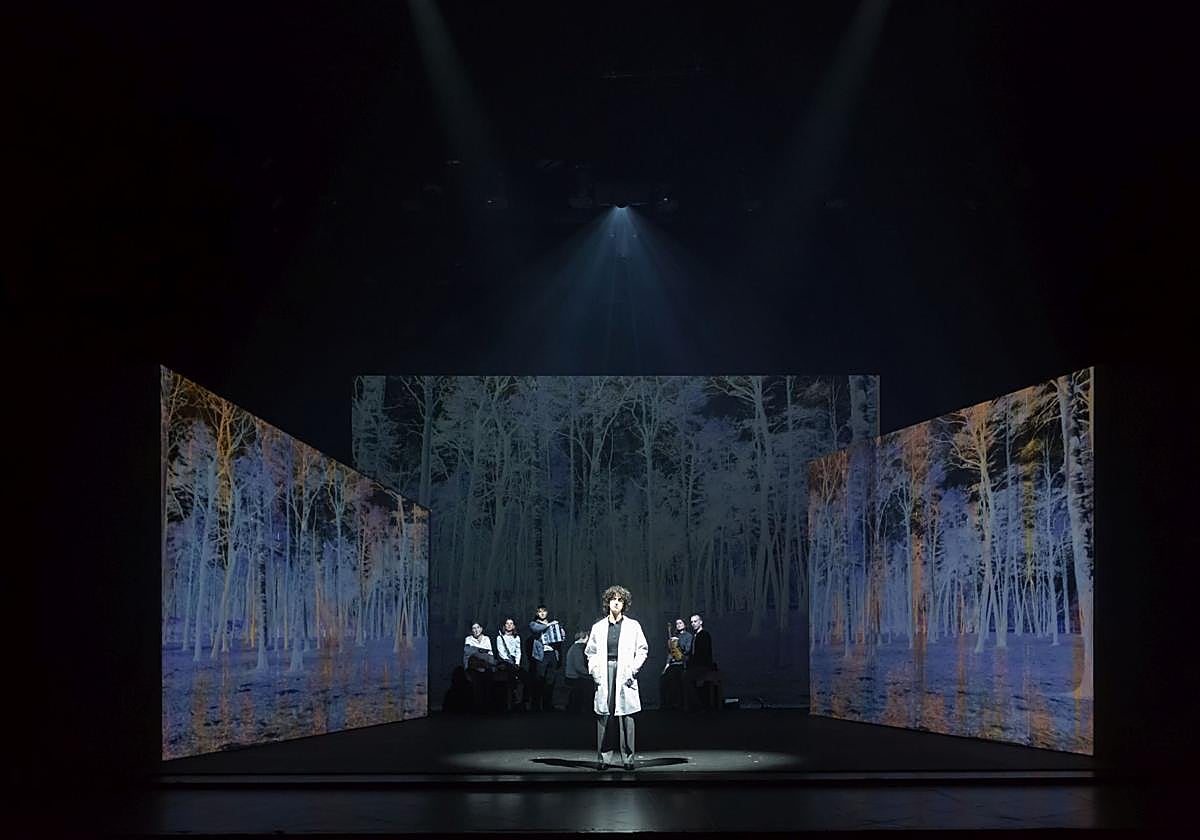

In 1961, philosopher Hannah Arendt closely followed the trial of the SS lieutenant colonel responsible for organizing the Final Solution. From her experience, she wrote 'Eichmann in Jerusalem': "The most serious issue with Eichmann was precisely that there were many men like him, and that these men were not perverted or sadistic, but were, and still are, terribly and terrifyingly normal."
I remember the first time I came across this sentence, after 402 pages of observing and analyzing the trial, I was almost stunned. Paralyzed. Overwhelmed by a truth that didn't even need to be rationalized to know that it was indeed the case.
A truth that challenges us all, our humanity. Something similar happened to me yesterday at the end of 'Blaubeereen', by Moisés Kaufman and Amanda Gronich, at the Cervantes Theater in Málaga. While people were leaving the auditorium, I was unable to get up, overwhelmed, with my heart in my throat, wondering how a play had dissected the banality of evil so scientifically, with a resource as simple as projecting photographs. A real case transformed into documentary theater, or rather an investigation, a doctoral thesis with footnotes based on photographs recovered almost by chance. The happy days of some Germans, with their families, in the Auschwitz concentration camp. And it is that Arendt also wrote: "There are too many people in the world for oblivion to be possible. There will always be a living man to tell the story."
And if they hadn't thrown me out, I would still be there, in my seat, admiring a scenic space that opened like a photo album, that became a museum or that raised its walls like a concentration camp. Listening in my head to the clarinet, the viola, the flute... played by the actors themselves, in the background but live, accompanying each scene. Astonished at the naturalness of María Pascual, who made me forget that she was acting, that we were in a theater. Admiring the nuances that Nacho López brings to each character, for the sobriety and commitment always shown by Víctor Clavijo. Anchored to the final monologue by Irene Maqueira as Lili Jacob, to the memory of the victims. Something so painful, precious, and moving that I don't know what would have happened if a cell phone had rung at that moment.
Just like with '14.4', the director, Sergio Peris-Mencheta, has once again brought to Spanish stages a text, a theme, that appeals to today's conversation, to what is urgent, to what matters. He leaves nothing to chance in the staging of 'Blaubeereen', every detail points to something. It is a significant and meaningful work, uppercase, that turns theater, this time indeed, into something necessary.
Before starting, the company read a statement denouncing the genocide in Gaza. I, to conclude, return to Hannah Arendt: "It is characteristic of the history of human nature that every act once executed and recorded in the annals of humanity still has a possibility long after its actualization has become part of history."

Latest news





Upcoming events
12
Nov
El Desembarco, la traición de Viriato at La Caja Blanca
12
Nov
HOMER El Mero Mero at Sala Trinchera Málaga
13
Nov
Marbella Startup Lab – Innovate & Collaborate
13
Nov
Candlelight: Coldplay & Imagine Dragons at Sala Fundación Unicaja María Cristina
13
Nov
Candlelight: Tribute to Ludovico Einaudi at Anantara Villa Padierna
Similar News

Málaga Airport Makes History with More Than Three Million Passengers in One Month
Málaga

Port of Málaga looks beyond its docks to support future growth
Málaga

Guide to the Virgen del Carmen Processions in Málaga and the Province
Málaga
