


Carmen Díez de Rivera: Anatomy of a Forgotten Story
The play 'Carmen, Nobody's Nothing', scheduled at the Cervantes Theater, rescues from oblivion the role during the Transition of the chief of staff of Adolfo Suarez.
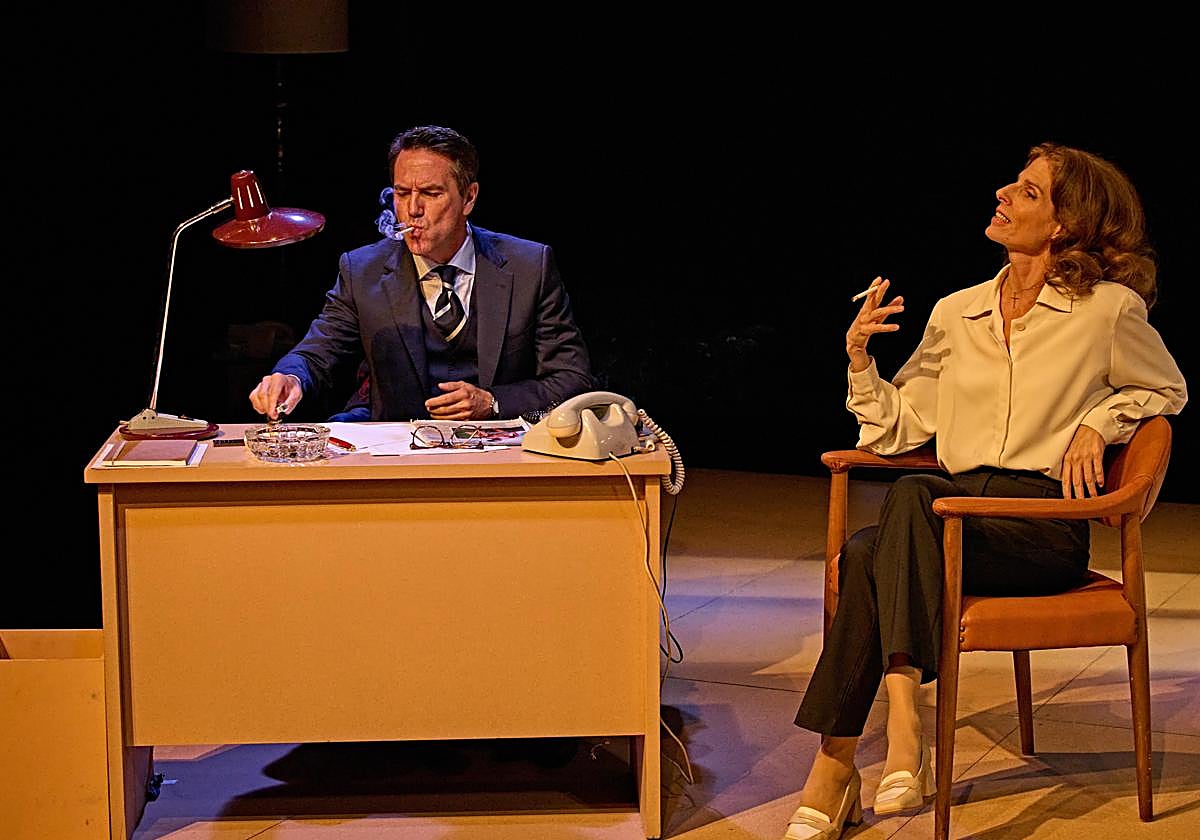

"What I want to tell you begins with a discussion. We are in 1976." This is how 'Carmen, nothing from nobody,' a play produced by Tablas y ... Más Tablas and the Teatro Español in 2024 about the figure of Carmen Díez de Rivera, begins. It arrives at the Malaga Theater Festival this Tuesday 13th. The discussion takes place in the office of Adolfo Suárez, chosen by King Juan Carlos I for the difficult task of transforming the dictatorship into a democracy. Díez de Rivera was, during those key years of the Transition, the chief of staff for the president, the only woman to have held that position. She was only 33 years old. Half a century later, the government has announced that it will recognize her work with the highest civil decoration, the Encomienda de la Orden Española de Carlos III, posthumously. Unlike other protagonists of the Transition, Díez de Rivera died in 1999 completely overshadowed. So much so, that Beatriz Argüello, the actress who portrays her in the theater, did not even know who she was. "No, I didn't know her and that, well, is a symptom of many things because she is a figure who has been fundamental in the recent history of our country and has always been somewhat in the shadows."
Francisco Umbral called her the muse of the Transition. And it was he who tipped off one of the authors, Francisco M. Justo, in the 90s. "I really liked reading Umbral's columns in El Mundo, his last stage," recalls the writer, who has teamed up with Miguel Pérez García for this play, "he talked a lot about her and I didn't know who she was. My curiosity was piqued and I started to investigate and discovered that she was a fascinating person, with a biography that seems taken from a Greek tragedy and of almost unknown political relevance." Daughter of the Marquises of Llanzol, at 17 she found out that her biological father was Ramón Serrano Suñer, minister and brother-in-law of Franco. These roots did not prevent her from defending the legalization of the Communist Party during the Transition. In 1977, Diario 16 headlined the first public meeting between Suárez's main collaborator and Santiago Carrillo: 'Carrillo and Carmen Díez de Rivera complimented each other.' "Her mere presence here fully justifies my trip," said the communist leader at the time. At the same event, Díez de Rivera, according to the journalist, "advocated, in this order, for contraceptives, responsible parenthood, and abortion."
Expand
Carmen Díez de Rivera Icaza, alongside Santiago Carrillo, general secretary of the PCE, in a photo from 1977. Source: ABCAt the helm of the play is veteran director and actor Fernando Soto. "I get the impression that she was very rooted in her ideas, in her convictions, but a bit tormented by finding herself inside a very oppressive, very macho, very dictatorial, very conventional, very conservative wrapper," reflects Soto, "like when one is born in the wrong place." Soto considers it "a responsibility as a citizen" to recover the legacy of those who fought for freedom. "It seems that the Transition was made by just two guys," he asserts, "Carmen Díez de Rivera, like so many women, and also men, who I imagine broke their backs in the unions, in the student struggles, have been forgotten."
In a separate conversation with the three members of the play's team, 'Anatomy of an Instant,' the Movistar Plus+ series based on the book by Javier Cercas about the 23-F, inevitably comes up. "I didn't want to get past the first episode," says Argüello, "the figure of Carmen appears as a secretary, as if she just brings the coffee. And she was much more than that." Justo agrees with Argüello and believes "the Transition has been little fictionalized, it's a task we have pending." As a result of this debt, Soto cites "this whole trend of youngsters saying that life was better under Franco," and emphasizes the perspective. "I don't want to look back from a vindictive place," Soto insists, "as a director I thought a lot, damn, Fernando, you have to be careful because positioning ourselves is counterproductive when talking about that process. What we need to do is open questions and let people come closer, investigate and draw their own conclusions, but far from any ideology." The people of Malaga will have that opportunity on Tuesday, January 13th at the Teatro Cervantes.

Latest news





Upcoming events
12
Nov
El Desembarco, la traición de Viriato at La Caja Blanca
12
Nov
HOMER El Mero Mero at Sala Trinchera Málaga
13
Nov
Marbella Startup Lab – Innovate & Collaborate
13
Nov
Candlelight: Coldplay & Imagine Dragons at Sala Fundación Unicaja María Cristina
13
Nov
Candlelight: Tribute to Ludovico Einaudi at Anantara Villa Padierna
Similar News

Málaga Airport Makes History with More Than Three Million Passengers in One Month
Málaga

Port of Málaga looks beyond its docks to support future growth
Málaga

Guide to the Virgen del Carmen Processions in Málaga and the Province
Málaga
