


Malaga Theater Festival | 'Courtyard Number 3': A Lot of Smoke in the Civil War Courtyard
The Malaga-based company Aeterno premieres 'El patio número 3' at the Malaga Theatre Festival
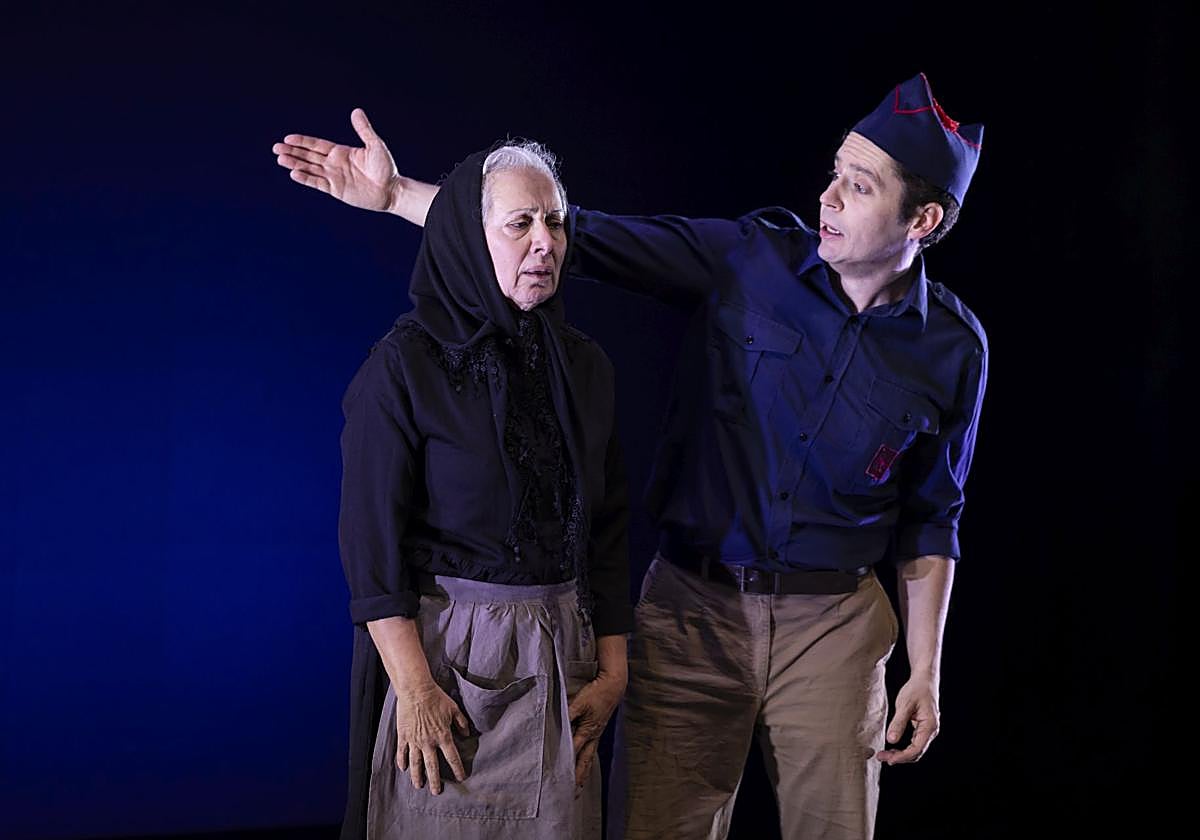

The Unamunian obsession with the other is almost a pathology of birth for a Spaniard. The struggle between the self and the non-self. We exist... because the other exists, and we do not think like him, or we do not have the same accent, or the same tastes, or any other excuse. Quoting Byung-Chul Han, our alterity provokes an immune response, creates borders, trenches, walls. It divides us. Why am I thinking about all this? You guessed it: 'Patio número 3', the first play by a company from Málaga, Aeterno, at the 43rd Theater Festival, is about the Civil War. Specifically, it's about the relationship between the mother of a prisoner from the insurgent side and one of the guards, at the gates of the Seville prison where she, every day, goes to leave a basket of food for her son. That 'other' who never appears and is always present.
Although it may seem unbelievable, during Francoism there were some attempts for the two sides to face each other in theaters. In 'Silent as the Dead', by José María Pemán, a Francoist diplomat falls in love with a woman who had fought for the republic. In 'Ninette and a Gentleman from Murcia' by Miguel Mihura, the young man from Murcia who arrives in Paris stays in the house of an exiled communist. 'The Skylight' by Antonio Buero Vallejo, tells the life of a defeated family. I bring these up because I perceive in the Sevillian playwright Víctor Muñoz, author of the play we saw yesterday at the Echegaray Theater, a healthy intention to convince rather than conquer, returning to Unamuno. To show two levels of suffering beneath the relationship between victim and executioner. A relationship based on repetition, on obsession, on horror, but also on a mother's love. A simple, predictable story, with its stereotypes, but with its bitter lyricism.
Related news
We see what we are, by Els Joglars
A simple story, I repeat, in which I did not engage nor felt due to an overly ambitious staging by Miguel Cegarra. In an almost expressionist code, the actors Carmen Ruiz-Mingorance and Javier Cereto suffer and twist from the beginning as they recount each of their steps in an exhausting choreography of comings and goings, sounds, lights, shadows, and smoke, lots of smoke (and a lot of coughing in the audience). The defamiliarization of reality, in my opinion, prevents empathy with a past that we all share in one way or another. An excess of audiovisuals, transitions, effects, and Easter week references. But I acknowledge that Cegarra does measure his actors well: Ruiz-Mingorance is very convincing and Cereto gives his all, managing to keep his character in panic for an hour without falling into ridicule. It's not easy. Especially when a mobile phone rang in the front row, almost next to him.
This is with respect to me. It is also true that the theater was packed up to the first floor (when will Málaga companies be able to access the Teatro Cervantes?) and the audience unanimously stood up and gave a long and warm applause to the team of the play at the end.

Latest news





Upcoming events
12
Nov
El Desembarco, la traición de Viriato at La Caja Blanca
12
Nov
HOMER El Mero Mero at Sala Trinchera Málaga
13
Nov
Marbella Startup Lab – Innovate & Collaborate
13
Nov
Candlelight: Coldplay & Imagine Dragons at Sala Fundación Unicaja María Cristina
13
Nov
Candlelight: Tribute to Ludovico Einaudi at Anantara Villa Padierna
Similar News

Málaga Airport Makes History with More Than Three Million Passengers in One Month
Málaga

Port of Málaga looks beyond its docks to support future growth
Málaga

Guide to the Virgen del Carmen Processions in Málaga and the Province
Málaga
