What is a panettone? An Italian Christmas sweet? An XL-sized brioche? A calorie bomb? A dough made from gluten networks, gelatinized starches, sugars, flavors, and alveoli? The answer is all of the above, as it depends on the point of view.
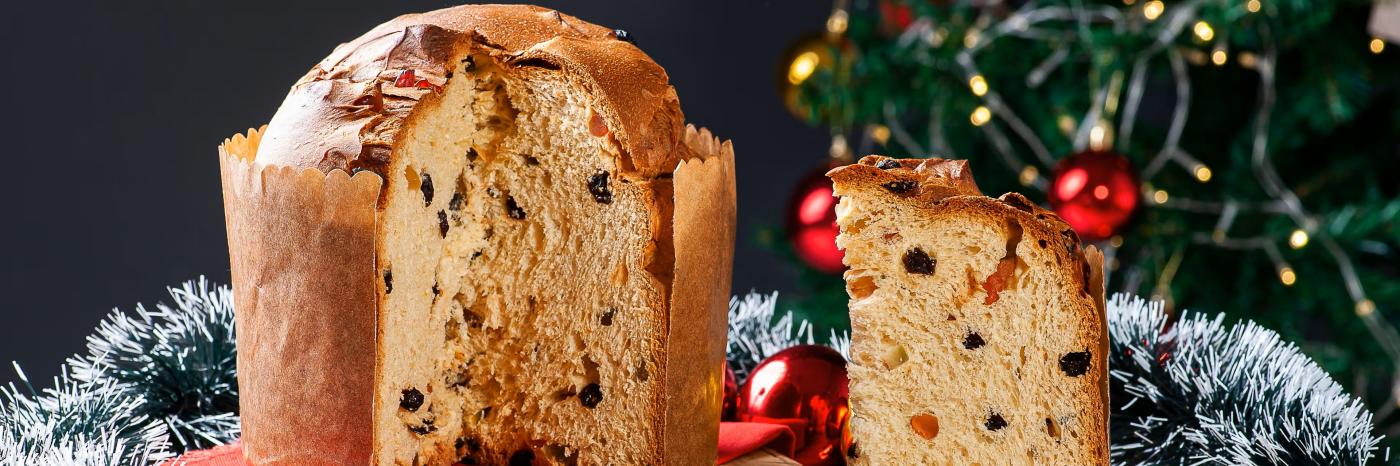

What is panettone? An Italian Christmas sweet? An extra-large brioche? A calorie bomb? A dough made up of gluten networks, gelatinised starches, sugars, flavourings and air pockets? The answer is all of the above, depending on your point of view. What seems indisputable is that we are dealing with a culinary masterpiece.
From Italy to the world
In Argentina, it has been known since the 19th century as pan dulce, from the Italian pandolce. The image shows an advertisement from December 1930. Wikimedia commons, CC BY
Panettone is an Italian sweet that is very famous all over the world, especially at Christmas. It has a typical dome shape and is approximately 12 to 15 centimetres high. In recent years, it has also become very popular in Spain, sharing the table with other typical Christmas sweets such as turrón, polvorones and roscón de Reyes. All these products are delicious and are associated with happy, even magical moments with family or friends.
Although ‘magical’ is a very nice term, especially for children, it is good to remember that all these products have a solid scientific basis. Everything we eat is science, and thanks to science we can enjoy these Christmas wonders.
Gastronomically speaking, a panettone can be defined as a type of brioche bread, large and spongy, made with sourdough and strong flour, which requires several fermentations, resting periods... and even turning it upside down, something that is not common.
A master baker could give a more beautiful description, but I happen to be a food technologist, so it is up to me to describe it from a scientific point of view.
More gluten, more volume
The first step in making panettone is to prepare the pre-fermented dough. To do this, we use strong flour, which provides more protein capable of forming gluten, a viscoelastic network similar to a mesh, acting as a ‘scaffold’ capable of trapping gas and adding volume to the product. This is why gluten-free products have great difficulty imitating them.
Your support helps us to continue providing accurate information free of charge.
Donate
We also add sourdough and/or baker's yeast, i.e. the live microorganisms that will ferment the dough, generating CO₂, aromas and flavours and softening its texture.
Sourdough, to put it simply, is a dough in which the microorganisms have been kept alive, maturing and generating more complex aromas and flavours. To make a comparison, sourdough is like AI in its latest updates, with faster and more elaborate responses, while dough with freshly made yeast is like early AI, functional but not complex.
Water, sugar, butter and egg yolks are also added, ingredients that hydrate and provide food for the microorganisms (sugars), as well as enzymes and fats.
Panettone ingredients: Flour, sourdough, butter, egg yolks, sugar, candied fruit and raisins. Wikimedia commons, CC BY
Panettone dough is special because it must be flexible and resistant at the same time. It has to stretch to grow, but without breaking. This is why it requires long and careful fermentation to allow the internal structure to develop properly and stably.
Kneading, gases and aromas
It is very important to knead correctly, using enveloping movements, so that all the ingredients are well integrated and the gluten network is formed. Little by little, the mixture turns into a dough and the starch in the flour becomes hydrated and extends its amylose and amylopectin chains (starch molecules), causing the mixture to thicken.
This kneading process, which varies in duration, ends with a first dough that will rest at room temperature for approximately two hours, allowing the yeasts present to ferment the sugars (because this is the easiest, they will then move on to other components), generating gases (responsible for the bubbles) and aromatic compounds such as aldehydes or organic acids.
The panettone dough
After this first pre-fermented dough or first impasto, a second round of the same ingredients is added, along with salt, vanilla, orange peel or chocolate chips (raisins or other fruits can also be added). This new mixture is kneaded again and left to rest for the same amount of time, allowing the structure to integrate the new ingredients and the yeast to continue fermenting the dough and generating gases, flavours and aromas.
Translated with DeepL.com (free version)

Latest news





Upcoming events
12
Nov
El Desembarco, la traición de Viriato at La Caja Blanca
12
Nov
HOMER El Mero Mero at Sala Trinchera Málaga
13
Nov
Marbella Startup Lab – Innovate & Collaborate
13
Nov
Candlelight: Coldplay & Imagine Dragons at Sala Fundación Unicaja María Cristina
13
Nov
Candlelight: Tribute to Ludovico Einaudi at Anantara Villa Padierna