Inside the sex lives of chimpanzees: it’s about much more than just reproduction

Doug was the leader of his chimpanzee group. He had quickly gained a
reputation from human observers as a fair and tolerant alpha male. One day he
was separated from the group for some health checkups along with a young,
confident male, Vis, and Vis’s ally, Zsabu.
We couldn’t see what was happening from
our vantage point, but you could hear it. Screaming and banging. Something was
kicking off. Doug had been ambushed by the two males and had to be released
hastily by the keepers.
Authors

Research Associate in the Department of Psychology, Durham University

Professor in the Department of Psychology, Durham University
When he emerged he wasn’t badly injured,
but was clearly distressed – this giant male was screaming, crouching and
outnumbered. In our months of observation, we’d never seen him like this.
Little Jones, a low-ranking male often
picked on by his peers, approached him and started making submissive gestures.
Doug rushed over to mount him for a few moments, with the weaker chimp
crouching down as Doug thrusted on top of him.
That seemed to be a green light for many
of the 40 or so chimps in the group to offer comfort and reassurance to Doug,
too. It was an extraordinary sight.

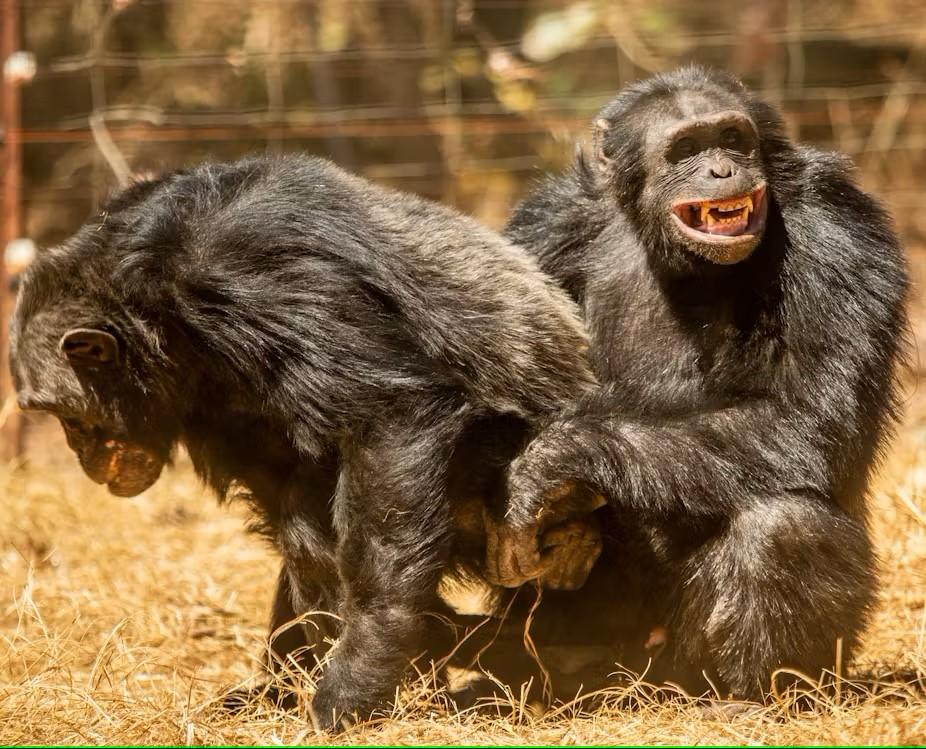
Most of the group approached Doug, embracing, touching
and body kissing him. There was also mutual genital touching and several
invited Doug to mount them. This kind of extreme consolation is rare in chimp
communities, reserved for very special circumstances.
People often think that animals just use sex for
reproduction. In fact, for many animals and birds, sex can play a comparable
social role to what it plays in humans. As we saw in this research into
the chimps at the Chimfunshi sanctuary in north-western Zambia, sex can help
ease tension, relieve stress, strengthen bonds and even repair relationships.
Chimps v bonobos
We spent months observing the chimpanzees at
Chimfunshi, living in simple concrete bungalows near to their large, forested
enclosures. We spent nearly all day every day observing them, living
vicariously through their soap opera.
You get the privilege of coming to know each and every
chimp, almost like a person – the way they walk, look and sound. Even the
silhouettes of their bodies as they walk away in semi-darkness as the light of
the day falls.
We compared their sexual behaviour with a group of
bonobos slightly over 1,000 miles away at the Lola Ya Bonobo sanctuary, near
Kinshasa in the Democratic Republic of the Congo.
Chimps and bonobos are humans’ closest relatives,
having diverged from us between 5 and 7
million years ago. They still share around 98.7% of our
DNA and offer us fascinating
insights into what we may have been like before we became human.
Researchers used to use chimps as the poster
boys of human evolution, while ignoring our less
understood yet equally important other cousin. More recently, though,
researchers have become more interested in bonobos, as well as comparing the
two species together.
Like humans, both chimpanzees and bonobos have rich
and complex social lives. In both species we see striking variations in
different groups’ use of tools, cultures, social tendencies, and
even the amount they engage in
conflict.
That said, there are fascinating differences between
the two species. Bonobo groups are overseen by coalitions of dominant females
and their sons, whereas the chimp hierarchy is usually structured around an
alpha male and his male cronies.
Bonobos are generally viewed as peaceful and tolerant,
while chimps have drawn the short straw in public relations, often depicted as
violent, competitive, even murderous.
Some of these differences have become contested,
however. For instance, some bonobo groups are less tolerant and more aggressive than
some chimpanzee groups, while both apes share food
peacefully and cooperate.
Chimpanzees can be tolerant and tender with one
another; they can help others in need and comfort them in distress. They’ll
often release their aggression by charging or making a lot of noise, without
necessarily coming to blows.
One characteristic that has continued to be firmly
associated with bonobos is their heightened sexuality. Whether in the wild or
captivity, they habitually engage in sexual interactions in almost all age and
sex combinations.
Sex seems to help them manage social problems, such as
repairing social bonds after fights and facilitating cooperation, such as
before sharing food.

Yet,
against assumptions, our study found
that even this difference is not what it appears. When directly comparing the
two species in similar sanctuary environments, we found chimps also use sex to
navigate tense social situations, as we saw with Doug, and to reconcile after
fights.
Both
species share similar sexual repertoires, although genito-genital rubbing –
moving genitals together rhythmically while in a “missionary” position – is
more common in bonobos, especially females.
Chimpanzees,
particularly males, often mount and hold the genitals of their allies,
especially during conflicts either within their group or with other groups.
They often thrust against one another, and these behaviours appear to serve a
reassurance and tension-reducing role.
As with
bonobos, we see all different sex combinations, sometimes with more dominant
chimps doing the mounting but sometimes the other way around. Meanwhile, chimps
are more likely to engage in other behaviours such as body kissing.
Human evolution
Evidence
that both bonobos and chimpanzees use sex to manage social problems suggests
that our last common ancestor would have done so too — and most likely early
humans as well.
Our
findings challenge the idea that human sexuality is uniquely complex. Far from
being a cultural construct, the social role of sex appears to echo through time
from our ancestors to our modern societies.
Much like
our primate relatives, humans also rely on other strategies beyond sex for
conflict resolution, such as verbal and physical reassurance. Yet, sex remains
a potent and often overlooked tool in human social dynamics.
And just as
the sexual behaviours of bonobos and chimps reflect their social structures,
human sexuality is influenced by our societies too. The way we use sex — for
intimacy, pleasure, bonding and negotiation — may be one of our most ancient,
and flexible traits.
Back in
Chimfunshi, Doug wasn’t deposed after his altercation with Vis and Zsabu. The
outpouring of intimate affection from the community reinforced his position as
leader of the group, which was then cemented by another incident later that
day.
The whole
community seemed to be quietly eating until Doug and his close male ally Pan
suddenly attacked Vis and his mother Violet, the dominant female. They
bodyslammed both of them, sending a clear message that the group was not under
new management. The violence went no further, and Doug still leads to this day.

Latest news





Upcoming events
12
Nov
El Desembarco, la traición de Viriato at La Caja Blanca
12
Nov
HOMER El Mero Mero at Sala Trinchera Málaga
13
Nov
Marbella Startup Lab – Innovate & Collaborate
13
Nov
Candlelight: Coldplay & Imagine Dragons at Sala Fundación Unicaja María Cristina
13
Nov
Candlelight: Tribute to Ludovico Einaudi at Anantara Villa Padierna