


The lion found in the lost city of Roman Malaga reveals its secret: it has a twin
The Customs Museum restores the sculpture found by chance two years ago in the disappeared Osqua, the Iberian-Roman town of Villanueva de la Concepción.
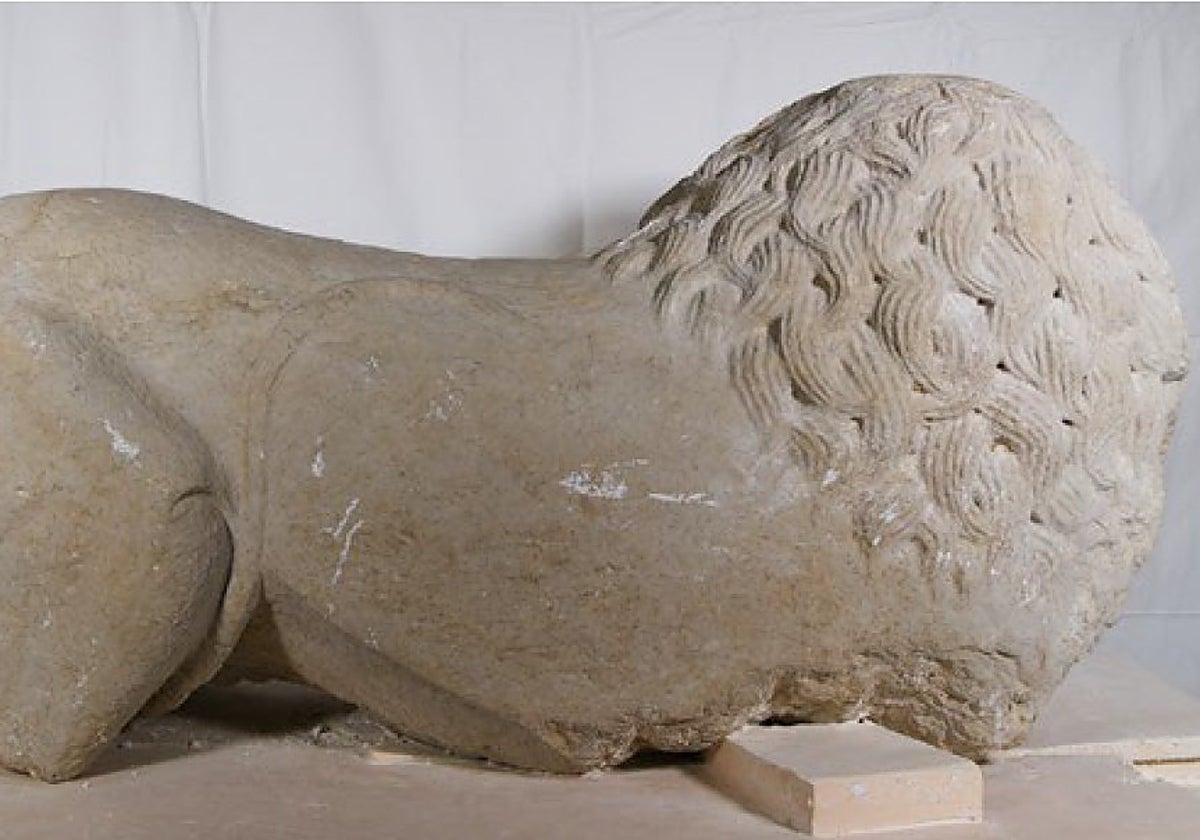

The news broke two years ago. During agricultural work, a sculpture was accidentally found upside down and partially buried in a place known as Cerro del León, just over a kilometer from Villanueva de la Concepción. The piece was moved to the edge of the promontory where it was found and the territorial Culture Delegation was notified, which recovered the piece after an analysis by archaeologists. It was a large stone carving of a lion of apparent Iberian origin, which was sent to the Málaga Museum for study and restoration. A process that has now concluded with significant new findings: the piece comes from the lost city of Osqua - strategically located at the passage from the coast to the interior of the province - it is from the Roman era, and likely paired with another almost identical sculpture in the tomb of an influential family from this town.
Expand
In a well-documented study, archaeologists Manuel Romero Pérez, Pablo Ruiz Montes, and Isabel López García propose the hypothesis that the piece found in 2023 in Cerro del León - where the ancient Osqua is located - corresponds to another stone carving representing the same feline, also originating from this same site in Villanueva de la Concepción. The difference is that this second lion was found much earlier, as there have been records of its existence since 1495. The piece can currently be seen by looking up at the Arco de los Gigantes in Antequera, where it has crowned this ancient city gate for centuries.
Related News
The town that could disappear because it was sliding over the earth
The treasures of the Málaga metro: Culture orders the preservation and relocation of several Roman tombs from an unknown cemetery
Cerro del Villar unveils its true face
Both lions come from the same site of Osqua and have similar dimensions, body positions, and identical tail designs
"The new sculpture from Osqua must be understood as part of a pair of opposing lions, with its counterpart likely being the one at the Arco de los Gigantes," state the experts, who have published the results of their investigations in an article in the latest issue of the 'Mainake' journal. Thus, the origin of both lions from the same archaeological site - although found more than five centuries apart - their similar dimensions and proportions - having lost limbs over time or having been retouched - the same body positions, identical tail designs, and the treatment of the tufts are the parallel keys to these 'twin' pieces that differ in the curvature of the head, one on each side. The archaeologists also have an explanation for this.
For this, the dating of the pieces is also fundamental, which, contrary to the initial belief of their Iberian origin, has now been verified to be later, from the Roman period. Specifically, their design coincides with the figurative models of the series of sepulchral lions from the late Republican era (from the end of the 2nd century BC) or Augustan Italic period (until 14 AD). For this reason, the archaeologists suggest that "we are facing two almost identical pieces, only differentiated by the orientation of the rotation of their heads which thus would face each other and could be part of the same funerary monument." Thus, the team of experts maintains that the lion pair guarded the tomb of a "distinguished settler or his family" residing in Osqua, and their respective heads faced towards the inside of the tomb as a gesture of protection.
Impressive Dimensions
The new lion found in 2023 at the archaeological site in the municipality of Villanueva de la Concepción coincided that same year with the study conducted months earlier by a team from the University of Granada led by Pablo Ruiz Montes, which carried out a survey to delimit the lost city of Osqua. This delineation of the site has allowed, together with the municipal archaeologist of Antequera, Manuel Romero Pérez, and the professor from the University of Málaga Isabel López García, to precisely locate the discovery of the zoomorphic sculpture at a point of what is today called Cerro del León and which coincides with the "nuclear oppidum" of that Iberian-Roman town, whose chronological arc extends approximately from the 3rd century BC to the 6th century AD.
Expand
Once restored and studied, the piece found in 2023, the Málaga Museum plans to soon present the zoomorphic sculpture and add it to its archaeological collection. According to SUR, the plans are to install the sculpture in the visitable warehouse of the Customs House. It would be poetically just for it to be displayed facing Antequera, where its 'brother' is located.

Latest news





Upcoming events
12
Nov
El Desembarco, la traición de Viriato at La Caja Blanca
12
Nov
HOMER El Mero Mero at Sala Trinchera Málaga
13
Nov
Marbella Startup Lab – Innovate & Collaborate
13
Nov
Candlelight: Coldplay & Imagine Dragons at Sala Fundación Unicaja María Cristina
13
Nov
Candlelight: Tribute to Ludovico Einaudi at Anantara Villa Padierna
Similar News

Málaga Airport Makes History with More Than Three Million Passengers in One Month
Málaga

Port of Málaga looks beyond its docks to support future growth
Málaga

Guide to the Virgen del Carmen Processions in Málaga and the Province
Málaga
