


The Concepción Once Again Releases Necessary Water: The Picture of Incoherence
The limited capacity of the Verde River water treatment plant prevents the use of the current volume; at least, the expansion of the plant is already underway.
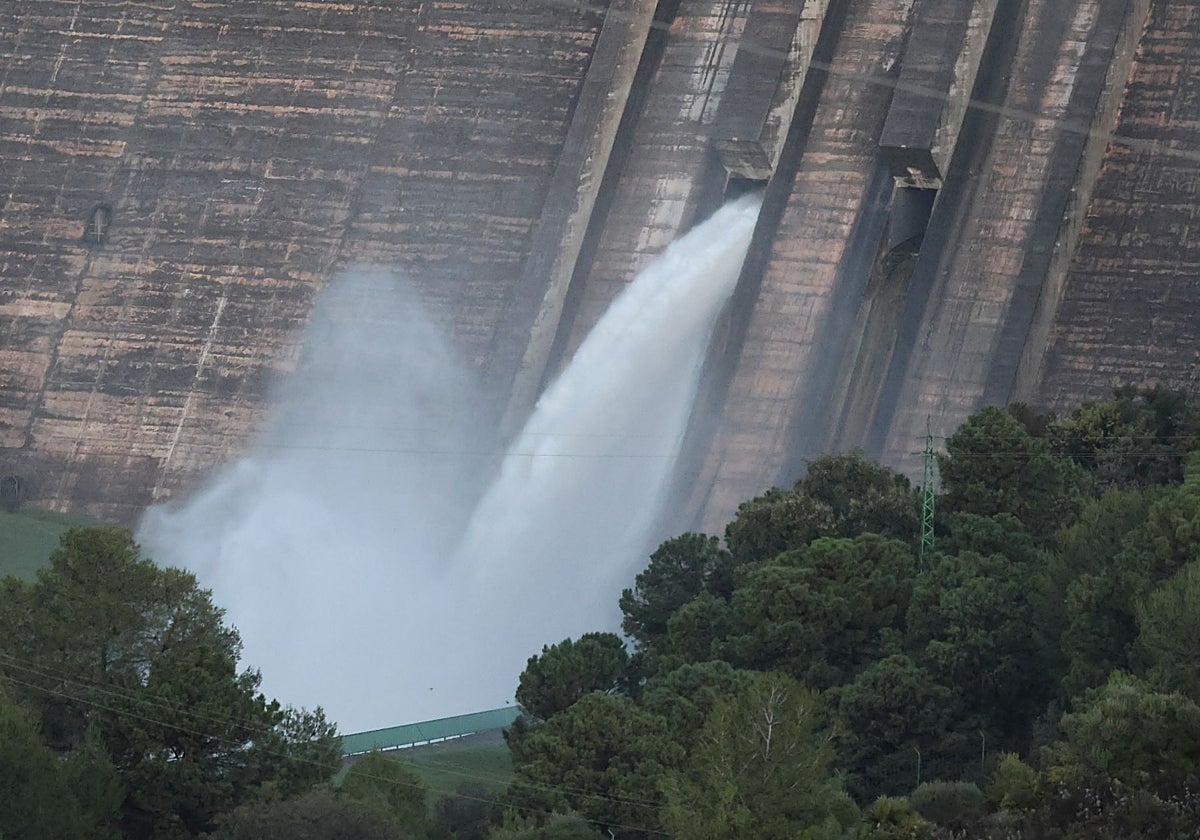

The image of the La Concepción dam releasing water is shameful. The 2.5 cubic hectometers that are being released throughout today will be missed when the lean times return. And this is not the first time that ballast has to be released due to the limited capacity of the coastal reservoir, which, in the best case, can collect about 62 Hm3 (only when it rains at the onset of summer).
On March 7 last year, and for several weeks, in the midst of a storm train, the reservoir opened its gates with flows reaching 60 cubic meters per second, up to a total of 25 Hm3. Throughout the hydrological year, it could have filled at least one and a half times, had it had that capacity (about 80 Hm3).
For nearly three decades, several options have been proposed to avoid this waste. The first was the heightening of the La Concepción reservoir, which was revisited in the technical and political agenda in 2001, with its inclusion in the Plan Málaga, a provincial component of the National Hydrological Plan (PHN).
The only solution to avoid having to release water is to expand the potabilization plant of the Río Verde as soon as possible, which has a tender underway but has not yet started.
However, both the heightening and a new dam, which were considered in the preliminary project, have been discarded. Instead, the project for the Gibralmedina dam (in the Guadiaro, between Cádiz and Málaga) has been drafted, from where up to 15 cubic hectometers per year will be sent already potabilized to the coast. But it is an expensive project, 780 million euros with the conduits, and the most optimistic scenario does not drop below a decade.
Related news
The La Concepción Reservoir in the Costa del Sol is already releasing water for safety
In recent years, the option of the so-called "water highway" has been proposed, that is, a high-capacity conduit to interconnect the Coast with the capital and from there to Axarquía; so that surpluses from one basin could be used to supply the deficitary one. Several works have been carried out in this direction, and the project continues with improvements to the conduits at various points, but at a frankly improvable speed.
Verde Potabilization Plant
Linked to the above is what is really the great work necessary both to take advantage of all the water that La Concepción captures, and to be able to move it to other points. For both tasks, the key is the current bottleneck of the potabilization station, which is obsolete, lacks capacity, and must be doubled.
The current teams of the Ministry of Agriculture and Acosol have activated this project, which was abandoned in 2009. In fact, since March it has been known that the public tender for the expansion, called by the Junta, still includes nine powerful alliances of construction companies and engineering firms. The Ministry expects that in this first quarter of the year the works will finally be awarded, with a budget of 35 million euros.
The modernization and doubling of the plant includes two huge tanks, which will allow up to 4,600 liters per second of potabilized water. That is triple the real-time demand of Málaga capital's consumption (Emasa usually injects between 1,500 and 1,650 liters per second depending on the population and brine rejections).
To these 35 million that the Junta will put into the expansion of the ETAP, another 17 from Acosol will be added to make a new large header tank, which is included in its investment plan. There will be two identical tanks, divided into two chambers each of 28,000 m3 for a total of 120,000 m3. That's half a day's consumption without restrictions at the peak of summer: plenty of solvency to operate in an extreme scenario.
Until these works are completed, the sad reality is that, right now, the ETAP is so tight that it cannot even exclusively supply the Costa del Sol with reservoir water... And hence the need to periodically release water. At the same time, energy must be spent to always have the Marbella desalination plant at a minimum production, since this densely populated metropolitan area needs about 90 cubic hectometers per year for its supply.
It will be two birds with one stone, for when it is ready it will also make possible the goal of allowing a transfer of potable water between the Coast and the capital of Málaga, which is not possible now. Once completed, the Rojas bypass in Churriana could be utilized, with a capacity in both directions of 500 liters per second. This is the same as is already done with Axarquía with the Rosaleda pumping. Both infrastructures were modernized by the Junta during the previous drought phase.
Thus, this time, the "water highway" will offer great possibilities to move resources and redistribute them between surplus and deficit basins. And to avoid having to see (except in unusual rains) the shameful image of the release at La Concepción.

Latest news





Upcoming events
12
Nov
El Desembarco, la traición de Viriato at La Caja Blanca
12
Nov
HOMER El Mero Mero at Sala Trinchera Málaga
13
Nov
Marbella Startup Lab – Innovate & Collaborate
13
Nov
Candlelight: Coldplay & Imagine Dragons at Sala Fundación Unicaja María Cristina
13
Nov
Candlelight: Tribute to Ludovico Einaudi at Anantara Villa Padierna
Similar News

Málaga Airport Makes History with More Than Three Million Passengers in One Month
Málaga

Port of Málaga looks beyond its docks to support future growth
Málaga

Guide to the Virgen del Carmen Processions in Málaga and the Province
Málaga
