Julio Iglesias
The author signs an enjoyable and well-documented biography of the singer, 'The Spaniard Who Charmed the World', which claims the artistic and cultural relevance of the character without falling into hagiography.
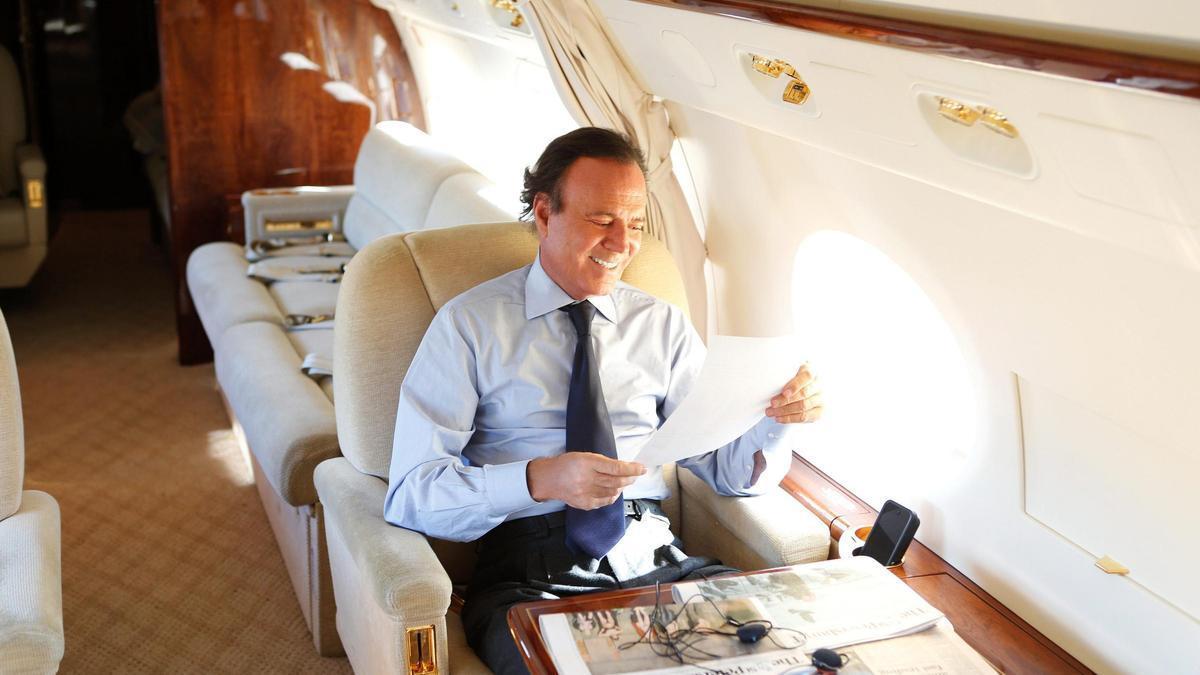

When future historians want to learn about the history of Spain in recent decades, they can do so by reading exhaustive monographs and scholarly essays, or simply by reviewing those issues of ¡Hola! magazine featuring Julio Iglesias. As if he were a sort of Spanish Forrest Gump, the singer from Madrid has been present at every significant event in the country. This fact becomes evident after reading 'The Spaniard Who Charmed the World', a biography of the artist written by Ignacio Peyró with as much historical accuracy as a sense of humor, recently released by Libros del Asteroide.
"When I started writing the book, I wasn't aware of all this," explains Peyró, who outlines the evidence supporting his theory. "Julio Iglesias was born in the years of hunger, in '43, '44, which were very tough post-war years. The family then took off with the economic development, with the 600, with Benidorm, and the father, who had been an old shirt of the Falange, even saw Primo de Rivera's grand speech at the Teatro de la Comedia in '35, ends up putting away the blue Mahón shirt, swapping it for a Lacoste polo, and replacing the bottles of Fundador with those of JB. When democracy arrives, what happens on the first night of voting? Well, there's Julio Iglesias with improbable glasses, reading a sort of manifesto for harmony and singing 'I am a Rogue, I am a Gentleman' for the first time. His marriage to Isabel Preysler was the driving force behind the gossip press as we know it today in Spain. In fact, when the first separation of a couple in Spain was announced, it was them, and if they didn't announce the divorce, it was only because it wasn't yet legalized. Then, that great drama of democracy that is ETA also directly affected his family with his father's kidnapping. After that, Julio was a pioneer in going to Spanish America before Spanish companies did, in the 2000s, he took part in that era of prosperity, and when everyone was blinded, he knew how to get out before the euphoria ended to avoid the consequences."
If before writing 'The Spaniard Who Charmed the World' you were unaware of all these curiosities, what then was the reason for deciding to write a biography about Julio Iglesias?
I think what's striking is why the character hadn't caught the attention of other authors before. It's true that there have been biographies about him, but they belonged to the realm of fans. Until now, no one had told us about this novel-like life, so entertaining and that says so much about us. We're talking about a man who started under conditions, let's say, very disadvantaged compared to other artists of his time, who set out to seduce the world as a Hispanic and sold hundreds of millions of records when you had to go buy them, which required a willpower that is not demanded today. Besides, maybe in '91 this book would have been premature, but today, when Julio Iglesias is over 80 years old and has been performing for more than half a century, it's possible to look back and make that assessment.
He claims that the story of Julio Iglesias tells a lot about the Spanish, but isn't it more revealing that his dimension as an artist and phenomenon has not been sufficiently appreciated?
I think that, in general, Spaniards do feel affection for him. There wouldn't be memes about Julio if there wasn't affection for Julio. If you send Julio to make people laugh, that's a sign of affection, because you don't share a meme of someone who isn't likable. In addition, in 1983 or 1984, when he returned after his triumph in America, Spain embraced him almost with guilty fervor. It was a form of national reparation. Then, even the progressive press put their best signatures, like Luis Antonio de Villena or Juan Cueto, to write about him. Sometimes in favor, other times as a phenomenon to study, and of course, sometimes against. Cabrera Infante, a Cervantes Prize winner, said of him that he was the García Márquez of the bolero; Francisco Umbral and Carmen Martín Gaite wrote against him but, in some way, he was there, in the debate. At that moment I think there was a kind of guilt feeling and also a certain provincial spirit that, as he had succeeded abroad, he must be amazing.
The writer Ignacio Peyró, author of 'The Spaniard Who Charmed the World'. / Daniel Ibáñez
To what extent did Julio Iglesias' success in the United States depend on managing his career with an entrepreneurial spirit, investing money not only in the musical aspect but also in communication?
Although he has made a lot of money, what he spent to succeed in the United States is really a lot. That was a bet that went well, but it could have gone very badly. Roberto Carlos or Aznavour, for example, went to the United States and, as they arrived, they returned. With Julio, it was different. In his case, Miami was very important because it was there that he found the aesthetic that has defined him. He was the one who made Indian Creek and that lifestyle in guayabera, linen pants, that looking into the infinite with bare feet on the shore, a palm tree swooning in the background, a house with a dock... That will place him in a very powerful aesthetic coordinate because, let's be honest, nobody imagines paradise as a forest in Canada. It can be beautiful, but paradise is a beach with coconut trees and someone running to give you a daiquiri. That's what Julio embodied in the eyes of the world, at a time when there was no Instagram nor people doing that 24 hours a day.
Julio Iglesias, in his paradise. / Archive
Now that you mention something as current as Instagram, you claim in the book that Julio Iglesias has never been modern, not even in his youth, which was the time when he should have been.
Julio has never stopped being a crooner, a light, romantic melodic singer... He has always moved there, he has never wanted to do anything else and that has also avoided many stumbles for him.
But it has also made his decline more pronounced. From being sponsored by Coca-Cola, he went on to be sponsored by La Casera, and recently, the concerts, in addition to being scarce, were held in increasingly smaller venues.
His story is very curious. He had a brutal career, with a sprint to the top, a time trial climb until reaching the peak in '85, and then, it was like a bird that you release in a room, it bumps its head against the ceiling two or three times and then settles. Although he tried again after '85, it didn't work out. He realized that he would never be as great as before, but what remains, he manages with enormous splendor.
However, it is striking that while Raphael has updated his image or changed his repertoire incorporating songs from young artists, Julio Iglesias has never tried to revitalize his career in that way. He hasn't even recorded, as Sinatra did with him, duet albums with current artists.
Julio is not someone who thinks "since I already have success assured I'm going to embark on an aesthetic path", nor is he a Paul Simon who says "I'm going to explore the rhythms of Africa to see what comes out" and releases an album. No. He doesn't do those things. On the other hand, although he has recorded many duets, he did them when it was convenient for him, when he had the most to gain from that collaboration. When it wasn't like that, he didn't participate. In fact, he has avoided enmities and polarizations because, directly, he does not consider himself on the same scale as other artists like, for example, Raphael.
Julio Iglesias, during a concert in Istanbul in 2015. / EFE
Another particularity of Julio Iglesias, besides not being modern, is that, being conservative, he has not given politics the importance it has, which would explain his participation in the Viña del Mar Festival during Pinochet's government or his recitals in Argentina under Videla after the 1976 coup.
He has been a guy capable of always speaking well of Felipe González and, at the same time, supporting Aznar. As an artist, he has always made it clear that he did not sing for the presidents of the countries, that he did not care if they were corrupt because he sang for the people and, well, he may have a point, but not always. When you are directly hired by Obiang to perform for him, as has happened, it is not exactly exemplary.
That lukewarmness with a few dictators contrasts, however, with his opposition to the President of the United States, Donald Trump, with whom he has been especially critical.
To Julio, Trump hurt his pride. For him, his most important issue was supporting Latinos, and when he realized that Trump is a Hispanophobe, he reacted. Although they had known each other for years, Trump still had a long time to become President of the United States, but when that happened, Julio reacted with great virulence and said he would never again perform in Trump's casinos.
You mention in the book that, although you tried to contact Julio Iglesias, the singer did not return your call, something that, ultimately, has been beneficial for the final result. Why?
I didn't want to have to write to dictation or have someone tell me to remove such an adjective or make a certain person not appear so much. I understand that this will be a job that someone will have to do someday, although I know that several writers have already been burned in the attempt, but I'm not interested in that. I am a writer, I wanted to tell a beautiful story and do it as I always do, with lightness.
Despite everything, it seems as if Julio Iglesias' hand had been retouching certain passages to hide certain details and highlight others. For example, that quote from Alfredo Fraile in which he claims that, in Miami in the 80s, when even the banks had problems counting the money generated by the cocaine business, neither Julio nor his entourage knew what that drug was.
Julio has wanted to script his life from minute one. He started with the claim that he was going to be the biggest star ever seen in football, that a tragic accident took that career away and that providence helped him because, between being a great football player and being a great singer, he ended up being a great singer. That's not exactly true, but well. As for drugs, it may be true. In fact, my theory is that it was wine that saved him from them. If you're opening bottles of Château Lafite from '70 every night, what is cocaine going to bring you? Nothing.

Latest news


Upcoming events
17
Sep
La Pequeña Cuba Gastro-Cultural Festival in San Pedro Alcántara 2026
18
Sep
World Wellness Weekend Marbella 2026
18
Sep
Candlelight: Queen vs. ABBA in Málaga
18
Sep
Candlelight: Coldplay and Imagine Dragons in Málaga
18
Sep
3 de Corazones – Pancho Céspedes, Enrique Ramil and José Luis Jaén in Málaga
Similar News

Málaga Airport Makes History with More Than Three Million Passengers in One Month
Málaga
Port of Málaga looks beyond its docks to support future growth
Málaga
Guide to the Virgen del Carmen Processions in Málaga and the Province
Málaga