


The Day Artificial Intelligence Took Up the Scalpel
They achieve, for the first time, an AI-guided robot to autonomously perform a gallbladder removal
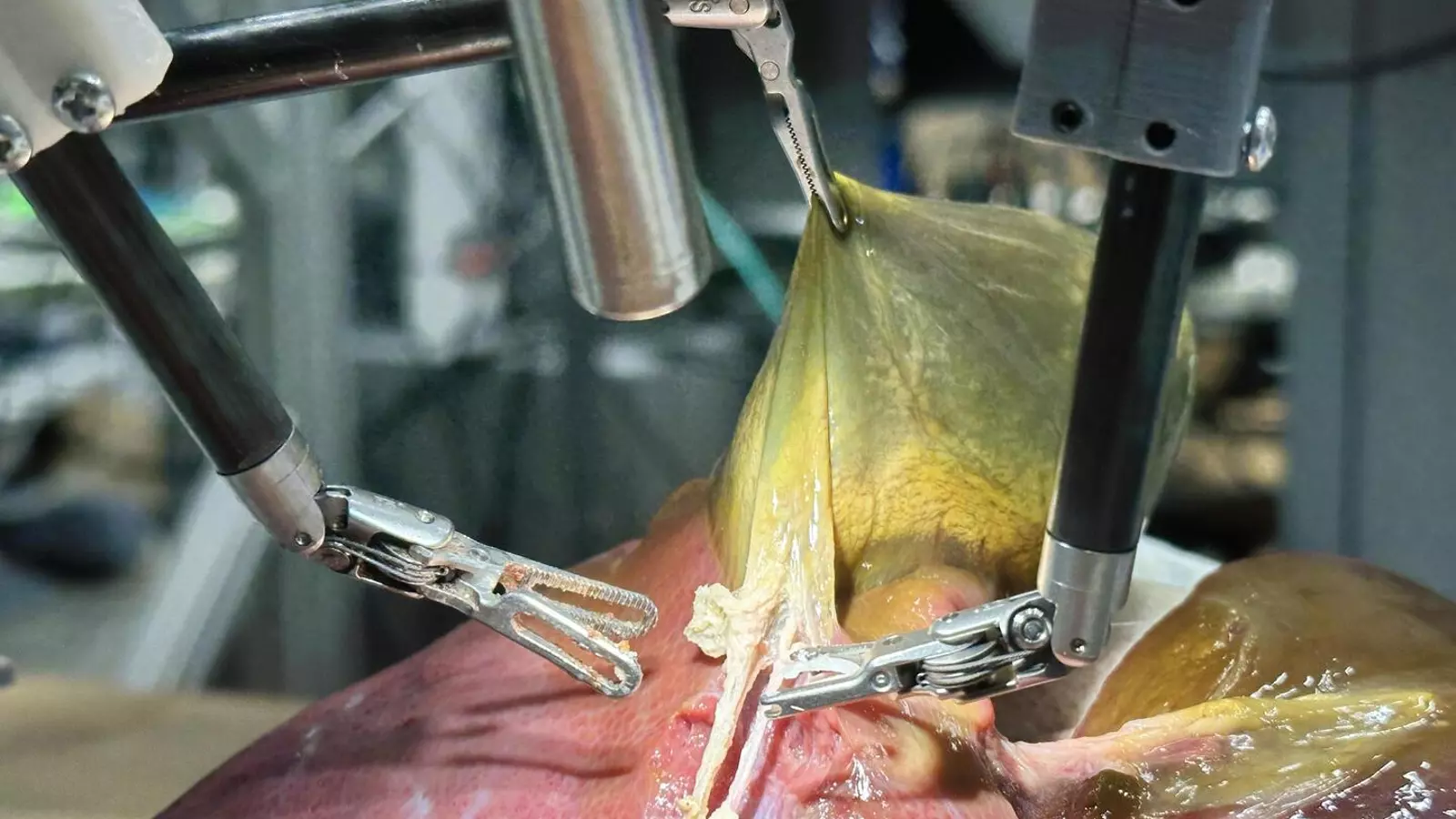

Robert Liston was a British surgeon who became very famous for his ability to operate extraordinarily quickly, something very important in the painful times before anesthesia. He could amputate a leg in 30 seconds. Today, Liston would be horrified to see the shared achievement of Axel Krieger, a mechanical engineer from Johns Hopkins University, and Ji Woong Kim, a researcher in artificial intelligence at Stanford University. They have managed, for the first time, for a robot to perform a totally autonomous gallbladder removal, marking a milestone in robotic surgery. It did it slower than Liston, but without errors.
The robot, trained with recordings of surgical interventions, autonomously performed an extensive phase of a cholecystectomy (gallbladder removal) and responded during the intervention to voice commands from the team, as a resident in training would do alongside their mentor.
The system, trained with videos, learns by itself and acts like an expert surgeonThis advance, which was published in Science Robotics, confirmed that the surgical robot demonstrated the skill level of an experienced surgeon, even in the face of unexpected situations similar to those that occur in real medical emergencies. "This advance takes us from robots that perform specific surgical tasks to robots that truly understand surgical procedures," said Axel Krieger, an expert in medical robotics at Johns Hopkins University.
In 2022, the Smart Tissue Autonomous Robot (STAR), also developed by Krieger, performed the first autonomous robotic surgery on a live animal, a laparoscopy on a pig. However, that system required specially marked tissues, a controlled environment, and a rigid surgical plan, akin to teaching a robot to drive only on a pre-mapped route.
The new system, however, "is like teaching a robot to drive on any road, in any condition, responding intelligently to everything it encounters," explains Krieger. The new robot, called SRT-H (Hierarchical Surgical Robot Transformer), performs surgery adapting in real-time to anatomical particularities, making decisions on its own and correcting itself if something does not go as planned.
Built with a machine learning architecture similar to that which powers ChatGPT, SRT-H is also interactive: it can respond to spoken commands like "hold the neck of the gallbladder" or to corrections like "move the left arm a bit." It learns from that feedback. "This work represents a significant leap from previous attempts because it addresses key barriers to deploying autonomous surgical robots in actual practice," stated in a press release from Stanford University Ji Woong Kim, lead author and former postdoctoral researcher.
Last year, Krieger's team had already used the system to teach a robot to perform three basic surgical tasks: handling a needle, lifting tissue, and suturing. Each task lasted only a few seconds.
The removal of the gallbladder is much more complex: a sequence of 17 tasks that requires several minutes. The robot had to identify ducts and arteries, hold them precisely, place clips, and cut with scissors.
25 years of advances
Over the past two decades, robotic surgery has evolved from mechanical assistance to the first autonomous systems. The da Vinci system, approved by the FDA in 2000 and developed by Intuitive Surgical, consolidated robotic surgery as a precision tool, although completely controlled by the surgeon. The big leap towards autonomy came with the aforementioned STAR system by Axel Krieger, which in 2016 performed sutures on soft tissues with results superior to humans.
Experts are already foreseeing the ethical and regulatory challenges that loom on the horizonLater, in 2022, STAR performed a laparoscopic intestinal anastomosis on pigs with millimeter precision. Concurrently, researchers like Lena Maier-Hein developed computer vision systems to identify anatomical structures in real-time, publishing results since 2017, and teams from Stanford or Imperial College pushed forward data-driven surgery. However, experts like Guang-Zhong Yang warn of the ethical and regulatory challenges posed by this technological revolution.
In this context, most experts agree that the coming years will be marked by supervised autonomous surgical systems, capable of performing complex tasks under the supervision of a professional. It's not about replacing the surgeon, but about providing them with more precise, fast, and safe tools.

Latest news





Upcoming events
12
Nov
El Desembarco, la traición de Viriato at La Caja Blanca
12
Nov
HOMER El Mero Mero at Sala Trinchera Málaga
13
Nov
Marbella Startup Lab – Innovate & Collaborate
13
Nov
Candlelight: Coldplay & Imagine Dragons at Sala Fundación Unicaja María Cristina
13
Nov
Candlelight: Tribute to Ludovico Einaudi at Anantara Villa Padierna
Similar News
Prevent the Flu
Marbella

Funding will be provided for a UMA scientist's research to slow down the development of Alzheimer's
Marbella
VARIcenter, medical excellence in vascular health care
Marbella
