You need to know
It has been five hundred and forty years since the city of Marbella surrendered to King Ferdinand the Catholic in June 1485. Since then, the apostle Saint Barnabas was proclaimed the patron saint, and around his figure, we continue to celebrate the Marbella Fair and Festivities every end of spring. We do not know exactly since when, but it has traditionally been a time to review the entire year, and based on the programs, we can deduce the economic situation of the city.
There was a time, during the Second Republic, when the City Council did not have a budget and declined the responsibility of organizing the festivities to merchants and economically well-off citizens. After the Civil War, more notably in the 1950s, when Marbella's tourist potential began to develop, the Municipality took charge of promoting the San Bernabé Fair by publishing relatively extensive supplements in provincial newspapers. Not only did the City Council fund these publications, but entrepreneurs, especially from the hospitality industry, were fundamental.
Through these pages, one can track how the fair and the city itself evolved. It will undoubtedly be illustrative to focus on a specific year. For personal reasons, I will focus on 1959; a transition year between the end of the second term of Mayor Francisco Cantos Gallardo and the arrival of the veterinarian Ricardo Lucena Sola.
It was a time when the future urbanization, sponsored by the banker Ignacio Coca, of Los Monteros, was being promoted. The Hotel Salduba was advertised, "on the tourist road Málaga-Cádiz," now Ramón y Cajal Avenue, at the height of Paseo de la Alameda, highlighting its bar and restaurant service, with reservations available at telephone number one hundred nineteen.
"Two prestigious hotel facilities on the incomparable Costa del Sol in Malaga" collaborated: Golf-Hotel Guadalmina, first A category, and Hotel and Club Montemar El Remo, first B category, in Torremolinos. The link between both realities was established through Mr. Ángel Fernández de Liencres, Marquis of Nájera, who was also fundamental in the Los Monteros hotel. The Cintrano Brewery, bar, and cafeteria promised "meticulous service" at the fairground.
The Marbella Club Hotel also supported the festivities, presenting itself, without any modesty, as "the most elegant on the Costa del Sol" and highlighting its international cuisine in the American bar-restaurant. Its phone number was 133. El Fuerte hotel, owned by José Luque Manzano, boasted its "own beach" and views of the sea and mountains. The Ricmar bar-restaurant focused its promotion on "meticulous service" and "international and typical cuisine." It was located in Las Chapas, eight kilometers from the city center, and offered a meal for fifty-five pesetas. The El Puerto bar-restaurant, owned by the Lorenzo brothers, specialized in seafood and tapas. They facilitated dancing with performances by an Italian Quartet and Cha Cha Cha Rhythm.
In that year of 1959, the Fair lasted four days (11, 12, 13, and 14) and the eve of San Bernabé. The Festivities Committee organized a varied program around the fairgrounds, located on Paseo de la Alameda and expanded into the area known as the avenue.
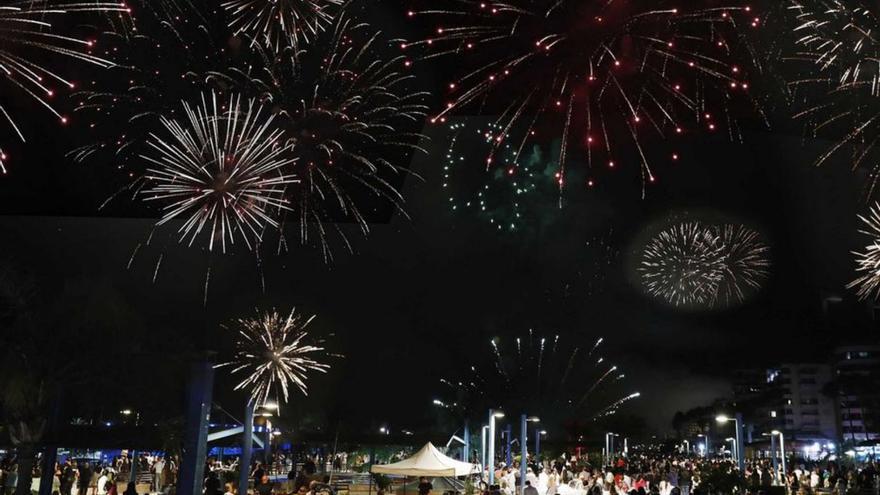
On June 10, at noon, accompanied by intense ringing of the bells of the Parish Church of Santa María de la Encarnación, the city's banner (today known mainly as Pendón), which was then maintained to have been donated by the Catholic Monarchs, was placed with the full corporation in attendance. Music bands, bugles, and drums from the Frente de Juventudes played the National and Movement anthems. Afterwards, a parade of giants and big-heads marched through the streets of the old town to the sounds of colorful street bands. At night, the fairground lighting, installed by Jaime Gabella's company from Seville, was turned on, and the official booth or Festivities Committee's booth was inaugurated. At eleven-thirty, "a collection of fireworks" was set off by the House of Carlos Alcaide Andrade, from Malaga. The 'Japanese bomb' was not missing. The chosen location for this pyrotechnics session was Huerta Grande, west of Paseo de la Alameda.
On June 11, the feast day of the Patron, the traditional civic-religious procession to the historic site of Cruz de Humilladero was celebrated. The Archpriest Mr. Rodrigo Bocanegra presided. The historic moment of the surrender, although at that time referred to as "the reconquest of Marbella by the Catholic Monarchs," was exalted. Likewise, the traditional panegyric of San Bernabé took place.
The presence of the radio was significant at the 1959 Fair, with the syndicalist station Radio Costa del Sol beginning its journey and, during the festival season, recommending dedicated records. On the 14th, the traditional "jira to Pinar de Guadalpín" (sic) did not fail to take place. Despite 66 years having passed, in the current fair, marking the end of the first quarter of the 21st century, the identity markers, adapted to the times, remain.