Manilva Grape Harvest Festival 2026: the village that says goodbye to summer by treading grapes and sharing the first must
Manilva will celebrate one of its most traditional festivals on 5 and 6 September, with muscatel grapes, music, horses and a public grape-treading ceremony that turns Plaza de la Vendimia into the centre of attention.
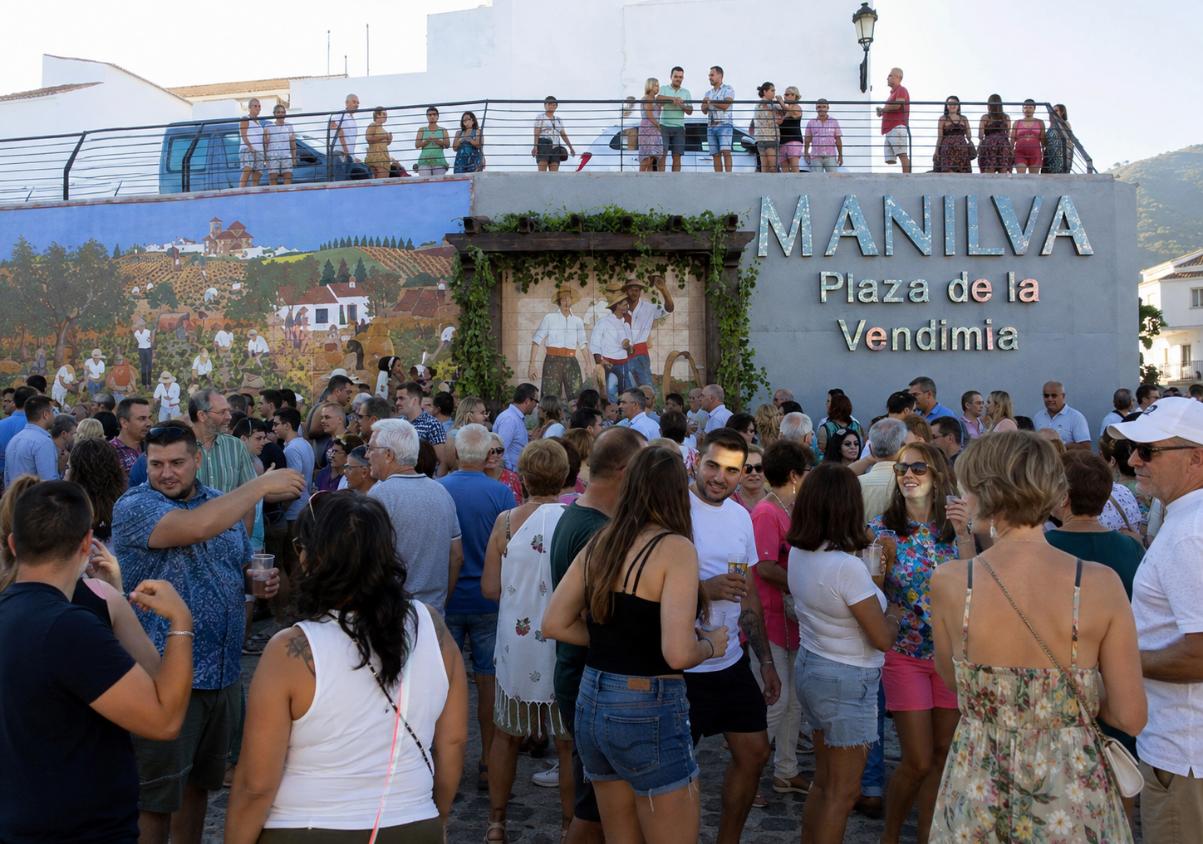

Just a few kilometres from the beaches of Sabinillas and La Duquesa, the Costa del Sol landscape begins to change. Urban developments give way to small agricultural plots and hillsides covered in vineyards, a reminder that Manilva is also a land of grapes and wine.
That agricultural identity will take over the streets next weekend. On Saturday 5 and Sunday 6 September 2026, Manilva village will celebrate its traditional Grape Harvest Festival, one of the most distinctive events on the western Costa del Sol calendar.
For two days, Calle Mar and Plaza de la Vendimia will become the setting for a celebration combining religion, gastronomy, music and traditions directly linked to the grape harvest.
And one moment will attract much of the attention: the traditional grape-treading ceremony and tasting of the season’s first must, scheduled for Sunday afternoon.
A festival that only makes sense because Manilva still has its vineyards
The Grape Harvest Festival is not simply a recreation of old rural customs.
The hills surrounding Manilva still contain plots dedicated to growing muscatel grapes, a product that has historically formed part of both the local economy and the municipality’s landscape.
That is precisely what makes the festival so distinctive.
On a Costa del Sol internationally associated with beaches, hotels and marinas, Manilva retains a different identity in which the Mediterranean coexists with an agricultural tradition still visible just a short distance from the coast.
The celebration takes place every year on the first weekend of September, coinciding with the end of the grape harvest. The daytime fair has formed part of the event since 1983, and the festival is officially recognised as a Provincial Festival of Tourist Interest.
Saturday begins with the most traditional ceremonies
The first day will be Saturday 5 September.
At 7.30pm, Santa Ana Church will host a mass in honour of Nuestra Señora de los Dolores.
After the religious service comes one of the moments that best reflects the link between the festival and local growers.
The image will be carried in procession towards Calle Mar, accompanied by music, where the traditional offering of grapes will take place.
Local farmers will present part of their harvest before another long-standing tradition begins: the competition for the heaviest bunch of grapes.
This is one occasion when size really does matter, as growers bring some of the best bunches from their vineyards to see which one weighs the most.
From 10.30pm, the mood will change completely. Music and dancing will take over Calle Mar, while DJs continue the party in Plaza de la Vendimia.
Sunday is the main day of the festival
For anyone who can only choose one day to visit Manilva, Sunday 6 September will feature many of the celebration’s most characteristic activities.
Traditionally known as Domingo Rociero, it is the main day of the festival.
From 1pm, Calle Mar will become a large daytime fair where Manilva’s wine and grapes share the spotlight with music and a lively street atmosphere.
Local-product tastings will also take place during the afternoon.
At approximately 1.30pm, the traditional horse riders’ parade is scheduled to begin, one of the most recognisable images of the day and the start of an afternoon that gradually builds towards the festival’s biggest moment.
Music and flamenco throughout the afternoon
From 2pm, live music and flamenco performances will take over the different stages along Calle Mar.
During these hours, the street becomes the real heart of the festival.
Tables, residents, visitors, music and local produce fill a space that normally serves as one of the main streets through the village.
That is one of the defining features of Manilva’s Grape Harvest Festival: it does not take place inside an isolated fairground.
It happens in the same streets where everyday village life continues throughout the rest of the year.
At 7pm comes the most anticipated moment: grape treading
The essential moment arrives on Sunday at 7pm in Plaza de la Vendimia.
This is when the traditional grape treading takes place.
The grapes are placed inside the press and trodden using the traditional method to extract the first juice of the harvest.
The result is the first must of the year, which is then offered for tasting among those gathered in the square.
It is no surprise that this is usually one of the busiest moments of the entire festival.
The scene brings together almost everything that defines the celebration: farmers, local produce, tradition and a square full of people waiting to taste a drink that only minutes earlier was still inside the grapes.
From the beach to the vineyards in just a few minutes
For visitors to the Costa del Sol, the festival also provides an opportunity to discover a very different side of Manilva.
Below the village lies San Luis de Sabinillas, with its long beach and promenade. A short distance away is Puerto de la Duquesa, one of the main tourism and yachting areas in this part of Málaga province.
But drive uphill towards Manilva village and the landscape changes.
Vineyards, small farms and traditional village streets replace much of the familiar coastal scenery.
That makes it easy to combine a morning at the beach with an afternoon and evening at the Grape Harvest Festival.
Muscatel grapes are much more than a local food product
Manilva’s relationship with grapes has shaped its landscape for generations.
The muscatel variety is particularly well adapted to the climatic conditions of this part of Málaga and has traditionally been used as a table grape as well as for raisins, must and wine.
As tourism developed along the Costa del Sol, many agricultural areas close to the coastline gradually disappeared or were transformed.
Manilva, however, still retains vineyards surprisingly close to the Mediterranean.
That gives the festival a significance that goes beyond the celebration itself.
It is also a reminder that behind the beaches and residential developments there is still an agricultural landscape that explains a large part of the municipality’s history.
One of the best plans for the first weekend of September
The timing also works in favour of anyone planning to visit Manilva.
The Grape Harvest Festival takes place just after August ends, while the summer atmosphere is still very much alive on the Costa del Sol.
The Mediterranean remains warm, the days are still long and the events calendar gradually shifts from large summer productions towards celebrations more closely linked to local villages and their traditions.
In Manilva, September begins around a harvest.
A mass, a procession, horses, music and crowded streets all lead towards a scene repeated for decades: grapes entering a traditional press while an entire village waits to taste the first must of the year.
Practical information
Event: Manilva Grape Harvest Festival 2026
Dates: Saturday 5 and Sunday 6 September
Location: Manilva village
Main areas: Calle Mar and Plaza de la Vendimia
Saturday: mass, procession, grape offering, bunch competition and music
Sunday: daytime fair, horse riders’ parade, performances, tastings and grape treading
Traditional grape treading: Sunday at 7pm
Admission: free
The full programme and details of the celebration can be found in the official festival programme published by Manilva Town Hall.

Latest news


Upcoming events
17
Sep
La Pequeña Cuba Gastro-Cultural Festival in San Pedro Alcántara 2026
18
Sep
World Wellness Weekend Marbella 2026
18
Sep
Candlelight: Queen vs. ABBA in Málaga
18
Sep
Candlelight: Coldplay and Imagine Dragons in Málaga
18
Sep
3 de Corazones – Pancho Céspedes, Enrique Ramil and José Luis Jaén in Málaga
Similar News
Mini golf, food and charity in Manilva: Roman Oasis hosts an afternoon fundraiser for ADANA
Manilva