


How to see the solar eclipse from Málaga on 12 August: times and key details
The event will begin in the province at around 7.43 pm and reach its maximum at 8.38 pm. Although the eclipse will be partial in Málaga, a large part of the Sun will be covered shortly before sunset.
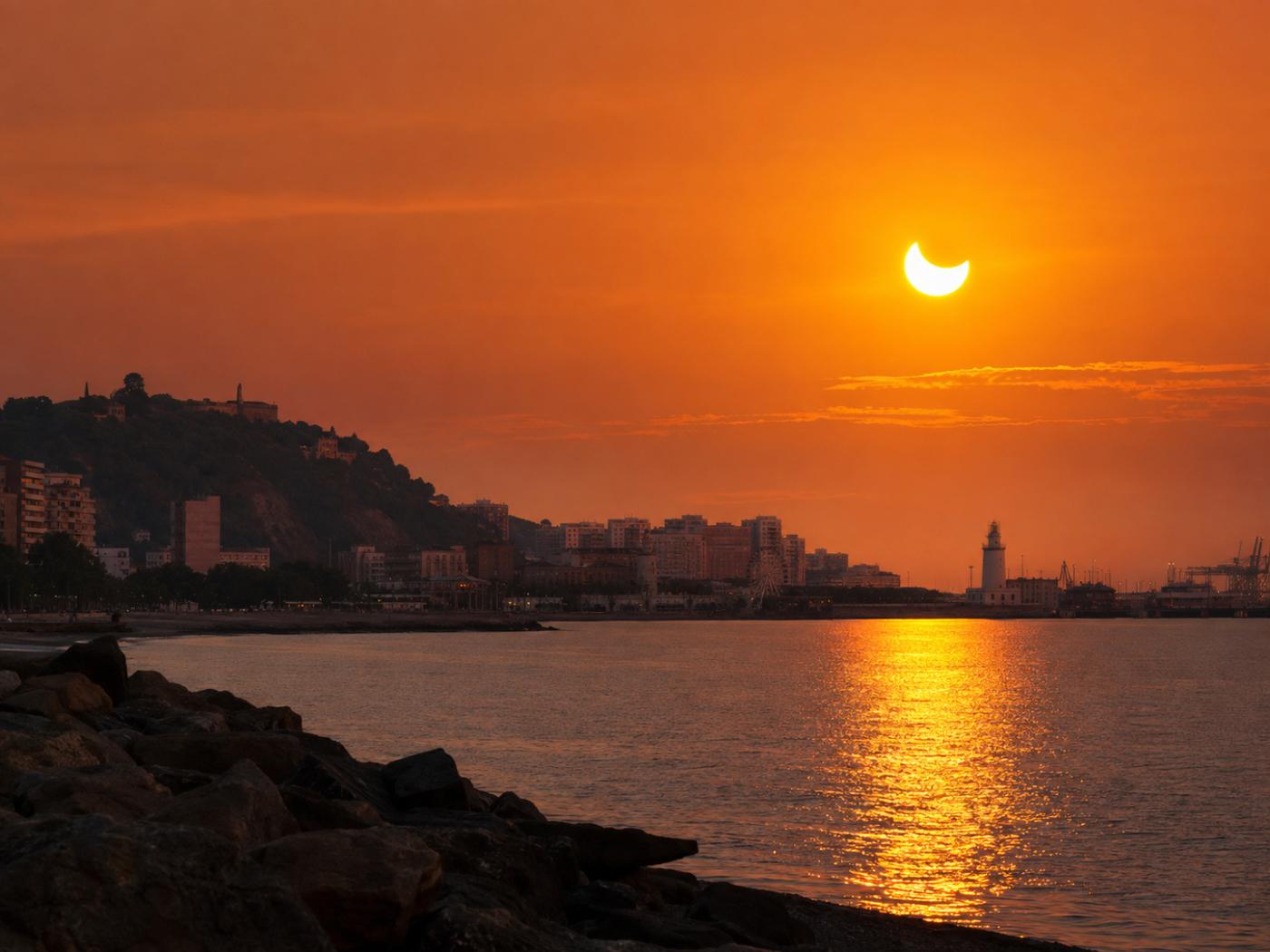

Málaga has a date with the sky on Wednesday, 12 August 2026. On that day, Spain will witness the first total solar eclipse visible from mainland Spain in more than a century, crossing the country from west to east during the late afternoon.
However, the path of totality will mainly pass through the northern half of the country, meaning that the eclipse will be seen as partial from Málaga.
Even without total darkness, the event is expected to be particularly impressive in the province, as the Moon will cover a large part of the solar disc while the Sun approaches the horizon. Location will be important: because the eclipse takes place close to sunset, observers should choose a spot with clear views towards the west.
The eclipse will begin in Málaga at 7.43 pm
According to data from Spain’s National Geographic Institute, the eclipse will begin in Málaga at approximately 7.43 pm. From that moment, the Moon will gradually move across the Sun.
The most important phase will arrive at around 8.38 pm, when the eclipse reaches its maximum as seen from the province.
The astronomical event will continue afterwards, although sunset in Málaga will take place at approximately 9.12 pm, meaning that the final stages will no longer be visible once the Sun disappears below the horizon.
Málaga will not experience complete darkness
The main difference between Málaga and other parts of Spain lies in its position outside the path of totality.
The 12 August eclipse will be total across parts of northern and eastern mainland Spain, passing through areas from Galicia towards the Mediterranean. In southern Spain, including Andalusia, it will be seen as a partial eclipse.
This means the solar disc will not disappear completely behind the Moon in Málaga. Nevertheless, the high degree of coverage should cause a noticeable drop in natural light around the time of maximum eclipse.
Because the Sun will also be very low in the sky, the phenomenon could create a particularly striking scene over the horizon if weather conditions are favourable.
Where to watch the eclipse in Málaga
One of the main challenges of this eclipse will be its timing. As it takes place close to sunset, buildings, hills and mountains could obstruct the most interesting phases.
The best places to watch it will therefore be locations with a clear western horizon. Elevated viewpoints, open sections of coastline and areas offering uninterrupted views towards the west may be particularly suitable.
This is especially important in mountainous parts of the province, where the Sun could disappear behind the terrain before reaching the true horizon.
Never look directly at the Sun without protection
Watching a solar eclipse requires specific safety measures. The Sun must never be viewed directly, even during the maximum phase of a partial eclipse.
Observers should use certified eclipse glasses or approved solar filters specifically designed for solar observation. Ordinary sunglasses, X-ray film, smoked glass and homemade solutions do not provide adequate protection.
Cameras, binoculars and telescopes must also never be pointed directly at the Sun unless suitable solar filters are correctly fitted to the front of the optical device.
Málaga will experience a total eclipse in 2027
Those hoping to experience complete darkness will not have to wait long.
On 2 August 2027, another total solar eclipse will cross southern Spain, and this time Málaga will lie within the path of totality.
In Málaga city, the total phase is expected to begin at around 10.48 am and last approximately 1 minute and 48 seconds, according to the National Geographic Institute.
The astronomical calendar will continue shortly afterwards, with Spain experiencing an annular eclipse on 26 January 2028, completing an exceptional sequence of major solar eclipses between 2026 and 2028.
For Málaga, the eclipse on 12 August will therefore be a spectacular preview: a late-summer sunset in which the Moon will cover much of the Sun and transform the western horizon.
Date: Wednesday, 12 August 2026
Approximate start in Málaga: 7.43 pm
Maximum eclipse: 8.38 pm
Sunset: Around 9.12 pm
Visibility in Málaga: Partial eclipse
Recommendation: Choose a location with a clear western horizon and use certified eye protection
Information sources: Málaga Hoy and Spain’s National Geographic Institute (IGN).

Latest news




Upcoming events
12
Nov
El Desembarco, la traición de Viriato at La Caja Blanca
12
Nov
HOMER El Mero Mero at Sala Trinchera Málaga
13
Nov
Marbella Startup Lab – Innovate & Collaborate
13
Nov
Candlelight: Coldplay & Imagine Dragons at Sala Fundación Unicaja María Cristina
13
Nov
Candlelight: Tribute to Ludovico Einaudi at Anantara Villa Padierna
Similar News

Bancosol’s Great Food Collection returns to Malaga: how and where to donate
Málaga

Christmas lunches in Málaga are already booking up: restaurants almost full after reservations began in May
Málaga

Malaga Marathon 2026 road closures: affected streets and times this Sunday
Málaga
